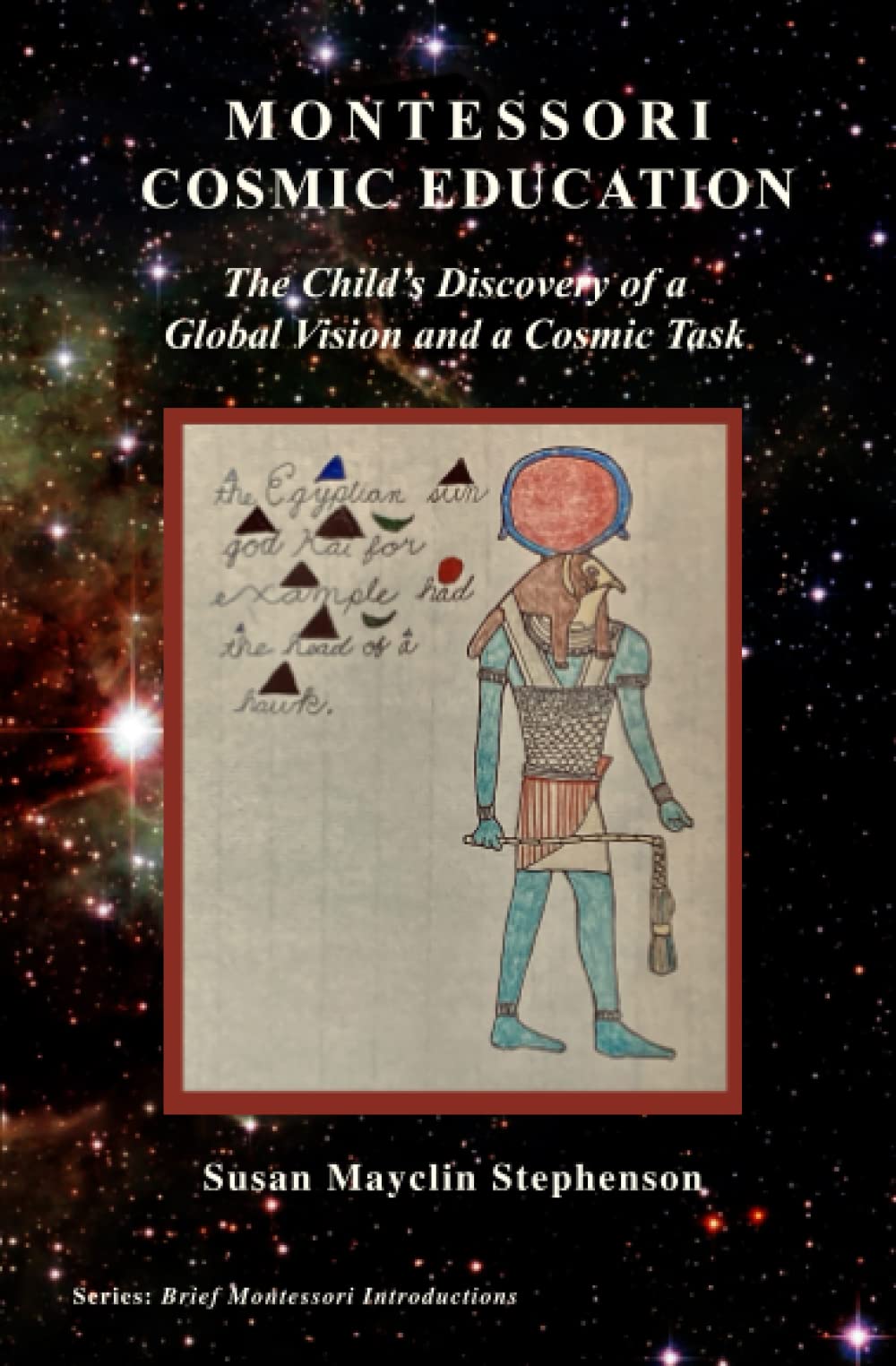
Montessori Cosmic Education, The Child’s Discovery of a Global Vision and a Cosmic Task (Brief Montessori Introductions)
$10.95
by Susan Mayclin Stephenson



This small book, 40+ pages, is the first title in the “Brief Montessori Introductions” created for busy parents and other educators. It is already being translated into several languages and thought by many to be the best introduction to Montessori for parents. Being aware of the meaning of the concepts “Cosmic Education” and “Cosmic Task” is essential in understanding authentic Montessori practice, at home and in school. It is sometimes overlooked, and begins at birth. Grounded in experience, Stephenson manages to convey the essence of one of Maria Montessori’s fundamental principles – the interdependent nature of life and the very concrete steps to helping children express their natural tendency to live well with others and take care of planet. This book offers practical insights for parents and others interested in the Montessori approach. —Lynne Lawrence, Executive Director of AMI, The Association Montessori Internationale Susan Mayclin Stephenson tackles a large subject, cosmic education, which Montessori defined as a “unifying global and universal view of the past, present and future.” Stephenson takes the reader from birth to the end of the elementary age with examples of how the child grows into an understanding of cosmic education through their experiences at home and at school. Central to her thesis is the theme of discovering one’s cosmic task, which depends on “fostering...curiosity and compassion toward other beings.” Stephenson concludes with examples from around the world and illustrates how children are born with this tendency toward compassion and how it is experienced from birth within Montessori environments. —David Kahn, Executive Director Emeritus of the North American Montessori Teachers’ Association (NAMTA) "I truly enjoyed reading this book. The author made me realize Montessori is not just a method of education but a global social movement! The Cosmic education inspires me greatly. Thank you for planting so many seeds for the bright future." Aika Wakanuki Mariana, Bilingual Montessori School, Milan, Italy This new series was inspired by our son who was raised in a Montessori world and whose Montessori elementary journal art graces the cover of this book. A very busy musician and lawyer he informs us that knowledge of Montessori would benefit many people who do not have time to read long books (and who may or may not be connected to a Montessori school). He recommends that Montessori information would be better shared in small bits that inspire thought and can be absorbed a little at a time. We agree with him that Montessori information shared on the internet is often misleading and unhelpful as is internet international news today. Drawing on over 50 years of work in 30+ countries I have accepted his challenge. Each planned "brief" introduction will be around 40 pages and cost approximately US$10. This is the first title of the series. The Montessori information introduced in these pages can be helpful to parents and grandparents, to those interested in the early months and years of life, in educational neuroscience, environmental education, emotional intelligence, and for those working with children and young adults. Older children and young adults today need to know that their individual interests and talents are important, that they can be valuable, contributing, and happy members of a family and social group not just "someday," but now! CONTENTS Introduction Definition Learning About the World The World, Birth to Three Years The World, 3-6 Years The World, 6-12+ Years Making the World a Better Place A Better World, Birth to Three Years A Better World, 3-6 Years A Better World, 6-12+ Years Grounded in experience, Stephenson manages to convey the essence of one of Maria Montessori's fundamental principles - the interdependent nature of life and the very concrete steps to helping children express their natural tendency to live well with others and take care of planet. This book offers practical insights for parents and others interested in the Montessori approach. —Lynne Lawrence, Executive Director of AMI, The Association Montessori Internationale Susan's first experience in the field of education was as a high school Latin tutor and counselor. After discovering Montessori in 1968 she earned AMI Montessori diplomas for birth to twelve and worked as a Montessori teacher and head of school. She was part of the research for forming the first Montessori farm school for adolescents in the USA and editor of "The Erdkinder newsletter." Susan has traveled in over 70 countries and shared Montessori ideas in more than half of them, lecturing in universities, for government education agencies, Suzuki music, education, and homeschooling conferences, and on Montessori teacher training courses. She has consulted in Montessori schools, orphanages, schools for refugees and the poor, and schools with no Montessori materials. She is an international examiner for Montessori diploma courses, a