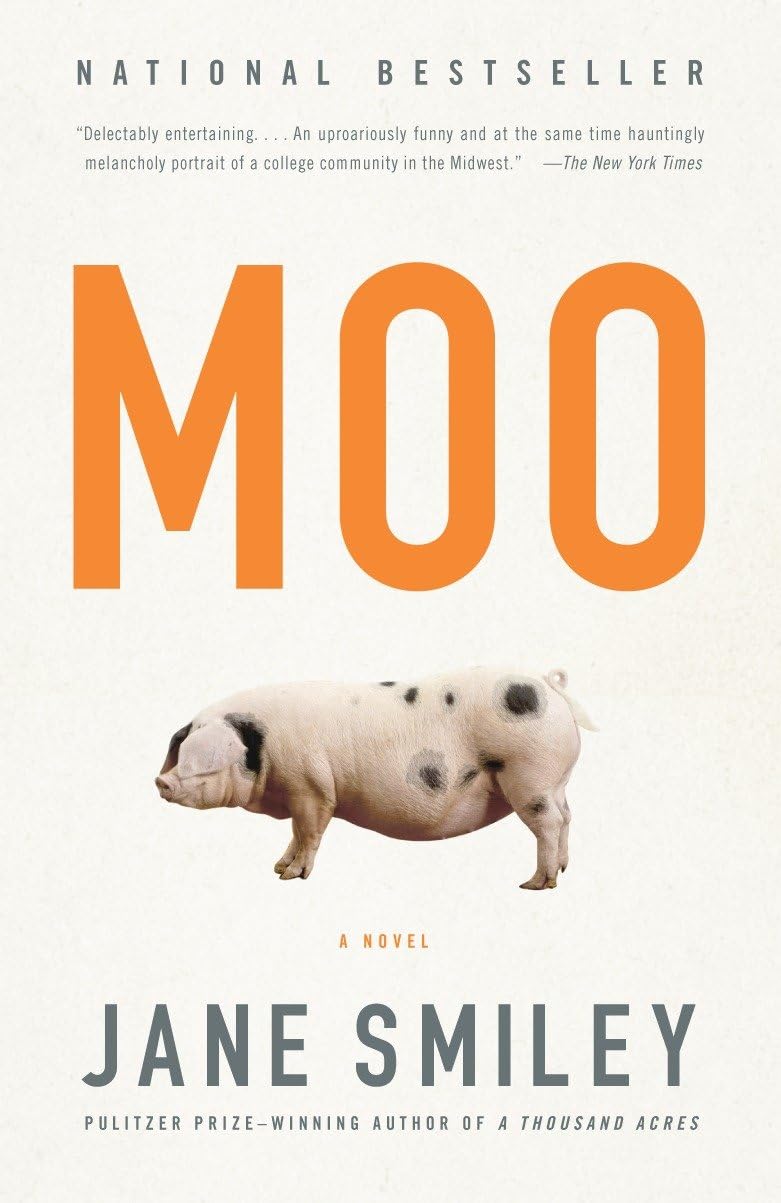



NATIONAL BESTSELLER • From the Pulitzer Prize-winning author of A Thousand Acres comes “an uproariously funny and at the same time hauntingly melancholy portrait of a college community in the Midwest" ( The New York Times). In this darkly satirical send-up of academia and the Midwest, we are introduced to Moo University, a distinguished institution devoted to the study of agriculture. Amid cow pastures and waving fields of grain, Moo’s campus churns with devious plots, mischievous intrigue, lusty liaisons, and academic one-upmanship, Chairman X of the Horticulture Department harbors a secret fantasy to kill the dean; Mrs. Walker, the provost's right hand and campus information queen, knows where all the bodies are buried; Timothy Monahan, associate professor of English, advocates eavesdropping for his creative writing assignments; and Bob Carlson, a sophomore, feeds and maintains his only friend: a hog named Earl Butz. Wonderfully written and masterfully plotted, Moo gives us a wickedly funny slice of life. “Delectably entertaining.... An uproariously funny and at the same time hauntingly melancholy portrait of a college community in the Midwest.” — The New York Times “Fast, hilarious, and heartbreaking...Not for a minute does Moo lose its perfect satiric pitch or its pacing. . . . Don't skip a page, don't skip a paragraph. It's going to be on the final.” — People “Smart, irreverent, and wickedly tender.... Moo suggests a mix of Tom Wolfe's wit and John Updike's satiny reach.... Engaging.” — The Boston Globe JANE SMILEY is the author of numerous novels, including A Thousand Acres, which was awarded the Pulitzer Prize, and most recently, Golden Age, the concluding volume of The Last Hundred Years trilogy. She is also the author of five works of nonfiction and a series of books for young adults. A member of the American Academy of Arts and Letters, she has also received the PEN Center USA Lifetime Achievement Award for Literature. She lives in Northern California. 1Old MeatsFROM THE OUTSIDE it was clear that the building known generally as "Old Meats" had eased under the hegemony of the horticulture department. Its southern approach, once a featureless slope of green lawn, was now an undulating perennial border whose two arms embraced a small formal garden defined by a carefully clipped and fragrant boxwood hedge. In front of that, an expanse of annuals flowed down the hillside and spilled across flat ground in a tide of August reds, golds, and yellows. Here and there, discreetly placed experimentals tested the climate. Right up against the long windowless southem wall of Old Meats, someone, sometime, without benefit of application, grant, permission from administration or grounds crew, without even the passing back and forth of a memo, someone had planted, then espaliered, a row of apricot and peach trees. In midsummer, just at the end of summer session, they were seen to bear fruit--heavy burnished apricots and big peaches swollen with juice that later disappeared and never seemed to reappear on the salad bars or the dessert bars in any of the dorms or fraternity houses. Nor were they sold at any hort department fund-raising sale, the way apples, Christmas trees, and bedding plants were. They just appeared and disappeared, unnoticed by most though legendary to the few who had stolen fruit, who kept an eye on the seed catalogues, wondering when these cultivars, the Moo U. cultivars, might be introduced to the open market.In fact, though it stood much in the way of foot traffic from the Bovine Confinement Complex, the Business College, the Chemistry building, the foreign travel office, and graduate student housing, and though, as generations of freshman geographers had found, it stood on the exact geographical center of the campus (unless you included the recently constructed Vet School two miles to the south, which threw everything off), and though it was large and blocky, Old Meats had disappeared from the perceptions of the university population at large. This was fine with the horticulture department, for certain unnamed members and their student cadres had just this summer laid out an extension of the perennial border to the east, curving in wanton floral revelry toward Old Meats' unused loading dock and Ames Road. So much, said the Chairman in private meetings with the rest of his faculty, for their assigned garden site, out by the physical plant and the bus barn, on a dead-end road that no one travelled unless lost. Guerrilla action, as he often remarked to the woman everyone including their children thought was his wife and whom he had met in SDS at the Chicago convention in 1969, was as protean and changeable as the needs of the people.It was also true, however, that Bob Carlson, sophomore workstudy student, was as invisible to the horticulturists, though he passed them every day, as Old Meats was to the rest of the campus. No busy digger or mulcher ever noticed him unlock the do