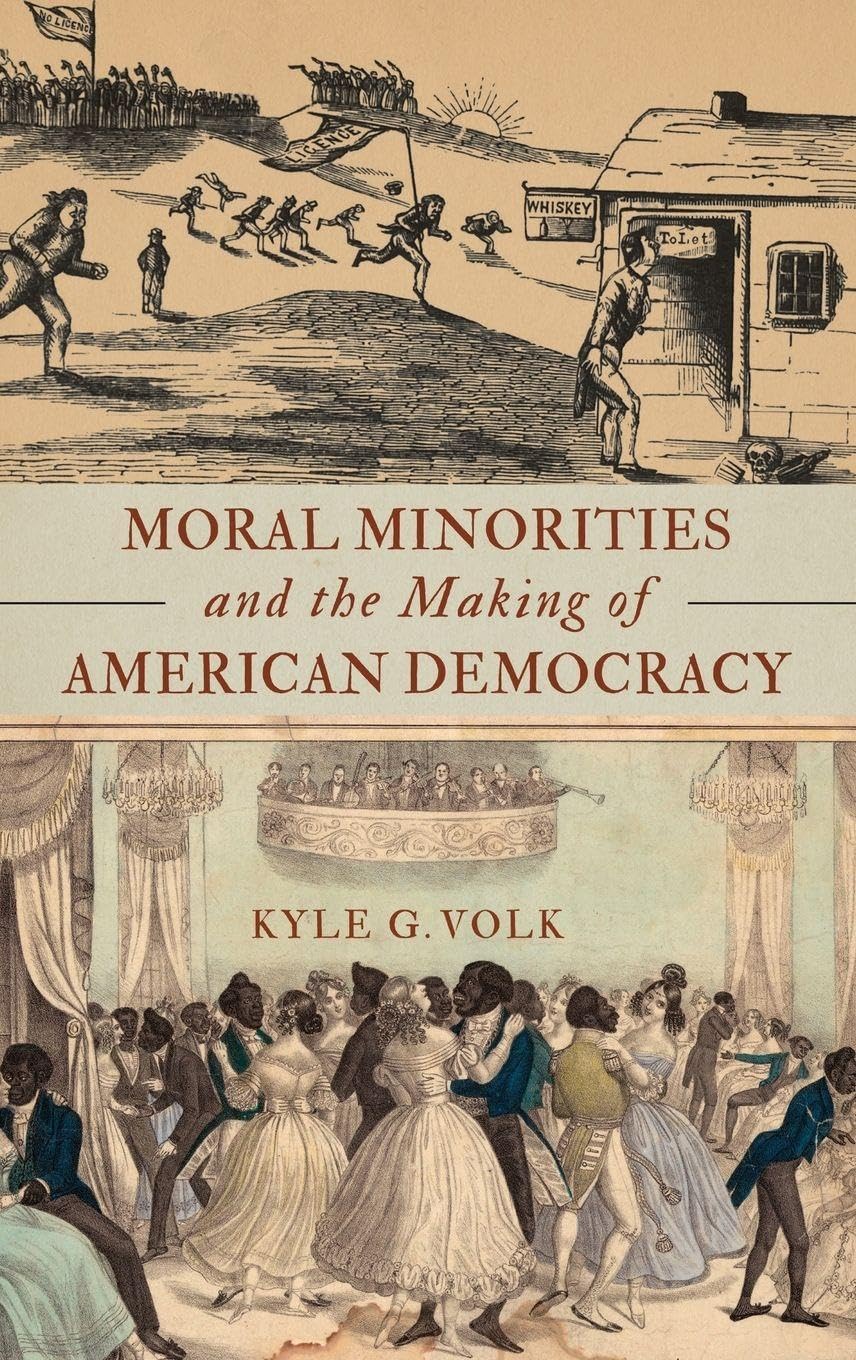



Should the majority always rule? If not, how should the rights of minorities be protected? In Moral Minorities and the Making of American Democracy, historian Kyle G. Volk unearths the origins of modern ideas and practices of minority-rights politics. Focusing on controversies spurred by the explosion of grassroots moral reform in the early nineteenth century, he shows how a motley but powerful array of self-understood minorities reshaped American democracy as they battled laws regulating Sabbath observance, alcohol, and interracial contact. Proponents justified these measures with the "democratic" axiom of majority rule. In response, immigrants, black northerners, abolitionists, liquor dealers, Catholics, Jews, Seventh-day Baptists, and others articulated a different vision of democracy requiring the protection of minority rights. These moral minorities prompted a generation of Americans to reassess whether "majority rule" was truly the essence of democracy, and they ensured that majority tyranny would no longer be just the fear of elites and slaveholders. Beginning in the mid-nineteenth-century, minority rights became the concern of a wide range of Americans attempting to live in an increasingly diverse nation. Volk reveals that driving this vast ideological reckoning was the emergence of America's tradition of popular minority-rights politics. To challenge hostile laws and policies, moral minorities worked outside of political parties and at the grassroots. They mobilized elite and ordinary people to form networks of dissent and some of America's first associations dedicated to the protection of minority rights. They lobbied officials and used constitutions and the common law to initiate "test cases" before local and appellate courts. Indeed, the moral minorities of the mid-nineteenth century pioneered fundamental methods of political participation and legal advocacy that subsequent generations of civil-rights and civil-liberties activists would adopt and that are widely used today. Tracing the origins of this vital American political tradition, this work sheds light on such hot-button contemporary issues as gay marriage, the rights of religious minorities, and debates over religion in public schools and birth control. Winner, 2015 Merle Curti Award for the Best Book in American Intellectual History (given by the Organization of American Historians) Honorable Mention, 2015 Frederick Jackson Turner Award for the Best First Book in American History (given by the Organization of American Historians) "In this boldly argued and engagingly written book, Kyle Volk brilliantly recasts the political history of nineteenth-century America." - Michael Willrich, author of Pox: An American History "A must-read for anyone interested in the tension between majority rule and minority rights in a diverse society." - Johann Neem, author of Creating a Nation of Joiners " Moral Minorities is a stunning intervention in the history of grass-roots politics and American democratic thought, as well as in the emerging fields of popular constitutionalism and everyday political practice. Kyle Volk shows us the history of minority rights movements in an entirely new light. He dramatically revises our understanding of the origins of such movements, their constitutional underpinnings, and their surprising political trajectories." - Reeve Huston, author of Land and Freedom "...an uncommon achievement: a book that is both scholarly and hard to put down. It is a book, moreover, that will engage the student of current social movements no less than the historian because its themes are as relevant today as they were in the turbulent decades preceding the Civil War." - H-Net Reviews "In this timely book, Professor Kyle G. Volk artfully explains the competing forces and shifting political coalitions in the mid-nineteenth century that ultimately constructed the modern paradigms of morality politics, majority rule, and minority rights that still govern our democratic landscape today. In this engaging historical account, Professor Volk provides perspective that illuminates political movements of both the 1800s and today." -- Harvard Law Review (April 2015) "Volk's innovative book recasts antebellum political history by introducing the category of moral minority into the narrative of the making of American democracy. This impeccably researched and gracefully written book will be of interest to scholars of antebellum America and all those who wish to understand the many roots of modern rights-based activism." -- The Journal of the Civil War Era (June 2015) "Moral Minorities is an important, path-breaking book... [It] is the first major piece of scholarship to demonstrate that the struggles of those who opposed Sabbatarian legislation, liquor regulation, and racial segregation before the Civil War helped to comprise a grass-roots popular movement dedicated to articulating a view of American democracy that in