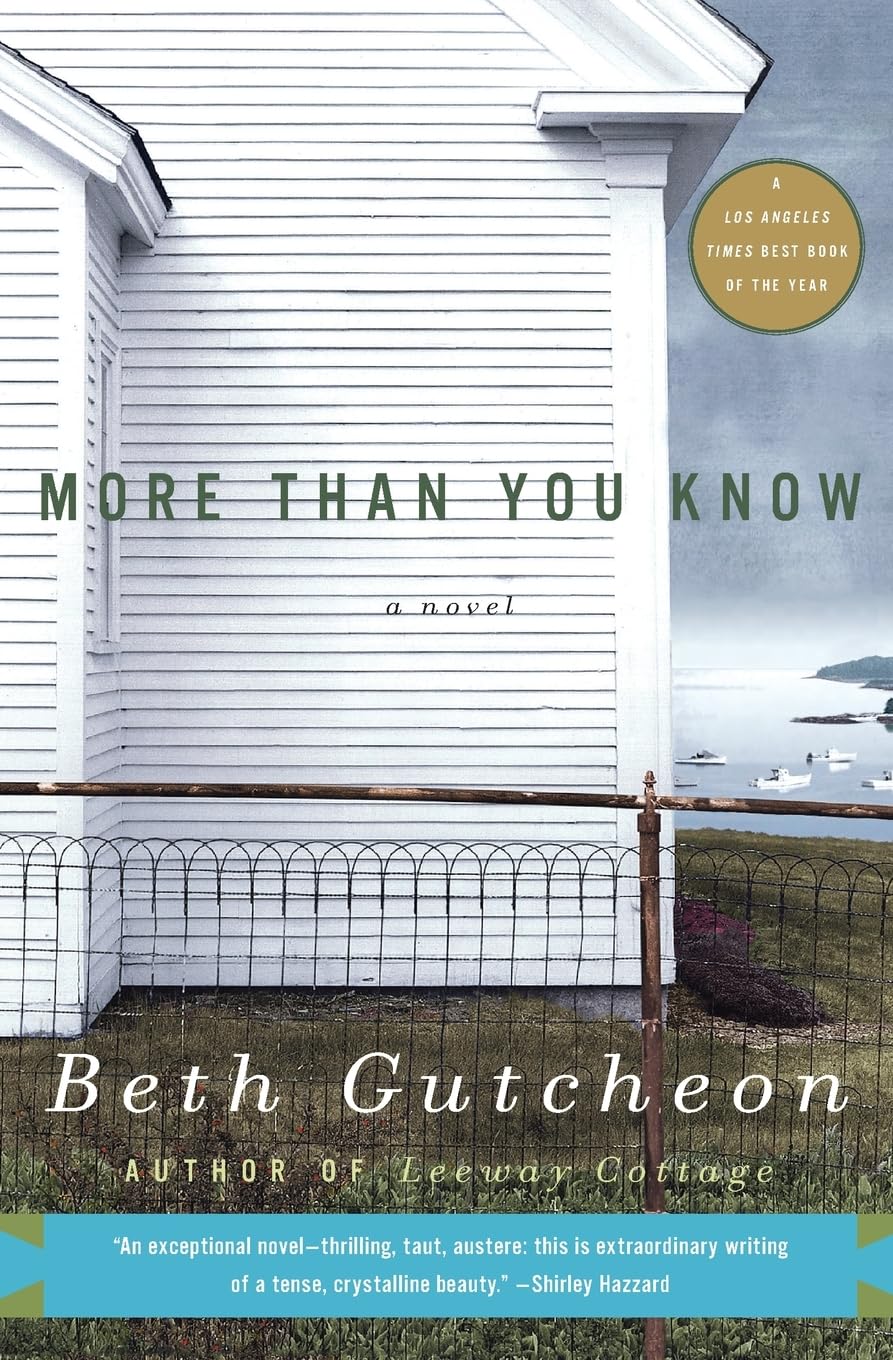



In a small town called Dundee on the coast of Maine, an old woman named Hannah Gray begins her story: "Somebody said 'true love is like ghosts, which everyone talks about and few have seen.' I've seen both and I don't know how to tell you which is worse." Hannah has decided, finally, to leave a record of the passionate and anguished long-ago summer in Dundee when she met Conary Crocker, the town bad boy and love of her life. This spare, piercing, and unforgettable novel bridges two centuries and two intense love stories as Hannah and Conary's fate is interwoven with the tale of a marriage that took place in Dundee a hundred years earlier. "An exceptional novel -- thrilling, taut, austere: this is extraordinary writing of a tense, crystalline beauty."-- Shirley Hazzard"Completely engrossing and entertaining, replete with suspense, grace, and sympathy..."-- Sandra Scofield, "Newsday..".Gutcheon is a wonderful writer. "More Than You Know is a triumph, ghost and all."-- Reeve Lindbergh, "Boston Herald In a small town called Dundee on the coast of Maine, an old woman named Hannah Gray begins her story: "Somebody said 'true love is like ghosts, which everyone talks about and few have seen.' I've seen both and I don't know how to tell you which is worse." Hannah has decided, finally, to leave a record of the passionate and anguished long-ago summer in Dundee when she met Conary Crocker, the town bad boy and love of her life. This spare, piercing, and unforgettable novel bridges two centuries and two intense love stories as Hannah and Conary's fate is interwoven with the tale of a marriage that took place in Dundee a hundred years earlier. Beth Gutcheon is the critically acclaimed author of the novels, The New Girls , Still Missing , Domestic Pleasures , Saying Grace , Five Fortunes , More Than You Know , Leeway Cottage , and Good-bye and Amen . She is the writer of several film scripts, including the Academy-Award nominee The Children of Theatre Street . She lives in New York City. More Than You Know By Gutcheon, Beth Perennial Copyright © 2004 Beth Gutcheon All right reserved. ISBN: 0060959355 Chapter One My children think I'm mad to come up here in winter, but this is the only place I could tell this story. They think the weather is too cold for me, and the light is so short this time of year. It's true this isn't a story I want to tell in darkness. It isn't a story I want to tell at all, but neither do I want to take it with me. If you approach Dundee, Maine, from inland by daylight, you see that you're traveling through wide reaches of pasture strewn with boulders, some of them great gray hulks as big as a house. You can feel the action of some vast mass of glacier scraping and gouging across the land, scarring it and littering it with granite detritus. The thought of all that ice pressing against the land makes you understand the earth as warm, living, and indestructible. Changeable, certainly. It was certainly changed by the ice. But it's the ice that's gone, and grass blows around the boulders, and lichens, green and silver, grow on them somehow like warm vegetable skin over the rock. Even rock, cold compared to earth, is warm and living, compared to the ice. For miles and miles, the nearer you draw to the sea, the more the road climbs; I always think it must have been hard on the horses. Finally you reach the shoulder of Butter Hill, and then you are tipped suddenly down the far slope into the town. My heart moves every time I see that tiny brave and lovely cluster of bare white houses against the blue of the bay. The earliest settlers in Dundee didn't come from inland; they came from the sea. It was far easier to sail downwind, even along that drowned coastline of mountains, whose peaks form the islands and ledges where boats land or founder, than to make your way by land. In many parts of the coast the islands were settled well before the mainland. This was particularly true of Great Spruce Bay, where Beal Island lies, a long tear-shaped mass in the middle of the bay, and where Dundee sits at the head of the innermost harbor. Not much is known about the first settlement on Beat Island, except that a seventeenth-century hermit named Beat either chose it or was cast away there, and trapped and fished alone near the south end until, one winter, he broke his leg and died. Later, several families took root on the island and a tiny community grew near March Cove. Around 1760 a man named Crocker moved his wife and children from Beal onto the main to build a sawmill where the stream flows into the bay. The settlement there flourished and was sometimes called Crocker's Cove, or sometimes Friends' Cove, or Roundyville, after the early families who lived there. In the 1790s, the town elected to call the place Sunbury, and proudly sent Jacob Roundy down to Boston to file papers of incorporation (as Maine was then a territory of Massachusetts). When he got back, Roundy explained that