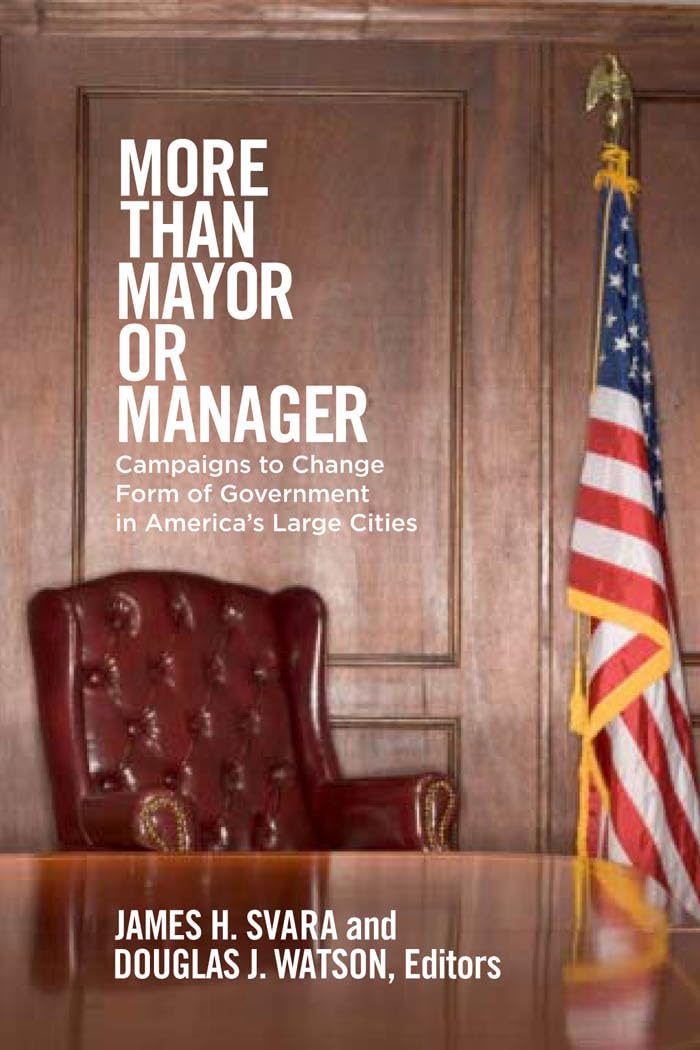
More than Mayor or Manager: Campaigns to Change Form of Government in America's Large Cities
$37.95
by James H. Svara



Different forms of city government are in widespread use across the United States. The two most common structures are the mayor-council form and the council-manager form. In many large U.S. cities, there have been passionate movements to change the structure of city governments and equally intense efforts to defend an existing structure. Charter change (or preservation) is supported to solve problems such as legislative gridlock, corruption, weak executive leadership, short-range policies, or ineffective delivery of services. Some of these cities changed their form of government through referendum while other cities chose to retain the form in use. More than Mayor or Manager offers in-depth case studies of fourteen large U.S. cities that have considered changing their form of government over the past two decades: St. Petersburg, Florida; Spokane, Washington; Hartford, Connecticut; Richmond, Virginia; San Diego, California; Oakland, California; Kansas City, Missouri; Grand Rapids, Michigan; Dallas, Texas; Cincinnati, Ohio; El Paso, Texas; Topeka, Kansas; St. Louis, Missouri; and Portland, Oregon. The case studies shed light on what these constitutional contests teach us about different forms of government―the causes that support movements for change, what the advocates of change promised, what is at stake for the nature of elected and professional leadership and the relationship between leaders, and why some referendums succeeded while others failed. This insightful volume will be of special interest to leaders and interest groups currently considering or facing efforts to change the form of government as well as scholars in the field of urban studies. "This important book is a contribution to both public administration and urban politics. It sheds light on the issues of democracy in political science but also has practical advice for those who are appointed or are elected officials."―Dick Simpson, University of Illinois at Chicago GEORGE WASHINGTON is remembered for leading the Continental Army to victory, presiding over the Constitution, and forging a new nation, but few know the story of his involvement in the establishment of a capital city and how it nearly tore the United States apart. In George Washington's Final Battle, Robert P. Watson brings this tale to life, telling how the country's first president tirelessly advocated for a capital on the shores of the Potomac. Washington envisioned and had a direct role in planning many aspects of the city that would house the young republic. In doing so, he created a landmark that gave the fledgling democracy credibility, united a fractious country, and created a sense of American identity. Although Washington died just months before the federal government's official relocation, his vision and influence live on in the city that bears his name. This little-known story of founding intrigue throws George Washington's political acumen into sharp relief and provides a historical lesson in leadership and consensus-building that remains relevant today. This book will fascinate anyone interested in the founding period, the American presidency, and the history of Washington, DC. James H. Svara is a professor of public affairs and director of the Center for Urban Innovation at Arizona State University. He is coeditor of The Facilitative Leader in City Hall and author of The Ethics Primer for Public Administrators in Government and Nonprofit Organizations . Doug Watson is a former professor at the University of Texas at Dallas and city manager of Auburn, Alabama. He is co-author of Civic Battles: When Cities Change Their Form of Government. Used Book in Good Condition