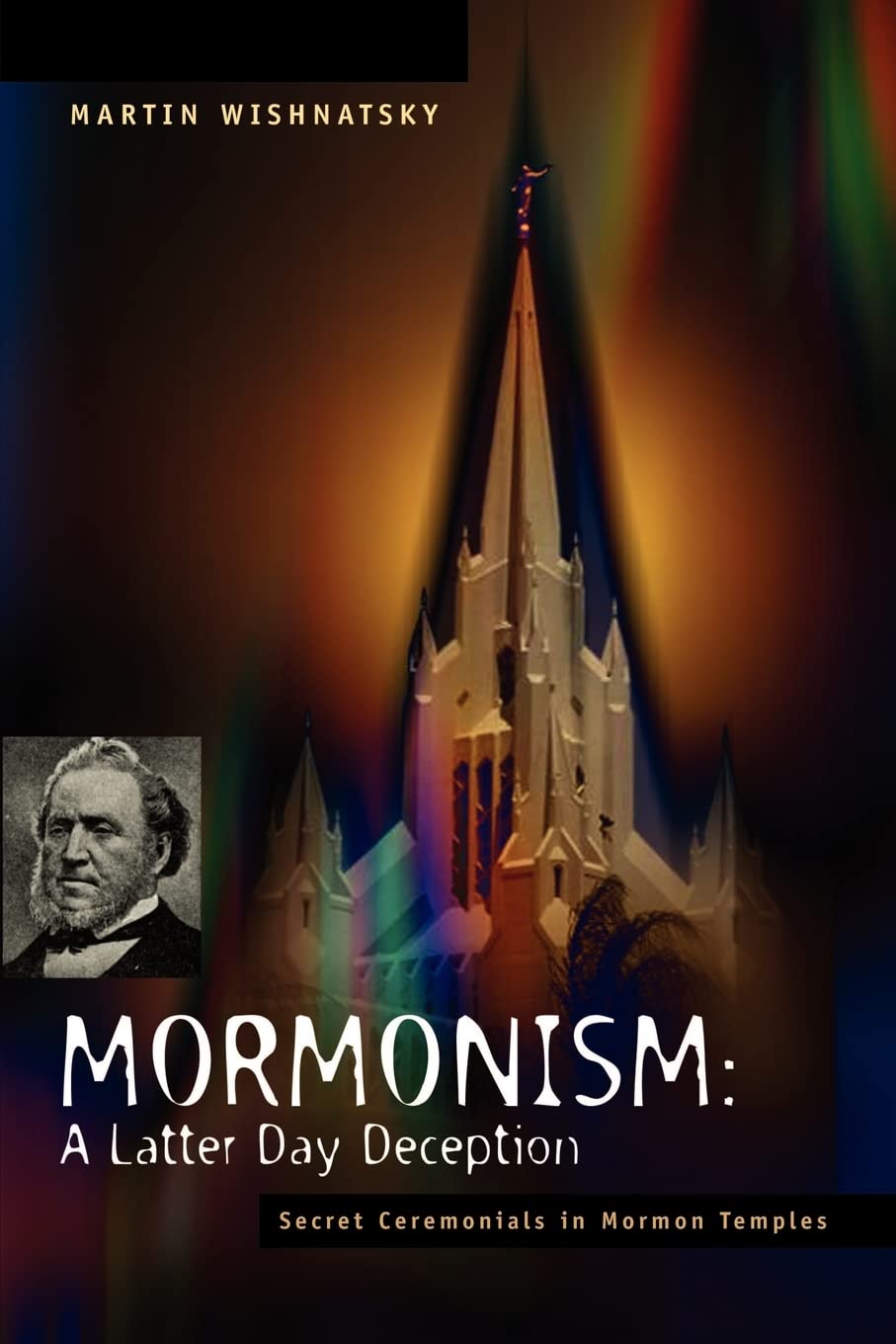



Mormonism: A Latter Day Deception is a riveting, often hilarious account of how a sincere believer was disabused of his confidence in the Mormon revelation. The author joined the Mormon Church in 1980. A year later, he received a Temple Recommend for the Washington, D.C., Temple. He entered the Temple a Mormon, but left it a non-Mormon. Mormonism: A Latter Day Deception presents a rare, detailed eyewitness account of the Mormon Temple ceremonies circa 1981. No other book of which the author is aware presents such a starkly authentic account of these secret ceremonies of Mormonism. As a Harvard Ph.D. in Political Science, the author was driven by his shocking experience in the Mormon Temple to research the origins of the Church of Jesus Christ of Latter-Day Saints. He tersely and cogently presents irrefutable evidence of its true character. From the Washington Temple to the millions of rolls of microfilm in Granite Mountain to Joseph Smiths Masonic rip-off, all is revealed and woven together to reveal the churchs foundation in darkness. If you want to know the truth about the Mormon Church, you will find it herefrom one who saw it with his own eyes. The ambitions and pretense of this institution, termed by one author "The Islam of America," is presented for the purpose of setting the captives free. "And ye shall know the truth, and the truth shall make you free" (John 8:32). Martin Wishnatsky, a Jewish man, was born in 1944 in Newark, New Jersey. In 1977, during a time of distress in his life, and after receiving prayer from a believer, he began to read the Bible and was drawn from darkness to light, from the power to Satan to Jesus Christ. Mr. Wishnatsky is a graduate of Harvard College (1966), and holds a Ph.D. in Political Science from Harvard University (1975). He is the author (Martin Weil) of A Pretty Good Club: The Founding Fathers of the U.S. Foreign Service (W.W. Norton and Co., 1978). FROM THE CONCLUSION. It has not been easy to tell the truth about the Church of Jesus Christ of Latter-day Saints to conduct a controlled extraction of the teeth of this cunning dragon. The Ku Klux Klan, by comparison, is a model of sincerity. Surely Mormon missionaries should be required by the municipalities in which they proselytize to wear a button reading: "Warning: Mormonism may be dangerous to your health." Under the pretense of "bearing a message from Jesus Christ," the missionaries are really seeking to lure the unwary into an oath-bound organization from which there is no escape except on terror of death. At least an initiate into the Ku Klux Klan understands the nature of the institution he is joining. A Mormon convert, however, as he prepares for his momentous and soul-stirring first trip to the Temple, is told that he will enter an atmosphere of "simplicity, dignity and quiet . . . there to ponder quietly the eternal things of God." "There is a feeling of timelessness and peace found there that exists nowhere else," writes BYU Stake President and Professor of Physics J. Duane Dudley. "The only way to prepare for the temple," he continues, "is to prepare your spiritual self. You should go to the temple in a spiritual frame of mind and be ready to learn spiritually." There is little in such language to prepare the novice for irrevocable membership in a secret society sealed by blood oaths. The fact that it is over seventy years since anyone has published the truth about Mormonism is an indication of the effectiveness of the terror instilled in the Endowment rooms. So sinuous and seductive is the preparation for this experience that the initiate is baffled, embarrassed and terrified to admit that he has been taken in and played for a sucker. (He also may be too busy adjusting to the discomfort of wearing his Mormon underwear continuously to think about much else.) If he wavers or quavers, his priesthood leaders will hover over him. "He is having trouble with his testimony," they will say and spend time "prayerfully" re-educating the weakling and carefully exclude him from any position of responsibility in the apparatus. An indication that other first-time endowees have been surprised and stunned by the experience may be seen in the carefully chosen remarks of Elder W. Grant Bangerter at the April, 1982 General Conference. "Having the privilege of working each day in the administration of the temples," said Elder Bangerter, swinging easily into temple-ese, "I am constantly impressed with the richness, the holiness, and the glory of the blessings administered there." And now the point: "Questions come to us about the ordinances performed in the temple." (What a world of anguish lies behind his affected innocence!) "We, of course, are not permitted," explains the faithful servant of God, "to discuss them outside the temple, because of their sacred nature." Apparently some members had complained at the sharp contradiction between what happens in the Endowment rooms and what they are led to expect. "Other