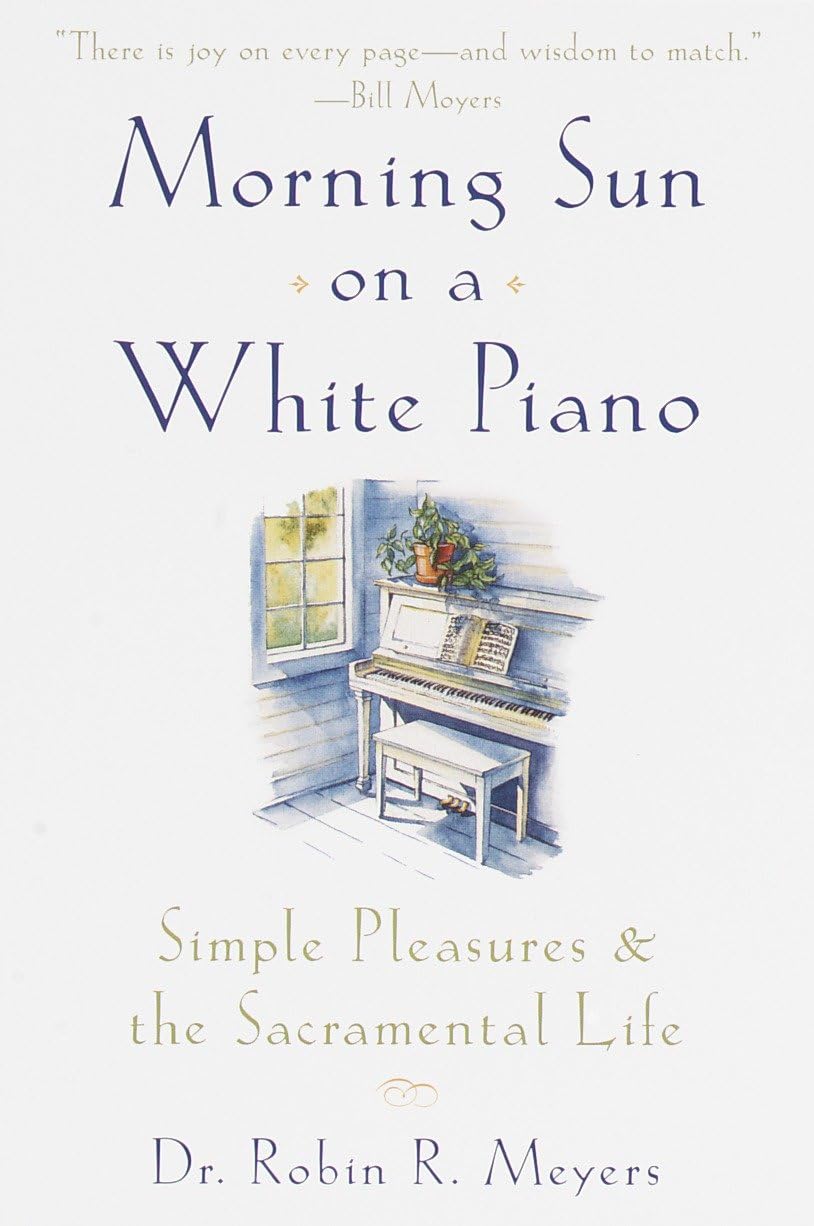
Morning Sun on a White Piano: Simple Pleasures and the Sacramental Life
$9.79
by Robin R. Meyers



There's a lot of talk these days about slowing down, simplifying, living in the moment, but it isn't really happening. We all talk the talk, but the walk we walk seems to be getting faster and faster, and we seem to be enjoying it less and less. Our problem is that, in search of life, we pass it by. Morning Sun on a White Piano is the perfect tonic for the freneticism of contemporary life. In twelve lucid, straightforward essays, Dr. Robin Meyers offers a brilliant guide to achieving the simple and sacramental life by recognizing what is holy in the seemingly insignificant details of everyday life: Books. Music. Letters. Children. Morning Sun on a White Piano is a book about finding joy in the present, about reclaiming the lost art of living, hearing again, in a culture that has gone deaf; seeing again, in a culture that's blinded; and feeling again, in a culture that overstimulates and numbs itself. If simplifying our lives means singing the song, Morning Sun on a White Piano challenges us to learn the dance. Compact, accessible, gorgeously written, and beautifully designed, here is a book that is a perfect gift for anyone--especially ourselves. "There is joy on every page--and wisdom to match." --Bill Moyers "Excellently written, it creates a plethora of vivid word pictures and is a delight to read." -- Christian Retailing There's a lot of talk these days about slowing down, simplifying, living in the moment, but it isn't really happening. We all talk the talk, but the walk we walk seems to be getting faster and faster, and we seem to be enjoying it less and less. Our problem is that, in search of life, we pass it by. Morning Sun on a White Piano is the perfect tonic for the freneticism of contemporary life. In twelve lucid, straightforward essays, Dr. Robin Meyers offers a brilliant guide to achieving the simple and sacramental life by recognizing what is holy in the seemingly insignificant details of everyday life: Books. Music. Letters. Children. Morning Sun on a White Piano is a book about finding joy in the present, about reclaiming the lost art of living, hearing again, in a culture that has gone deaf; seeing again, in a culture that's blinded; and feeling again, in a culture that overstimulates and numbs itself. If simplifying our lives means singing the song, Morning Sun on a White Piano challenges us to learn the dance. Compact, accessible, gorgeously written, and beautifully designed, here is a book that is a perfect gift for anyone--especially ourselves. There's a lot of talk these days about slowing down, simplifying, living in the moment, but it isn't really happening. We all talk the talk, but the walk we walk seems to be getting faster and faster, and we seem to be enjoying it less and less. Our problem is that, in search of life, we pass it by. Morning Sun on a White Piano is the perfect tonic for the freneticism of contemporary life. In twelve lucid, straightforward essays, Dr. Robin Meyers offers a brilliant guide to achieving the simple and sacramental life by recognizing what is holy in the seemingly insignificant details of everyday life: Books. Music. Letters. Children. Morning Sun on a White Piano is a book about finding joy in the present, about reclaiming the lost art of living, hearing again, in a culture that has gone deaf; seeing again, in a culture that's blinded; and feeling again, in a culture that overstimulates and numbs itself. If simplifying our lives means singing the song, Morning Sun on a White Piano challenges us to learn the dance. Compact, accessible, gorgeously written, and beautifully designed, here is a book that is a perfect gift for anyone--especially ourselves. Dr. Robin R. Meyers is Senior Minister of the Mayflower Congregational United Church of Christ Church in Oklahoma City and Professor of Speech and Rhetoric at Oklahoma City University. He lives in Oklahoma City with his wife, a sculptor, and their three children. There is no frigate like a book. --Emily Dickinson Children's books are now edible. This is a fairly recent development, and a very sensible one. With cardboard pages and rounded edges, these board books (or "chunky" books, as they're called), can be gnawed on and slobbered over in lieu of being actually read. It occurs to me that this is not only a good idea for babies, but the perfect analogy for the importance of reading in life--long after the impulse to cut teeth has faded. Because no matter what our age, we ought never to stop eating books, for books are the feast of the imagination. At the top of the list of things to be alarmed about these days is this: too many people have stopped reading. In small towns where libraries have closed for lack of funds and patrons, the omnipresent video store stays lit well into the night. People line up with their membership cards to purchase a largely passive form of entertainment, a spectacle, the latest montage of images cut and pasted into seamless illusions requiring l