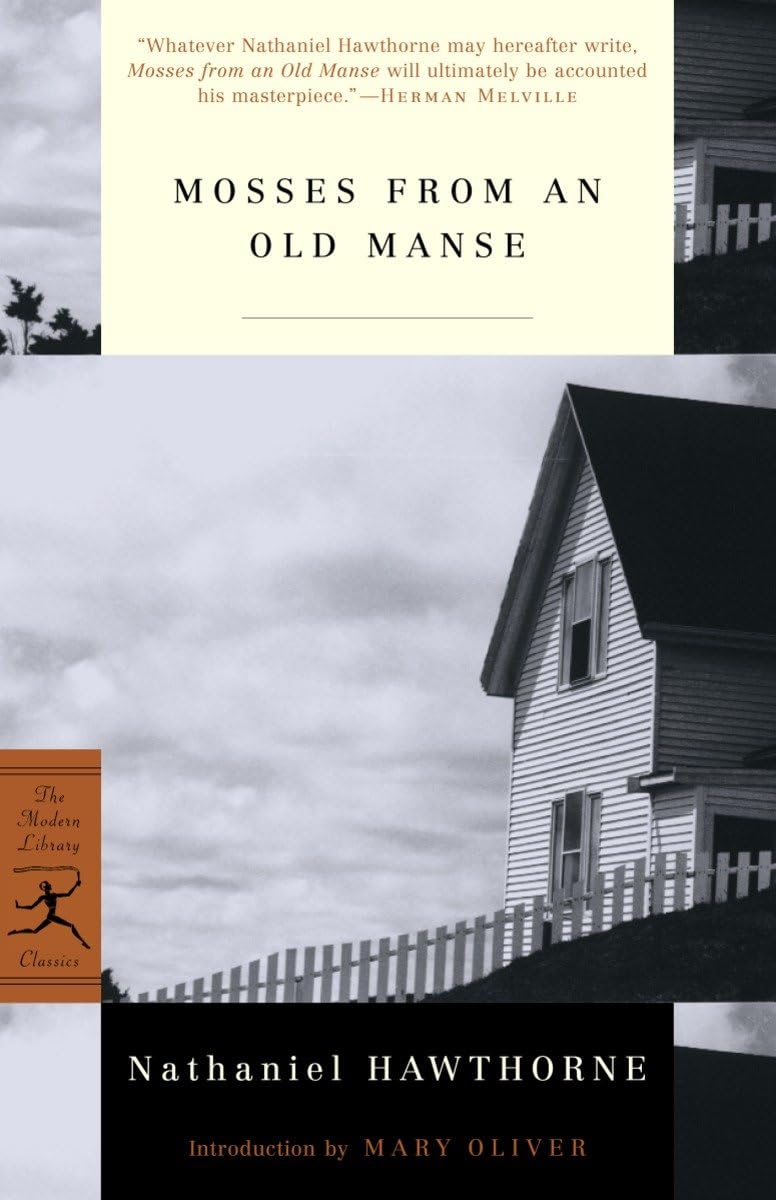



Mosses from an Old Manse is Nathaniel Hawthorne’s second story collection, first published in 1846 in two volumes and featuring sketches and tales written over a span of more than twenty years, including such classics as “Young Goodman Brown,” “The Birthmark,” and “Rappaccini’s Daughter.” Herman Melville deemed Hawthorne the American Shakespeare, and Henry James wrote that his early tales possess “the element of simple genius, the quality of imagination. That is the real charm of Hawthorne’s writing—this purity and spontaneity and naturalness of fancy.” “Whatever Nathaniel Hawthorne may hereafter write, Mosses from an Old Manse will ultimately be accountedhis masterpiece.”—Herman Melville from an Old Manse is Nathaniel Hawthorne s second story collection, first published in 1846 in two volumes and featuring sketches and tales written over a span of more than twenty years, including such classics as Young Goodman Brown, The Birthmark, and Rappaccini s Daughter. Herman Melville deemed Hawthorne the American Shakespeare, and Henry James wrote that his early tales possess the element of simple genius, the quality of imagination. That is the real charm of Hawthorne s writing this purity and spontaneity and naturalness of fancy. from an Old Manse is Nathaniel Hawthorne’s second story collection, first published in 1846 in two volumes and featuring sketches and tales written over a span of more than twenty years, including such classics as “Young Goodman Brown,” “The Birthmark,” and “Rappaccini’s Daughter.” Herman Melville deemed Hawthorne the American Shakespeare, and Henry James wrote that his early tales possess “the element of simple genius, the quality of imagination. That is the real charm of Hawthorne’s writing—this purity and spontaneity and naturalness of fancy.” Mary Oliver is the author of eleven books of poetry, including American Primitive , for which she was awarded the Pulitzer Prize; New and Selected Poems , which won the National Book Award; and House of Light , which won the Christopher Award and the L. L. Winship/PEN New England Award. She lives in Provincetown, Massachusetts. The Old Manse The Author makes the Reader acquainted with his Abode. Between two tall gateposts of roughhewn stone (the gate itself having fallen from its hinges at some unknown epoch) we beheld the gray front of the old parsonage, terminating the vista of an avenue of black ash trees. It was now a twelvemonth since the funeral procession of the venerable clergyman, its last inhabitant, had turned from that gateway towards the village burying ground. The wheel track leading to the door, as well as the whole breadth of the avenue, was almost overgrown with grass, affording dainty mouthfuls to two or three vagrant cows and an old white horse who had his own living to pick up along the roadside. The glimmering shadows that lay half asleep between the door of the house and the public highway were a kind of spiritual medium, seen through which the edifice had not quite the aspect of belonging to the material world. Certainly it had little in common with those ordinary abodes which stand so eminent upon the road that every passer by can thrust his head, as it were, into the domestic circle. From these quiet windows the figures of passing travellers looked too remote and dim to disturb the sense of privacy. In its near retirement and accessible seclusion it was the very spot for the residence of a clergyman—a man not estranged from human life, yet enveloped, in the midst of it, with a veil woven of intermingled gloom and brightness. It was worthy to have been one of the time-honored parsonages of England, in which, through many generations, a succession of holy occupants pass from youth to age, and bequeath each an inheritance of sanctity to pervade the house and hover over it as with an atmosphere. Nor, in truth, had the Old Manse ever been profaned by a lay occupant until that memorable summer afternoon when I entered it as my home. A priest had built it; a priest had succeeded to it; other priestly men from time to time had dwelt in it; and children born in its chambers had grown up to assume the priestly character. It was awful to reflect how many sermons must have been written there. The latest inhabitant alone—he by whose translation to paradise the dwelling was left vacant—had penned nearly three thousand discourses, besides the better, if not the greater, number that gushed living from his lips. How often, no doubt, had he paced to and fro along the avenue, attuning his meditations to the sighs and gentle murmurs and deep and solemn peals of the wind among the lofty tops of the trees! In that variety of natural utterances he could find something accordant with every passage of his sermon, were it of tenderness or reverential fear. The boughs over my head seemed shadowy with solemn thoughts as well as with rustling leaves. I took shame to myself for having been so long a writer of idle stories, and ventured to