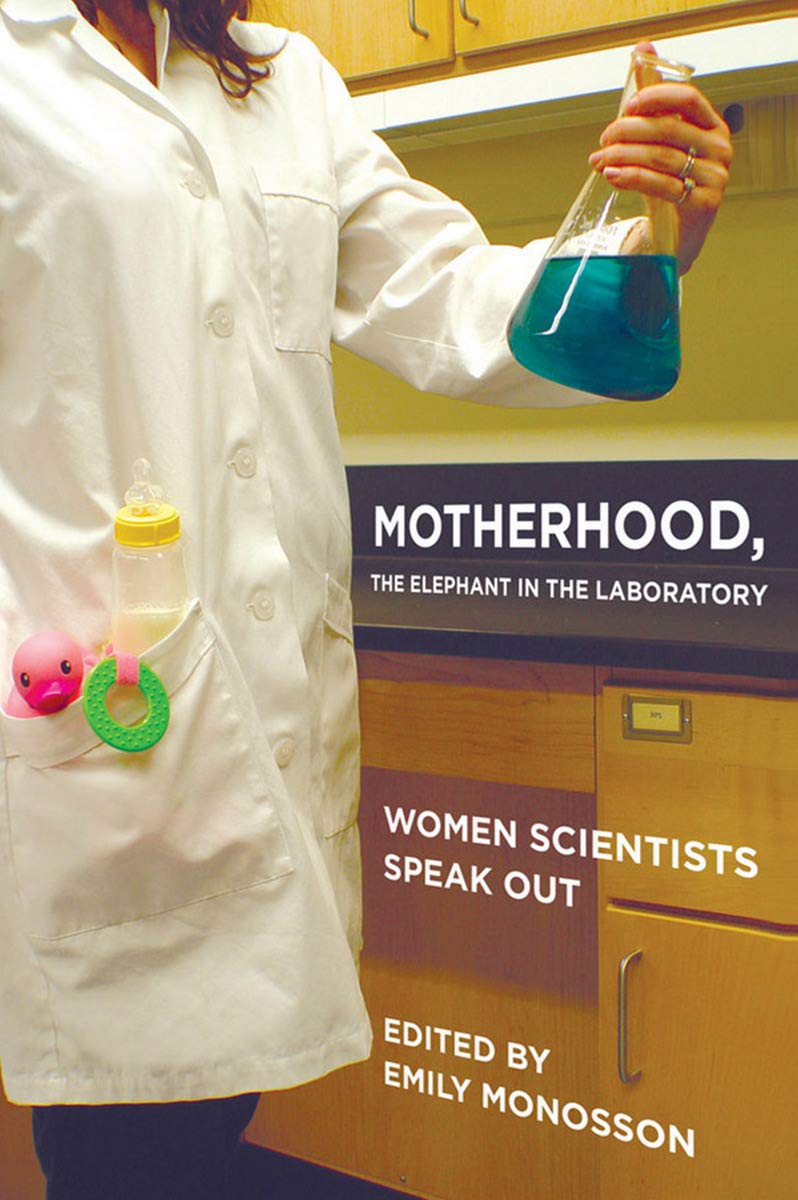
Motherhood, the Elephant in the Laboratory: Women Scientists Speak Out
$23.50
by Emily Monosson



About half of the undergraduate and roughly 40 percent of graduate degree recipients in science and engineering are women. As increasing numbers of these women pursue research careers in science, many who choose to have children discover the unique difficulties of balancing a professional life in these highly competitive (and often male-dominated) fields with the demands of motherhood. Although this issue directly affects the career advancement of women scientists, it is rarely discussed as a professional concern, leaving individuals to face the dilemma on their own. To address this obvious but unacknowledged crisis―the elephant in the laboratory, according to one scientist―Emily Monosson, an independent toxicologist, has brought together 34 women scientists from overlapping generations and several fields of research―including physics, chemistry, geography, paleontology, and ecology, among others―to share their experiences. From women who began their careers in the 1970s and brought their newborns to work, breastfeeding them under ponchos, to graduate students today, the authors of the candid essays written for this groundbreaking volume reveal a range of career choices: the authors work part-time and full-time; they opt out and then opt back in; they become entrepreneurs and job share; they teach high school and have achieved tenure. The personal stories that comprise Motherhood, the Elephant in the Laboratory not only show the many ways in which women can successfully combine motherhood and a career in science but also address and redefine what it means to be a successful scientist. These valuable narratives encourage institutions of higher education and scientific research to accommodate the needs of scientists who decide to have children. "Overall, I would recommend this book to anyone interested in the very personal side of the struggles and opportunities that accompany the decision of a collection of women scientists to have children. But the book also gets at a larger issue that goes beyond the topic of motherhood: the failure of our scientific culture, particularly in our academic institutions, to embrace and value the full range of career options beyond the professoriate that can lead to rewarding and satisfying professional and personal lives. For both reasons the book is a good read even for those readers who will never be mothers." --Chemical and Engineering News In eloquent and often witty essays, these women directly address the challenges of being mothers in the scientific workforce. -- The Scientist The writers, who all balance science careers and motherhood, provide a fascinating insight into a world too often kept hidden. -- New Scientist When toxicologist Rebecca Efroymson flew to Washington D.C. to defend a grant proposal before a federal agency, she lacked child care options and was forced to bring along her sick toddler. On the day of her presentation, she left her feverish, screaming son in a hotel room in the care of his grandparents, who had taken a train down from Philadelphia to babysit. Fatigued by lack of sleep, Efroymson did not give her best presentation, and her grant was not funded. "This was the first time that my split life might really have impacted my work and the viability of my job," she writes. The "split life" between work and child rearing is one familiar to millions of working parents. For women, balancing work and family can present particularly difficult challenges in the highly competitive, often male-dominated world of research science. Efroymson's story is one of many told in a timely new book, Motherhood, the Elephant in the Laboratory: Women Scientists Speak Out. Contributors to this volume include biologists, physicists, geologists, and oceanographers. They are professors, writers, independent consultants, science policy experts, teachers, and government researchers. For those who fear that motherhood is incompatible with traditional scientific research careers, this book offers some stunning examples to the contrary. An atmospheric chemist writes of raising five children as she works and rises to a position of leadership at NASA. Other women seek non-traditional careers in a quest for balance, and forge new paths for themselves. The editor of the anthology, Emily Monosson, is a prime example: a toxicologist with a Ph.D from Cornell, she has established a career as an independent consultant, researcher, and writer. The diversity of career paths described is impressive and eye-opening. Even for those who eventually end up in traditional careers, the road may be circuitous. Some of the women in these pages drop out of the workforce for a few years while their children are young, or work part-time. Some eventually return to the lab and tenure-track careers; testament that these traditional careers - often thought of as rigid, unyielding pathways - may have more flexibility than we have been led to believe. Indeed, the fluidity of scientific car