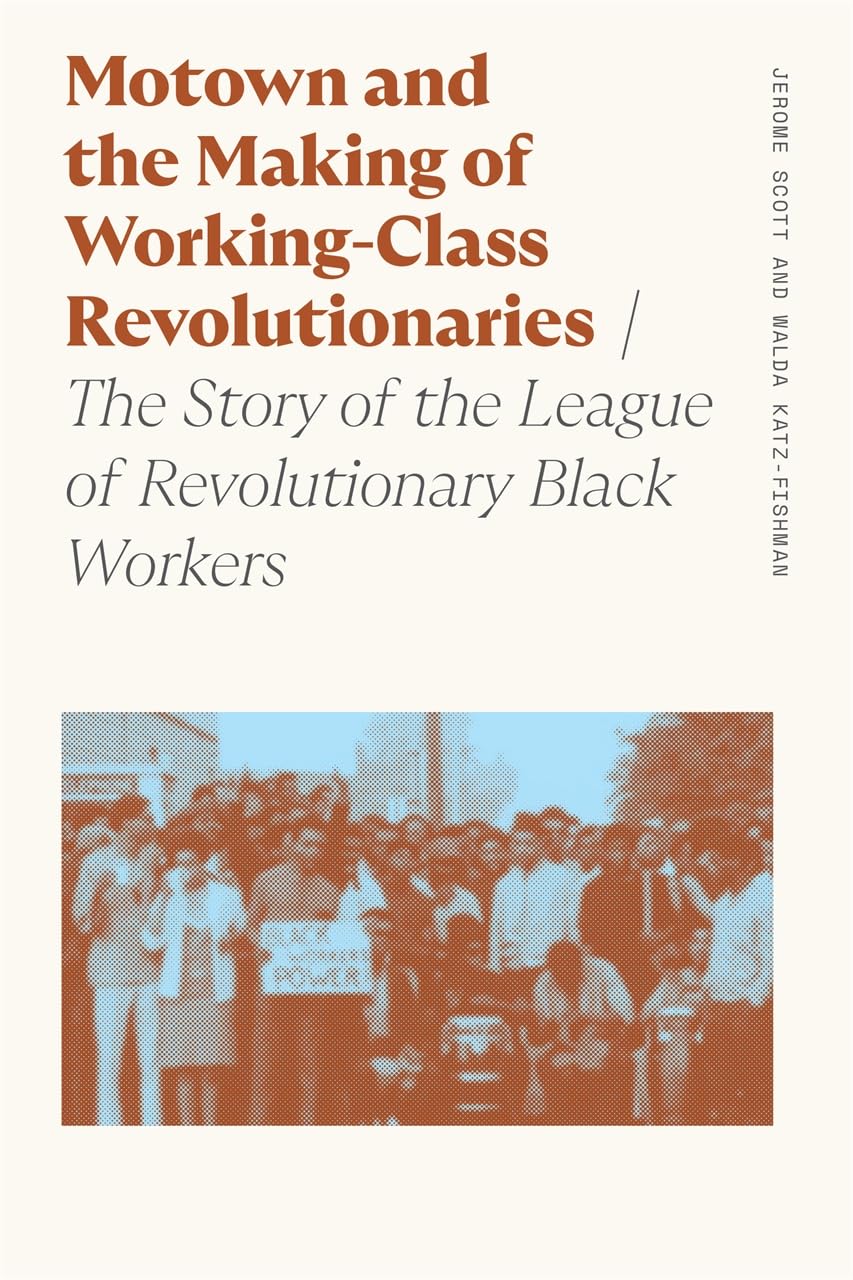
Motown and the Making of Working-Class Revolutionaries: The Story of the League of Revolutionary Black Workers (Sociology of Race and Ethnicity)
$119.95
by Walda Katz-Fishman



Motown and the Making of Working-Class Revolutionaries offers a fresh perspective on class, race, and revolution in the United States. Drawing on more than forty hours of interviews with former members of the League of Revolutionary Black Workers, Scott and Katz-Fishman share the rich story of the League, including the women and students. That story includes the history of the automotive industry in Detroit, the 1967 Detroit Rebellion, and the wildcat strike that sparked the Dodge Revolutionary Union Movement (DRUM). The authors describe the rise of the League from 1968 to 1971. They explore the centrality of struggle and political education as the League split and a section of League comrades moved into revolutionary organizations and social movement spaces, many of which remain active today. League comrades share their analysis of the current moment and staying the course of revolutionary struggle. At long last! Here is the story of the League of Revolutionary Black Workers, one of the most important working-class movements in U.S. history, as told by the very people who made it and lived it. Reflection on the experience of the League and the lessons we must draw from it and from the revolutionary political organizations that developed out of it could not be more vital at this barbarous time. Every social justice activist and proletarian intellectual must read it and discuss how to apply the lessons of our revolutionary parents, grandparents, and ancestors to the contemporary working-class struggle for an end to capitalist exploitation and to the racism, sexism, and other oppressions that capitalism generates. -- William I. Robinson ― Distinguished Professor of Sociology, University of California at Santa Barbara and author of Epochal Crisis: The Exhaustion of Global Capitalism Motown and the Making of Working-Class Revolutionaries is an essential contribution to the understanding of a transformative period in post-World War II United States capitalism. It reveals, in deeply personal narratives, the formation of a workers’ movement in the automotive industry that challenges both race and class oppression in the factories and within the UAW. It’s a history that few are aware of, but all can learn from. It’s history that matters. Today. -- Gene Bruskin ― activist, veteran labor organizer, and playwright Motown and the Making of Working-Class Revolutionaries is an exceptionally powerful analysis of the 1969 formation and history of the League of Revolutionary Black Workers. These workers in the Detroit automobile industry developed into working class revolutionaries who studied and struggled for social transformation at the point of production and beyond. They took on the exploitative automobile industry and embedded themselves in the worldwide class struggle against white supremacy and imperialist capitalism. Their voices are clear and incredibly potent with critical lessons for today. -- Rose M. Brewer ― Distinguished Teaching Professor, University of Minnesota-Twin Cities and President of the Society for the Study of Social Problems, 2024-2025 An inside look at how the experiences of Black workers created lifelong revolutionaries Walda Katz-Fishman (Author) WALDA KATZ-FISHMAN is a scholar activist and professor of sociology at Howard University. A founding member and former board chair of Project South: Institute for the Elimination of Poverty & Genocide, she is a contributing author or editor of popular education toolkits and books, including The United States Social Forum: Perspectives of a Movement and The Roots of Terror, among others . Jerome Scott (Author) JEROME SCOTT is a former autoworker, labor organizer in Detroit auto plants, and member of the League of Revolutionary Black Workers. The founding director of Project South: Institute for the Elimination of Poverty & Genocide, he is a contributing author or editor of popular education toolkits and books, including The United States Social Forum: Perspectives of a Movement and The Roots of Terror, among others .