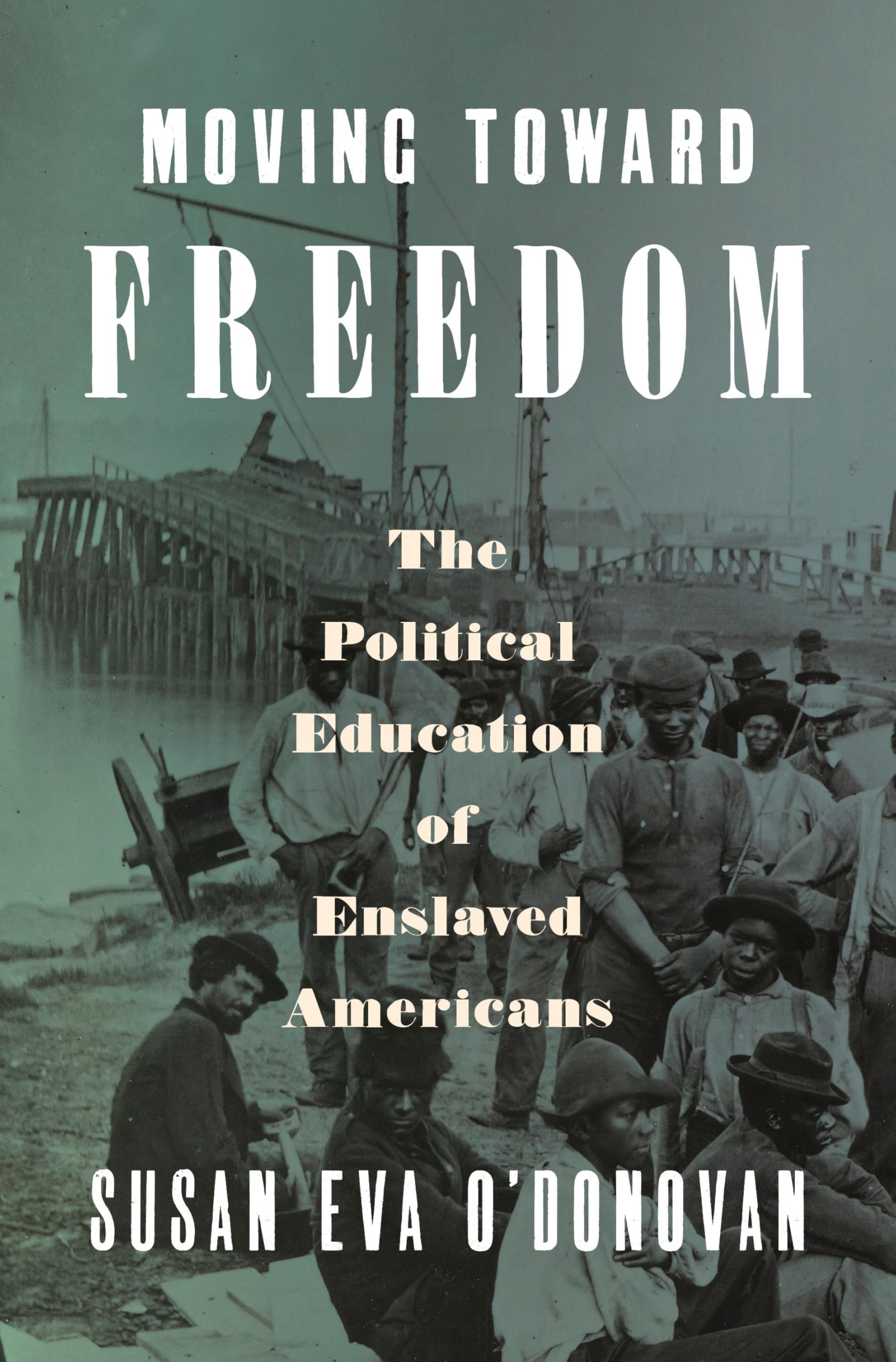
Moving Toward Freedom: The Political Education of Enslaved Americans
$35.00
by Susan Eva O'Donovan



A magisterial, groundbreaking new study of the lives of enslaved Americans on the cusp of the Civil War that places them—and their hard-won political knowledge—rightly at the center of the fight for freedom The enduring image of American slavery has been of workers trapped on plantations, shuttling from squalid quarters to the fields and back again, or confined to the homes of abusive owners, constantly under surveillance and restriction. But if that were the whole picture, how would black Southerners have organized into such a formidable force the moment war erupted? With Moving Toward Freedom , eminent historian Susan Eva O’Donovan radically widens the lens to reveal a new landscape of the slaveholding South: one in which enslaved workers were not pinned in place but mobile, deployed as laborers—and even as captains—on steamboats and ferries, or as teamsters transporting staple crops across the expanding country, or as ladies’ maids waiting on their mistresses on European vacations. While performing brutal and involuntary work, O’Donovan argues, enslaved Americans managed to accumulate the crucial experience and knowledge that they would use to bring about their own liberation. Piecing together an extraordinary archive of letters, travel passes, receipts, and other documentation of lives in which literacy was illegal, O’Donovan allows her subjects to speak for themselves as they move through markets, jails, waterways, gold mines, and foreign lands. In so doing, O’Donovan demonstrates that slavery’s incredible profitability depended on a fundamentally unsustainable balance between commercial imperatives and slaveholders’ drive for control—one that enslaved workers eventually succeeded in using to their advantage, bringing slavery to its knees. "Using a remarkable plethora of voices, Susan Eva O’Donovan’s Moving Toward Freedom masterfully tracks the growth of a powerful political consciousness among enslaved Americans in the first half of the nineteenth century. It is startling and groundbreaking work, shedding new light upon the momentous and rapid movement in the mid-nineteenth century toward emancipation and full citizenship for enslaved Americans." — Jonathan M. Bryant, author of Dark Places of the Earth: The Voyage of the Slave Ship Antelope "Susan Eva O’Donovan rightfully implores us to take a new view of American political history by paying the closest attention to what enslaved people were learning, doing, and seeing. Her book is a gripping account of the enslaved people who 'moved toward freedom,' as their local, national, and even international travels allowed them, and thus their communities, to get a thorough political education even while living under the lash." — Henry Louis Gates, Jr., Alphonse Fletcher University Professor, Harvard University " Moving Toward Freedom tilts our angle of vision, enabling us to see the histories of slavery and resistance in creative and inspiring new ways." —Marcus Rediker, author of Freedom Ship: The Uncharted History of Escaping Slavery by Sea Susan Eva O’Donovan is an associate professor of history at the University of Memphis. She is the author of Becoming Free in the Cotton South and coeditor of two volumes of Freedom: A Documentary History of Emancipation, 1861–1867 , part of the ongoing scholarship of the Freedmen and Southern Society Project at the University of Maryland. She is an Organization of American Historians distinguished lecturer and the codirector of the Memphis Massacre project, a public commemoration of Reconstruction.