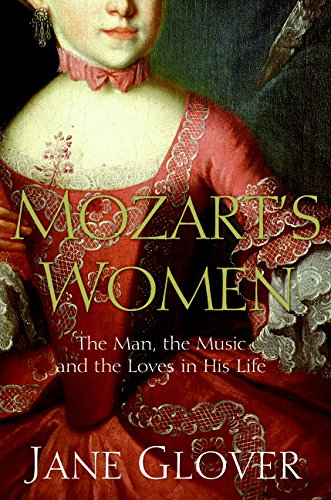



Throughout his life, Mozart was inspired, fascinated, amused, aroused, hurt, disappointed and betrayed by women -- and he was equally complex to them. But, first and last, Mozart loved and respected women. His mother, his sister, his wife, her sisters, and his female patrons, friends, lovers and fellow artists all figure prominently in his life. And his experience, observation and understanding of women reappear, spectacularly, in the characters he created. As one of our finest interpreters of Mozart's work, Jane Glover is perfectly placed to bring these remarkable women -- both real and dramatized -- vividly to life. We meet Mozart's mother, Maria Anna, and his beloved and devoted sister, Nannerl, perhaps as talented as her brilliant brother but, owing to her sex, destined to languish at home while Wolfgang and their father entertained the drawing rooms of Europe. We meet, too, Mozart's "other family" -- his in-laws, the Webers: Constanze, his wife, much maligned by history, and her sisters, Aloysia, Sophie and Josefa. Aloysia and Josefa were highly talented singers for whom Mozart wrote some of his most remarkable music. Aloysia was the first woman whom Mozart truly and passionately loved, and her eventual rejection of him nearly broke his heart. Constanze, though a less gifted singer, proved a steadfast and loving wife and -- after Mozart's death -- his extremely efficient widow, consolidating his reputation and ensuring that his most enduring legacy, his music, never be forgotten. Mozart's Women is their story. But it is also the story of the women in his operas, all of whom were -- like his sister, his mother, his wife and his entire female acquaintance -- restrained by the conventions and strictures of eighteenth-century society. Yet through his glorious writing, he identified and released the emotions of his characters. Constanze in Die Entführung aus dem Serail ; Ilia and Elettra in Idomeneo ; Susanna and the Countess in Le nozze di Figaro ; Donnas Anna and Elvira in Don Giovanni ; Fiordiligi, Dorabella and Despina in Così fan tutte ; Pamina and the Queen of the Night in Die Zauberflöte: are all examined and celebrated. They hold up the mirror to their audiences and offer inestimable insight, together constituting yet further proof of Mozart's true genius and phenomenal understanding of human nature. Rich, evocative and compellingly readable, Mozart's Women illuminates the music and the man -- but, above all, the women who inspired him. Glover, a respected British conductor, views Mozart through the women in his life: his mother; his sister and sometime duet partner, Nannerl; his wife, Constanze Weber; and the female singers for whom he wrote roles that are "some of the most vividly drawn and brilliantly understood women on the operatic stage." Mozart seems to have had more in common with the happily domestic Figaro than with the brilliant seducer Don Giovanni, and knew how to appreciate a talented, vivacious, and resourceful woman, as Glover illustrates with many touching excerpts from his correspondence. However, after Mozart's death, in 1791, her book begins to drag as she follows the lives of his survivors; Constanze remarried, completing her second husband's biography of her first, and lived until 1842. The book's title notwithstanding, much of the first half is dominated by Leopold Mozart, Wolfgang's authoritarian and manipulative father, who emerges as probably the most significant person in Mozart's life. Copyright © 2006 The New Yorker Mozart (1756-91) was involved with four groups of women during his life. His mother, sister Nannerl (1751-1829), and cousin were with him when his father insisted on touring him and Nannerl as child prodigies throughout the main cities of Europe. He fell in love with the members of the second group, the Weber daughters, all of whom performed in his operas and concerts, eventually marrying Constanze (1762-1842). The female singers and the female characters in his operas make up the third and fourth groups, respectively, according to Glover, who is exceptionally clear--indeed, a joy to read----as she explains the part each woman, real and fictive, played in Mozart's life. The last chapter chronicles the life that Constanze, Nannerl, and Mozart's two surviving sons led after the composer's early death. While very little original research went into it, Glover's book accounts for what made Mozart tick as do few others. Glover is a versatile musician herself, particularly noted as a conductor of eighteenth-century repertoire, and that probably enabled her insight. Alan Hirsch Copyright © American Library Association. All rights reserved “Beautifully written and scholarly without seeming so.” — Dame Felicity Lott “It is Jane Glover’s great gift to show how the women surrounding Mozart...all influenced him.” — Judith Flanders “Jane Glover has pulled off a coup des livres with her fresh take on Mozart’s life and work.” — John Allison, Sunday Telegra