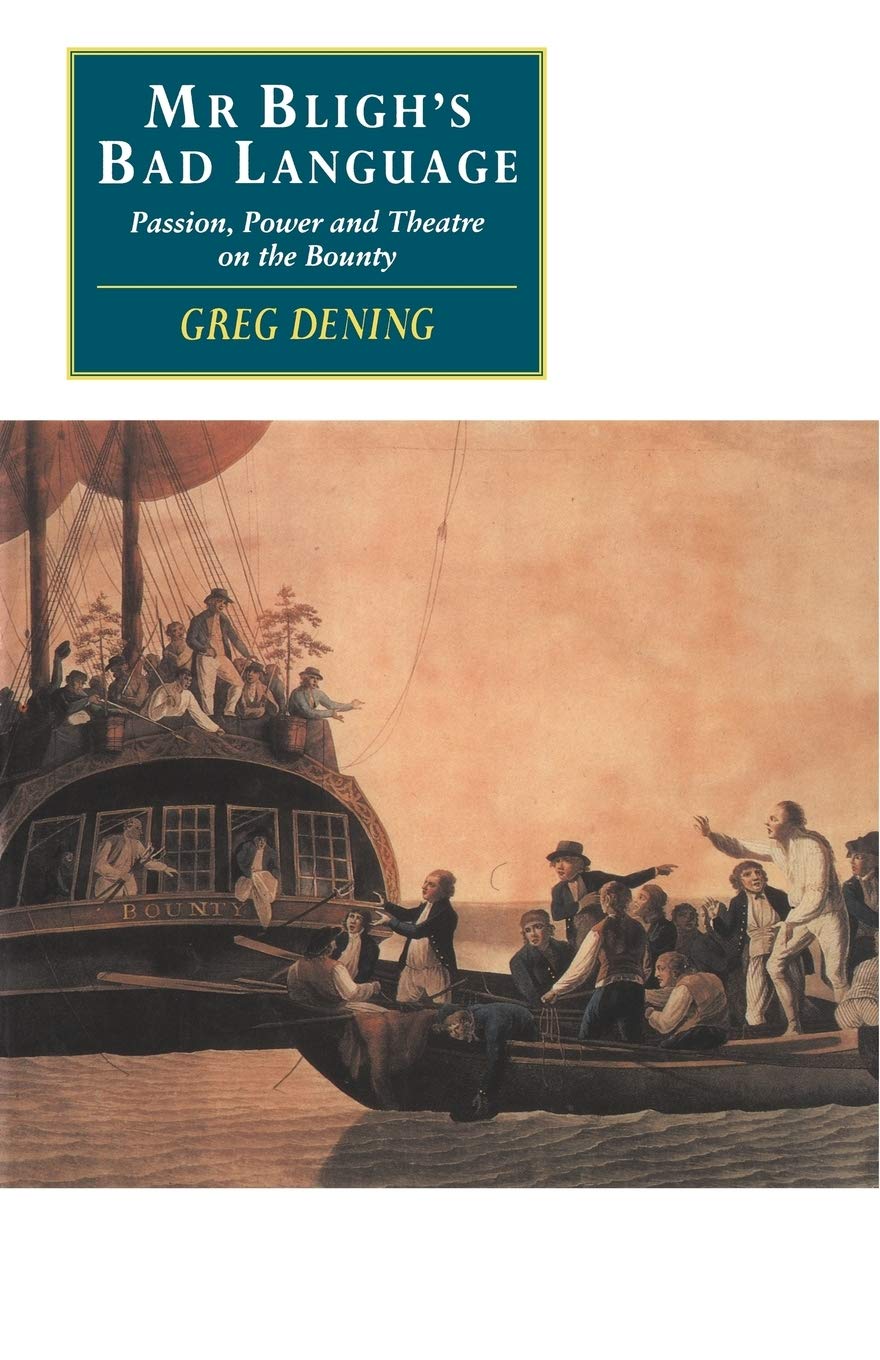
Mr Bligh's Bad Language: Passion, Power and Theatre on the Bounty (Canto original series)
$16.83
by Greg Dening



Captain Bligh and the mutiny on the Bounty have become proverbial in their capacity to evoke the extravagant and violent abuse of power. But William Bligh was one of the least violent disciplinarians in the British navy. It is this paradox that inspired Greg Dening to ask why the mutiny took place. His book explores the theatrical nature of what was enacted in the power-play on deck, on the beaches of Tahiti and in the murderous settlement at Pitcairn, on the altar stones and temples of sacrifice, and on the catheads from which men were hanged. Part of the key lies in the curious puzzle of Mr Bligh's bad language. "...after only a short time with Mr. Bligh's Bad Language, readers will recognize that this is a truly major historical work that transcends Bligh and the Bounty voyage to confront much broader historical questions involving analysis, interpretation, and research." The Northern Mariner "As a stunningly original meditation on the illusions of power and possession, Dening's study raises profound questions concerning the lessons of history and the uses of the past." Arkansas Democrat-Gazette "...works through the layers of myth and misrepresentation which rapidly gathered around Bligh following the mutiny, discussing the concerns people brought to this incident...All this makes fascinating reading and it is backed by exquisitely detailed research...Dening's discussion of others' works that bear on the actualities of seafaring and the attitudes of succeeding ages is alone worth the price of admission." Sea History "[Dening] has written a classic, an absorbing book likely long to remain the definitive analysis of the mutiny." Times Literary Supplement "Mutiny on the Bounty" summons to the popular mind images of violence and power on the high seas. Dening restores a sense of perspective in this fascinating study of the Bounty through images of space, language, and ceremony in Britain's Royal Navy of the late 18th century....Dening provides excellent details of the daily life of seamen and officers from the perspectives of history and anthropology." Library Journal "Mr. Bligh's Bad Language is quirky; Dening casts a net so wide one never knows what he'll bring up next...On the other hand, the omnivorous approach also produces countless insights, provocative evaluations and fresh relationships, and is a genuine contribution to the literature of the subject." Boston Globe "Greg Dening has produced a powerful new account of an event that has, over two centuries, helped to define our modern understandings of tyranny and resistance. His tale about Bligh and the mutineers is imaginative and learned, engaging and entertaining, much to be enjoyed by anyone interested in the society and culture of wooden ships and iron men." Marcus Rediker, Georgetown University "A learned, humane, provocative 'creative reading' of mutiny on the Bounty--the events; their meaning and representation in native lore, British life, the theater, and cinema; and their historical value. An engaging style and familiarity with political, naval, theater and film history, with anthropology, and with thinkers such as Foucault, Barthes, and Lévi-Strauss enrich this 'celebratory narrative,' as Dening calls it. A fascinating, essential chapter in the history of the Bounty." Kirkus Reviews "This is a post-Simon Schama history, told with the ambiguities of cultural analysis, and the excitements of fiction." The Observer "...stimulating, entertaining and informative analysis....The last of the many keywords...in Mr. Bligh's Bad Language is 'claptrap,' an eighteenth-century term which refers to that particular moment when a theatre audience acknowledged the brilliance of an actor's performance by applauding spontaneously in the middle of a scene....In that it provided Greg Dening with the stimulus to write this splendid book, replete as it is with claptraps of its own, we, the audience, should be grateful that William Bligh so misinterpreted the part he was required to perform aboard the Bounty, that theatre of personal, cultural, and institutionalized conflict." David J. Starkey, International Journal of Maritime History An acclaimed and intriguing new interpretation of the mutiny on the Bounty. Captain Bligh and the voyage of the Bounty are the starting point of this new study of the famous mutiny in history, literature and film. By juxtaposing an account of the mutiny with an analysis of its evolving place in history and culture, Mr. Bligh's Bad Language offers a new interpretation of the mutiny in the context of its historical and cultural representations. Beginning with an analysis of naval life and ritual aboard the Bounty, Greg Dening argues that the famous mutiny did not take place due to punitive violence, as Captain Bligh is shown to be one of the least violent of British Navy captains. Instead, he argues, Captain Bligh misunderstood the theatrical nature of shipboard life, especially his role as captain. Moving to a larger stage,