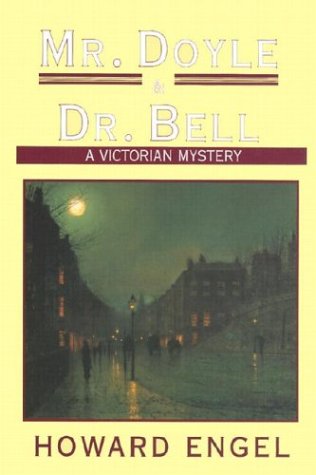



Howard Engel is the winner of the Arthur Ellis Award for crime fiction and creator of the acclaimed Benny Cooperman mystery series as well as Murder in Montparnasse , a departure from the series. He is a founding member of the Crime Writer's Association of Canada, where his private eye has been described as a cherished national institution. Howard Engel is founding member of the Crime Writer's Association of Canada. Mr. Doyle and Doctor Bell: A Victorian Mystery By Howard Engel Abrams Books Copyright © 1997 Howard Engel All rights reserved. ISBN: 978-1-58567-417-6 CHAPTER 1 In the year 1879, I had not yet completed my medical studies at Edinburgh University. My time was occupied in staving off the tedium of botany, chemistry, anatomy, physiology and the rest of the attendant evils of the healing arts. I achieved this by burying myself in mastering them. It was a life punctuated by the striking of the twelve-o'clock bell from Tran church, the climbing of stairs to watch Sir William Turner remove a metacarpus or resect a carbuncle or two, and refreshed by the occasional glass of sherry at Rutherford's bar in Drummond Street to relive with a fellow sufferer the moments of a deathless lecture on the morphology and properties of the islets of Langerhans. To say that I was going sour on the prospect of becoming a country doctor is to understate the case. It had never been my idea in the first place. It was a matter of necessary expediency, in the light of my father's increasing inability to support his large family. We came from aristocratic Norman French traditions. The name was originally spelled D'oyly, D'oel, D'Oil and other variations on the same theme. It finally settled on Doyle and Doyle it has remained. Both in France and later in Ireland, where a branch of the family put down roots, we were esteemed an ardent Catholic family. Most Irishmen take us for Leinster Doyles, but we are unrelated either to the M'Dowells of Ireland, of which Doyle is a variant, or the M'Dougalls of Scotland. When we had been forbidden the land under the harsh religious laws in practice then against Roman Catholics in Ireland, to everyone's surprise, we burgeoned out in the arts. My grandfather was a celebrated portrait painter and caricaturist, my uncles all were artists and illustrators. One designed the cover of Punch, another was director of the National Gallery of Ireland in Dublin. Only my father was a practical man of affairs, a clerk in the Edinburgh Board of Works. These changes in the family fortunes put a scowl on the crowned stag in the family crest, but we were apparently supported by the motto Fortitudine vincit. While medicine was respected around the family hearth, it was not a traditional profession among us. In spite of this I continued to struggle with Materia Medica and Therapeutics, only grousing about it at Rutherford's to Stevenson, who was a good listener with a dram in his hand. Stevenson was my senior by nearly ten years, but we had fallen in together when he was having difficulties similar to my own, first with engineering, where he was expected to perform up to the traditional standards of his forebears, who had made the designing and construction of lighthouses a family mystery, and then with the law, which he liked no better. He had had his initial call to the bar, but proclaimed that Rutherford's was to be his chosen bar from then on. Our taste in books was miles apart, but we were both inveterate devourers of literature of all kinds and fought about our favourites by the hour. Our own small literary successes were known to one another, but seldom mentioned. To be frank, Louis was restless in Edinburgh and had plans to sail off to America in pursuit of someone named Fanny. He was just returned from France, so there was much to discuss. "Why don't you chuck it all, Doyle, old chap? Cut loose, raise your sail and be off!" We were seated at a corner of the saloon bar, facing one another above the mahogany counter: I with a satchel of notebooks at my feet and Stevenson with his long legs bunched up, making tenuous his purchase on the stool he was perched upon. Dressed in his accustomed bohemian déshabillé, a black shirt with a knotted artist's tie under a velvet jacket, he looked sallow and gaunt. He resembled nothing so much as a corpse animated by the desire to complete what he had set out to accomplish before surrendering himself to the sexton at Greyfriars. His appearance was not improved by strong drink, of which he had already liberally partaken. With his usual happy perspicuity, Louis had read my mood. I had been taken to task roundly for an assignment which had not pleased my teacher. The event had coloured the rest of the afternoon and was now casting a shadow on the evening as well. Caught out in this way, and attempting to mislead my friend, I tried to imagine that there was a bright side to my situation. "I'm beginning to see, Stevenson, that I'm not without advantag