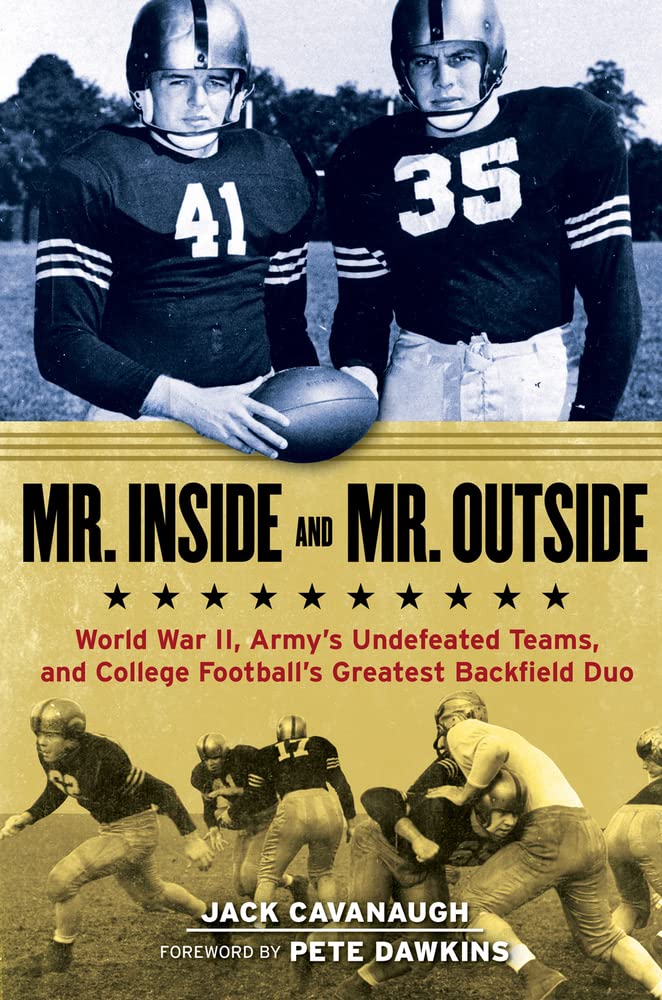
Mr. Inside and Mr. Outside: World War II, Army's Undefeated Teams, and College Football's Greatest Backfield Duo
$16.95
by Jack Cavanaugh



Heisman Trophy winners Glenn Davis and Felix Blanchard—renowned during their playing days at West Point as “Mr. Inside and Mr. Outside”—were the best-known college football players in the country between 1944 and 1946, and Army was the nation’s top-ranked team under legendary coach Red Blaik. Acclaimed author Jack Cavanaugh takes readers through the Black Knights’ three consecutive National Championship seasons, including the 1946 “Game of the Century” between Army and Notre Dame, the only college game to date to have included four Heisman Trophy winners. Cavanaugh also examines the impact the war had on Army’s success—because its players were already considered to be in the military and thus deferred from active duty while students at West Point, Army featured many outstanding high school and prep school players in those years. A unique look at the changes that took place in sports and almost every aspect of American life in the wake of World War II, this book a must-read for fans of college football and military buffs in addition to Army fans. Jack Cavanaugh is a veteran sportswriter whose work has appeared most notably on the sports pages of The New York Times , for which he covered hundreds of assignments over 25 years. He was a news reporter for ABC for five years and CBS for two years, and was an adjunct professor at the Columbia University Graduate School of Journalism. Cavanaugh is the author of five other books, including Season of '42 , Giants Among Men , The Gipper , Damn the Disabilities , Full Speed Ahead! , and Tunney , which was nominated for a Pulitzer Prize in biography. In addition, Cavanaugh has been a frequent contributor to Sports Illustrated and has written for Reader’s Digest , Tennis and Golf magazines as well as other national publications. He lives with his wife, Marge, in Connecticut. Pete Dawkins was an All-American halfback for Army who won the 1958 Heisman Trophy and the 1958 Maxwell Award. A Rhodes Scholar, he served with the 82nd Airborne and won two Bronze Stars for valor in Vietnam. After a 24-year career in the Army, he retired as a Brigadier General in 1983 and moved on to a successful business career. Mr. Inside and Mr. Outside World War II, Army's Undefeated Teams, and College Football's Greatest Backfield Duo By Jack Cavanaugh Triumph Books Copyright © 2014 Jack Cavanaugh All rights reserved. ISBN: 978-1-60078-929-8 Contents Foreword by Pete Dawkins, Brigadier General, U.S. Army (Ret'd), Introduction, 1. The Professor's Recruit, 2. "I Love Hearin' Those Southern Voices", 3. "Two Good to Be True", 4. Racial Divide Even During War Time, 5. The Midshipman-Cadet, 6. A "Story Book" Team, 7. "There's Good News Tonight", 8. Sky-High Expectations, 9. Changing the Game, 10. Better Than Ever?, 11. The Colonel as Coach, 12. "Say a Little Prayer for Us", 13. The Future Dictator and the Army Halfback, 14. Three-Peat Champions?, 15. "Game of the Century", 16. The Last Hurrahs, Epilogue, Acknowledgments, Sources, Photo Gallery, CHAPTER 1 The Professor's Recruit Like many college football coaches, earl "red" blaik received plenty of tips on potentially good college football players — even from a few generals — but never before had he gotten one from a college dramatics professor, as he did in early 1943, his third year as the head coach at the United States Military Academy in West Point, New York. The tip came from a friend, Warren Bentley, a drama professor at Dartmouth, where Blaik had coached for seven years before returning to West Point, his alma mater, as head coach in 1941. Bentley had attended college in Pomona in Southern California and along with occasionally vacationing in the area, had relatives there, one of whom, a grocer, told him about a football player in Los Angeles County whose mother had told him her son was interested in going to West Point. "Everybody in California talks about a football player at Bonita High School in La Verne, which is not far from Pomona," Professor Bentley wrote to Blaik. "They say that this kid is the fastest halfback ever seen out there. He's an all-round athlete: baseball, basketball, and track, as well as football. Since I'm told he is interested in going to West Point, I thought you would want to know about him. His name is Glenn Davis." Not only had Blaik never heard of Davis, he had never even tried to recruit a player from the West Coast, either while he was at Dartmouth or since his arrival at West Point. "I didn't know anything about West Coast football," Blaik said years later. Even if he had, Blaik knew recruiting would be difficult. For one thing, most people still traveled by train in the 1940s, and the transcontinental trip from the West Coast to New York took at least four days. For another, it was hard enough recruiting players from the Northeast, the South, and the Midwest because of the rigorous academic schedule at West Point and the commitment after