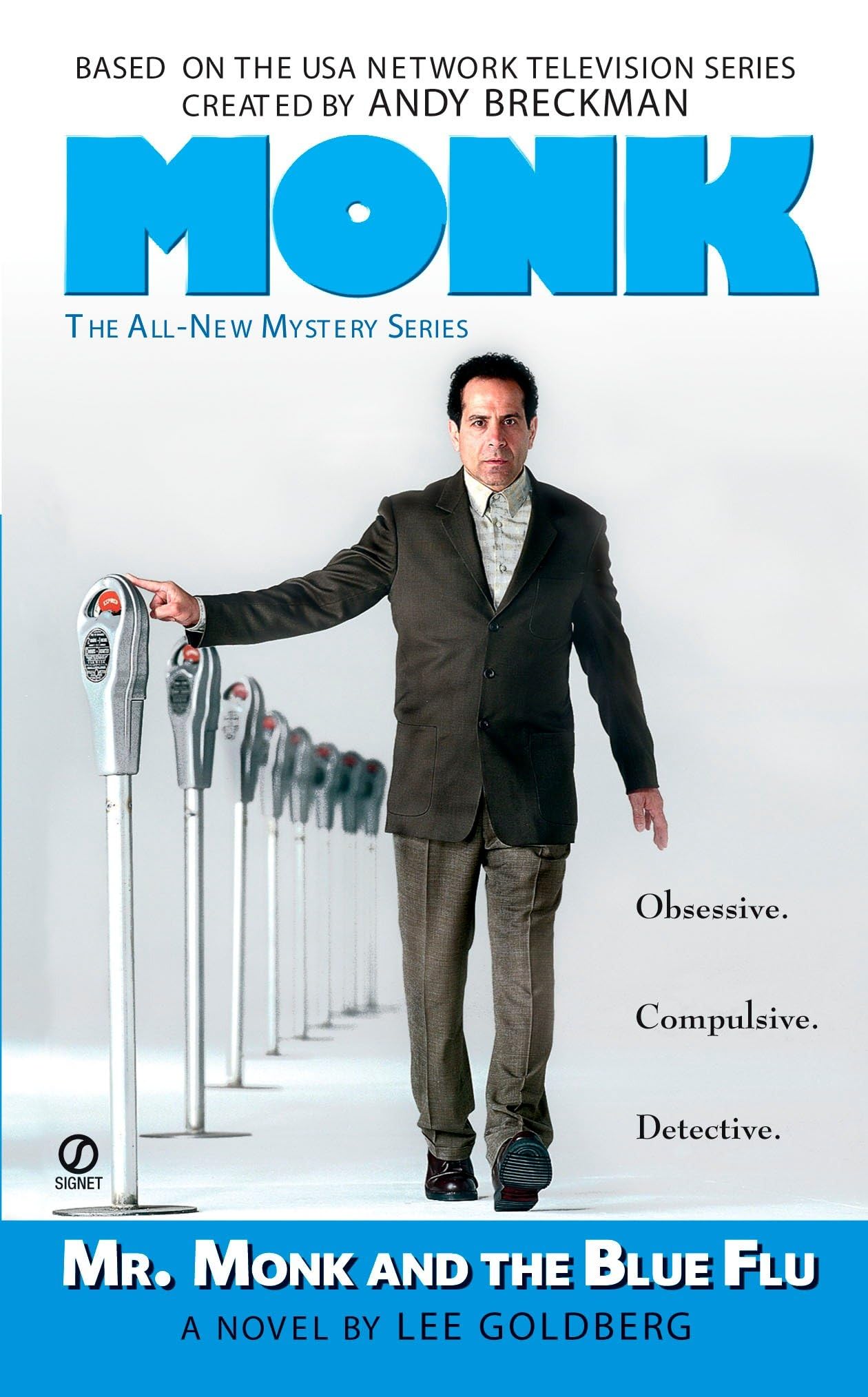



Monk is horrified when he learns there's going to be a blue flu in San Francisco-until Capt. Stottlemeyer explains that it just means the police plan to call in "sick" until they get a better contract.The good news is the labor dispute will give Monk a chance to get back on the force.The bad news is it means he'll be a "scab"-and he doesn't like the sound of that either. But before he knows it, Monk has his badge back, and his own squad to command. Unfortunately, some of the squad members make Monk look like a paragon of mental health. But despite the challenges, they'll have to pull together to catch an astrologer's killer, solve a series of mysterious fatal assaults, and most importantly, clean up their desks. "Can books be better than television? You bet they can--when Lee Goldberg's writing them." -- Lee Child Lee Goldberg has written episodes for the Monk television series, as well as many other programs. He is a two-time Edgar Award nominee and the author of the acclaimed Diagnosis Murder novels, based on the TV series for which he was a writer and executive producer. The San Francisco City Hall was built not long after the 1906 earthquake to scream to the world that the city was back, bigger, stronger, and more opulent than ever. The building’s Beaux-Arts flourishes, Doric columns, and Grand Baroque copper dome inspired by St. Peter’s Church in Rome meant you would never mistake it for anything but a capitol of some kind. As if the grand dome wasn’t grand enough, it’s topped with an ornate steeple and a torch that lights up at night when the City Council is meeting. The building always struck me as garish and pompous rather than majestic and imposing. I guess that’s fitting for a place that houses mostly politicians and bureaucrats. But standing in Mayor Smitrovich’s office, I felt like I was in an aquarium. There were tarpon, swordfish, and Dorados mounted on the walls, their mouths agape, forever twisting in midthrash. A pair of window cleaners worked outside, peering in at us from the other side of the glass behind the mayor. All that was missing to make the effect complete were a ceramic mermaid and a castle for us to swim around. “It’s a real pleasure to finally meet you, Mr. Monk,” Smitrovich said, coming around the desk and shaking Monk’s hand. “I’m a big fan.” I handed Monk a moist towelette. “Really?” Monk said, wiping his hand. “I truly appreciate your tireless efforts on behalf of this city.” “That’s such a relief. I was beginning to think you were ignoring all my letters,” Monk said. “It’s about time someone in authority ended our city’s shame and turned Lombard from the world’s crookedest street to the straightest.” “You want to straighten Lombard?” the mayor said. “Whoever approved that street should have been beaten with his T-square,” Monk said. “It’s a good thing he was stopped before every street in the city looked like Lombard. It’s astonishing to me that nobody has ever bothered to correct it.” “You know how it is, Mr. Monk,” the mayor said. “There are so many other pressing issues that demand our attention.” “What could be more important than that?” “Actually,” the mayor said, “that’s why I asked you here today.” “You’re not straightening Lombard?” “Not just yet.” “I know you’ll face some opposition from a wacko minority of hippies and beatniks. But I’ll back you one hundred percent.” “That’s reassuring, because I truly need your support,” the mayor said. “It’s clear to me that we both share a deep and abiding love for this great city.” “It can’t be great as long as the world’s crookedest street is here,” Monk said. “What would be great is a city with the world’s straightest street. Just think of all the tourists who would come here to see it.” “Millions of tourists do come to see Lombard Street,” the mayor said. “To ridicule us,” Monk said. “Where do you think the phrase ‘those crazy Americans’ came from? Lombard Street. Fix the street and they’ll never say it again.” “Right now, I’m more concerned about the lack of police officers reporting to work. Most of the patrol officers are on the job; it’s the detectives and supervisory personnel who aren’t showing up,” the mayor said. “It’s creating a serious public safety issue. We don’t have the manpower to investigate major felonies. You know how important the first forty-eight hours are in an investigation. Tracks are getting cold. Something must be done about this, especially with this strangler on the loose. They couldn’t have picked a worse time to pull this crap.” “You could drop your demands for big cuts in police salaries and benefits,” I said. “I bet that would bring the detectives back to work.” “Sure, I could give the police officers what they want,” the mayor said, shooting me an angry look before shifting his gaze back to Monk, “but then where would the money come from to straighten Lombard Street?” Monk glanced at me. “He has a point.” “No, he doesn’t,” I said. “With all due respect, Mr. Smitrovich, these peo