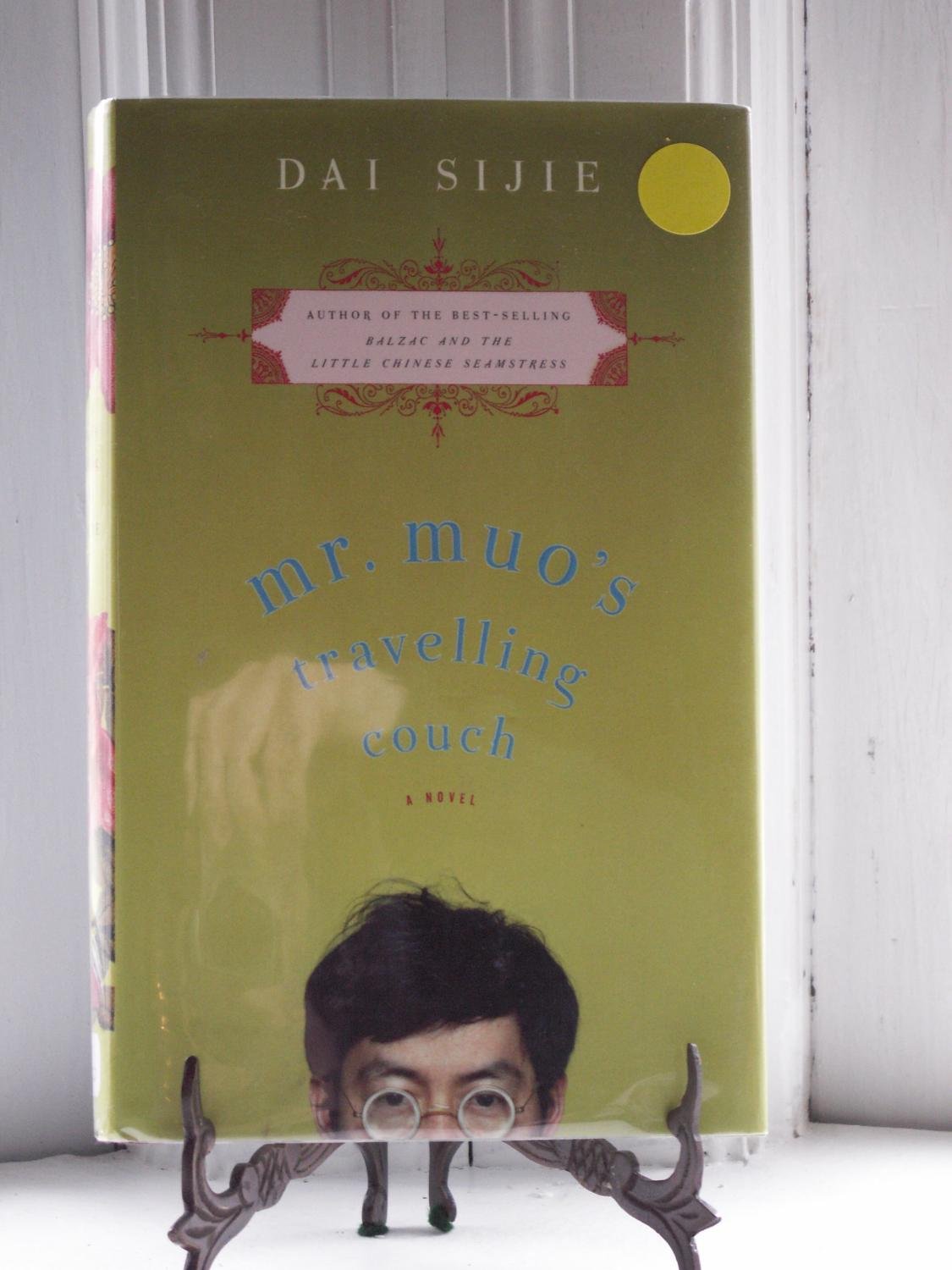



Following his runaway best seller, Balzac and the Little Chinese Seamstress, Dai Sijie gives us a delightful new tale of East meets West: an adventure both wry and uplifting about a love of dreams and the dream of love, and the power of reading to sustain and inspire the spirit. After years of studying Freud in Paris, Mr. Muo returns home to introduce the blessings of psychoanalysis to twenty-first-century China. But it is his hidden purpose—to liberate his university sweetheart, now a political prisoner—that leads him to the sadistic local magistrate, Judge Di. The price of the Communist bureaucrat’s clemency? A virgin maiden. And so our middle-aged hero Muo, a Westernized romantic and sexual innocent himself, sets off on his bicycle in search of a suitable girl. Muo’s quest will take him from a Chengdu mortuary to a rural panda habitat, from an insane asylum to the haunts of the marauding Lolo people. Along the way, he will lose a tooth, his virginity, and his once unshakable faith in psychoanalytic insight. But his quixotic idealism will not waver, even as he comes to see that the chivalrous heart may have room for more than one true love. Dai Sijie’s exuberant, touching—and most unlikely—romance is a triumph of unbridled imagination, a celebration of the yearning spirit. This comic novel encompasses huge themesnot just political repression in China, but also love, sex, the commodification of women, and the twisting, winding roads one must take to gain self-knowledge. Reviewers concur that Sijies second novel is something of a picaresque; it meanders as it follows the hapless Mr. Mous adventures and missteps and enters into the terrain of the absurd. What reviewers dont agree on is whether or not the novel succeeds as a whole, particularly compared to the elegant Balzac and the Little Chinese Seamstress (2001). IT seems Sijie hasnt escaped the second-novel scourge, but hell charm and entertain many readers nonetheless. Copyright © 2004 Phillips & Nelson Media, Inc. When we first meet Mr. Muo, he is traveling on a train to his home province in China, with $10,000 stuffed into his pants. He has been in France for the past 11 years as an apprentice in psychoanalysis. Always somewhat different, Muo was a university student when he was thunderstruck by two things: Freud's Interpretation of Dreams and a beautiful girl named Volcano of the Old Moon. Muo immediately recognized his vocation and earned a stipend from the French government. But he never forgot about Old Moon, even when she was imprisoned by the Chinese police as a political dissident. Now he has returned to gain her release through judiciary bribery. Unfortunately, her life is in the hands of the ruthless Judge Di, who wants, not money, but a virgin girl to sleep with. Humor derives from Muo's clumsy endeavors to lure a virgin, as he finds much has changed in modern China. A stranger in his homeland, Muo admirably continues trying to help Old Moon. But ultimately the pressing question becomes, Who will help Muo? Jerry Eberle Copyright © American Library Association. All rights reserved Dai Sijie is a Chinese-born filmmaker and novelist who has lived and worked in France since 1984. His first novel, Balzac and the Little Chinese Seamstress, was an overnight sensation; it spent twenty-three weeks on the New York Times best-seller list. Four years ago, Balzac and the Little Chinese Seamstress, its cover adorned irresistibly with red scuffed Mary-Jane shoes, introduced the novelist Dai Sijie to American readers. Like his two main characters, he had been "re-educated" in China's Cultural Revolution, exiled to a remote village to be purged of intellectualism. And while one shouldn't ascribe autobiographical footnotes to fiction, personal experience and a reportorial eye were undoubtedly driving the story. Now comes Mr. Muo's Travelling Couch, and with it a whole new voice -- more wry, more charming and even more quixotic. Mr. Muo is a 40-year-old student of Freud, self-described as China's only psychoanalyst-at-large, a near-sighted klutz who has returned to his home country from his adopted Paris. His main mission, besides introducing 21st-century China to the blessings of psychoanalysis, is to win the release of his university love, a 36-year-old photographer named Volcano of the Old Moon, who has been imprisoned for documenting police torture. "Love" may be an overstatement; Muo's sexual experience is confined to his notebooks, where he religiously records his dreams in the language of Molière, with the help of a Larousse dictionary. He records these dreams with something like rapture, "especially as he recalls or applies a phrase, perhaps even an entire paragraph, of Freud or Lacan, the two masters for whom his esteem is boundless." Muo is our hero and straight man, so wonderfully earnest, stepping aside to observe himself, to excoriate and revile his shortcomings, to dream his dreams aloud. While his faith in psychoanalysis is