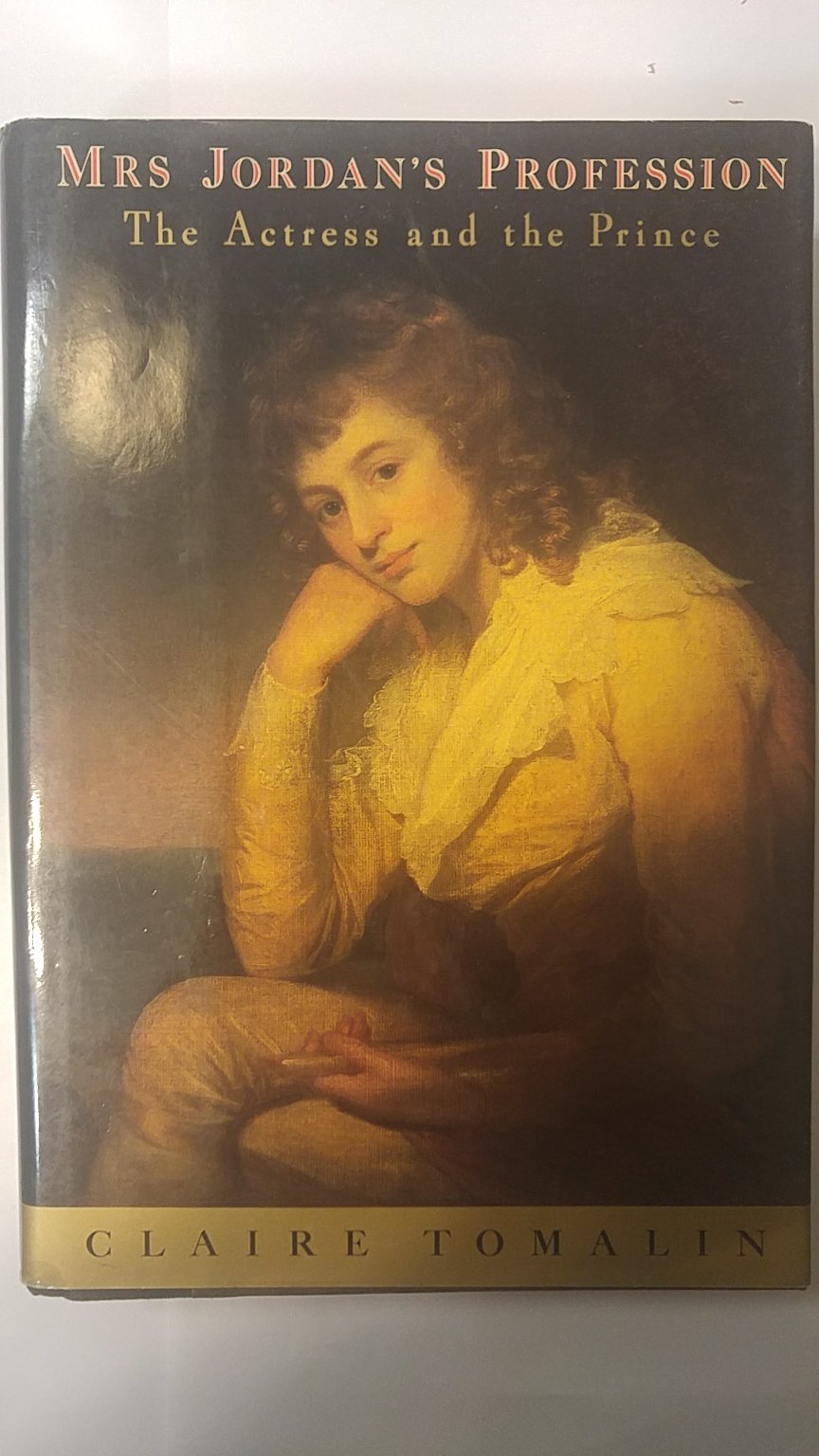



On the London stage ill the late eighteenth century, Dora Jordan was a star, probably the greatest comic actress the British theatre has ever known. Seductive and vivacious. as delightful off-stage as on, she was adored by the public and high society alike. Then, in 1791, she attracted the attentions of Prince William, the Duke of Clarence, third son of King George III. who eventually prevailed upon her to live with him. For more than twenty years. in spite of the attacks of caricaturists and satirists. she was a loyal and loving mate, bearing him ten children, helping to pay his debts out of her earnings as an actress, acting for all intents and purposes as his wife. Yet as Claire Tomalin shows in this brilliant rediscovery of Dora Jordan, the idyll had tragedy at its heart. Under pressure from the royal family and moved by his own ambitions, William abandoned her. For Dora, thrown out of her house, estranged from her children, it was a disaster; she was to die in poverty and loneliness in 1816. And while William evidently regretted the loss of the happiness he had known with her, he went on to marry a German princess and take the throne as King William IV in 1830. When his biography was published in 1884, Dora's name did not even appear in it. As in The Invisible Woman, her prizewinning biography of Dickens's mistress, Nelly Ternan, Claire Tomalin has here retrieved from obscurity a fascinating and important figure. She also offers us insight into an era. For Dora Jordan's tragedy, growing as it did out of the collision and interweaving of two worlds -- the rough and colorful world of the Georgian theatre where she was at home, and the glittering world of the court and the aristocracy, increasingly shadowed by the pall of convention that would define Victoria's reign -- is a vivid reflection of historical change. Yet the story told in Mrs Jordan's Profession is, ultimately, a personal one, a love story with a sad and brutal ending. Its essence lies in the gaiety and charm of Dora singing and joking onstage in Drury Lane, in the accounts of life with the children at 'dear Bushy,' in the notes she wrote to William in the days of happiness and the helpless, mystified letters that followed her dismissal. It is impossible to read without being moved -- and enchanted. Tomalin presents a sympathetically and painstaking docubiography of Dora Jordan (1761-1816), one of the most acclaimed British comic and comi-tragedy actresses of her day, rivaled in abilty only by Mrs. Siddons. Dora's talent, industry, generosity, and loving nature formed her tragic flaw; illegitimate herself, powerlessly taken advantage of by men of higher social status, she attracted Prince William, who became Duke of Clarence, and lived with him as surrogate spouse through 20 years and ten children. Her earnings as an actress staunched his debts. He abandoned her to make a royal marriage, leaving her in poverty and illness in France, where she had fled to avoid debtors' prison for her son-in-law's debts. Upon becoming King William IV in 1830, one of his first acts was to commission a statue of her. Of interest to theater history, women's studies, and culture studies.?Marilyn Gaddis Rose, Univ. of Binghamton, N.Y. Copyright 1995 Reed Business Information, Inc. Distinguished biographer Tomalin traverses an interesting juncture of British theatrical and political history by providing a substantial biography of the famous eighteenth-century actress, Mrs. Jordan, who was also the mistress of the third son of King George III, living openly with him for 20 years and supplying him with 10 illegitimate children. Based largely on Mrs. Jordan's letters, this admirably researched and presented biography limns a life Tomalin admires: an "unmarried working mother," who picked herself up from provincial poverty to enjoy fame on the London stage and association with royalty without ever losing the naturalness that made her such an attractive person. The domestic bliss she shared for so long with Prince William, duke of Clarence (and eventually king as William IV), was shabbily brought to a halt when His Royal Highness, compelled by the rest of the royal family to form a legal union with a suitable (royal, that is) woman, chucked Mrs. Jordan completely, leaving her to die ultimately in despair. Mrs. Jordan is a very worthy subject for such a worthwhile biography as this. Brad Hooper 'This is a riveting biography...[It] conjures up a rich, alluring period which, in its brittle decadence and love of scandal and flamboyance, often seems closer than the nineteenth century to our own times...the wit and razzle-dazzle of Drury Lane...the cat's cradle of partner swapping among the Sheridans, the Royals and Dora recalls Cosi fan tutte...It is the most haunting biography I have read this year.' -- Jackie Wullschlager, Financial Times 'A brilliant book, even better, if possible, than the author's previous study of Dickens's mistress, The Invisible Woman.' -- Anto