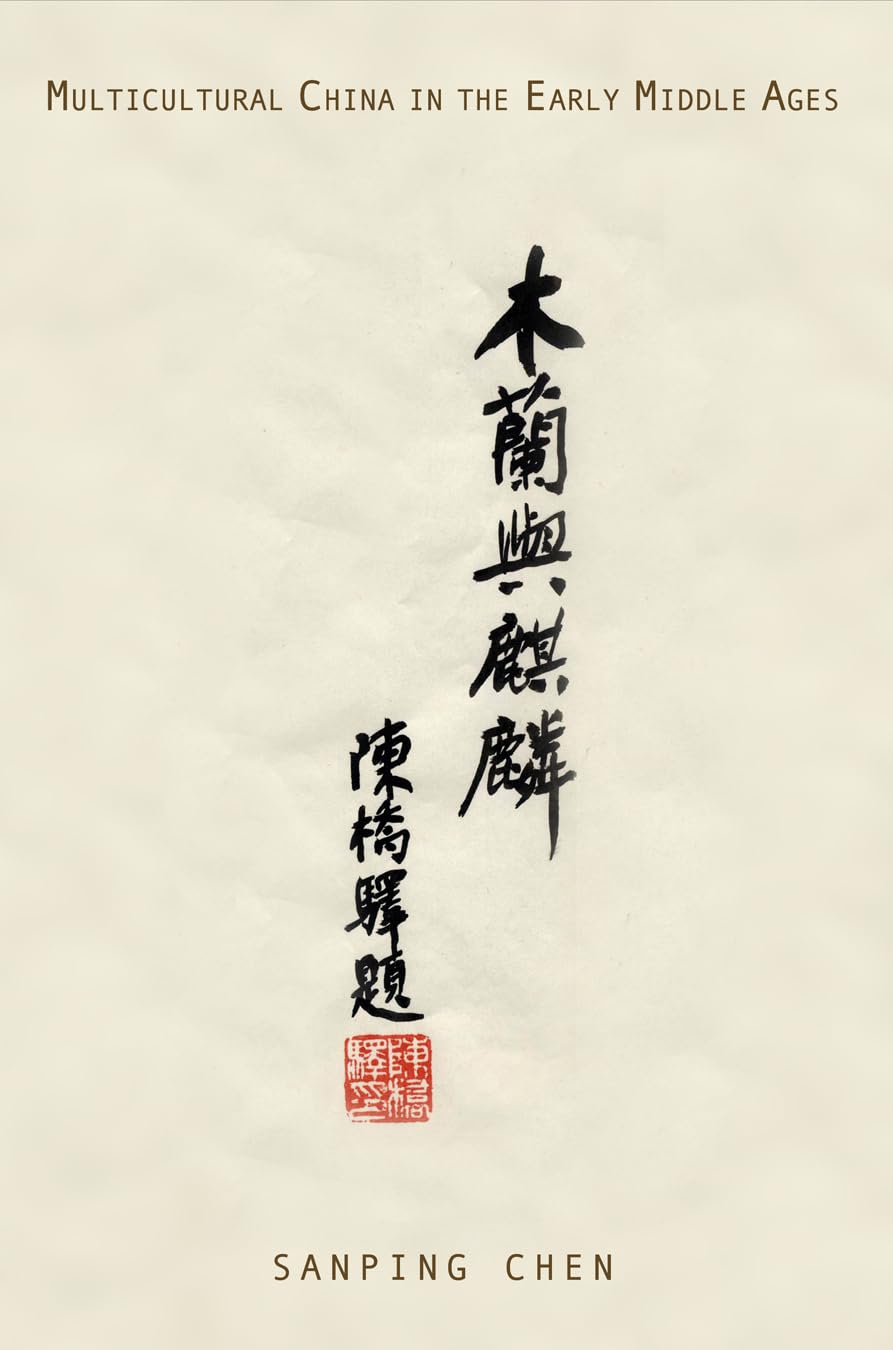



In contrast to the economic and cultural dominance by the south and the east coast over the past several centuries, influence in China in the early Middle Ages was centered in the north and featured a significantly multicultural society. Many events that were profoundly formative for the future of East Asian civilization occurred during this period, although much of this multiculturalism has long been obscured due to the Confucian monopoly of written records. Multicultural China in the Early Middle Ages endeavors to expose a number of long-hidden non-Sinitic characteristics and manifestations of heritage, some lasting to this very day. Sanping Chen investigates several foundational aspects of Chinese culture during this period, including the legendary unicorn and the fabled heroine Mulan, to determine the origin and development of the lore. His meticulous research yields surprising results. For instance, he finds that the character Mulan is not of Chinese origin and that Central Asian influences are to be found in language, religion, governance, and other fundamental characteristics of Chinese culture. As Victor Mair writes in the Foreword, "While not everyone will acquiesce in the entirety of Dr. Chen's findings, no reputable scholar can afford to ignore them with impunity." These "foreign"-origin elements were largely the legacy of the Tuoba, whose descendants in fact dominated China's political and cultural stage for nearly a millennium. Long before the Mongols, the Tuoba set a precedent for "using the civilized to rule the civilized" by attracting a large number of sedentary Central Asians to East Asia. This not only added a strong pre-Islamic Iranian layer to the contemporary Sinitic culture but also commenced China's golden age under the cosmopolitan Tang dynasty, whose nominally "Chinese" ruling house is revealed by Chen to be the biological and cultural heir of the Tuoba. "Sanping Chen's fine new work on the diversity of the first millennium of the Common Era in China is exactly what teachers and scholars of Chinese history need to be reading at the beginning of an even newer millennium. Chen begins with a startling title that immediately shakes the Confucian historiographical cobwebs with its modern sound. . . . Chen's arguments are both penetrating and backed by linguistic evidence and a thorough understanding of the key historical documents of his period." ― History: Reviews of New Books "Chen's work is a useful corrective and provides a nuanced perspective on China's history and culture in the first millennium C.E." ― Peter B. Golden, Rutgers University Sanping Chen is an independent scholar. Foreword Old Wine in New Bottles Victor H. Mair After nearly half a century of isolation, China has recently reemerged as an integral member of the global economy and the international political structure. Since its rise has been so explosive, however, knowledge of Chinese culture and society in other countries is still sketchy and often highly distorted. Indeed, so long and so extraordinarily complicated is the Chinese historical record, and so richly complex is Chinese literature, that modern Chinese citizens themselves are often confused about many details of their nation's past. Virtually everyone has heard of the brave heroine Mulan, who rides off to war (as in the Disney movie), and most of us are familiar with the mythical unicorn that heralds the coming of a sage who will rule justly, yet we see them through a glass darkly. The wonder of this book, Multicultural China in the Early Middle Ages , is that it offers a completely new look at many aspects of Chinese history and culture that heretofore may have seemed bewildering or even absurd. The author of the present volume, Sanping Chen, has the great virtue of being able to examine the past with a fresh eye. He does not take any received text or tradition at face value. Instead, he closely reexamines all the available evidence and subjects secondary interpretations to intense, critical scrutiny. The results of this type of inquiry are frequently surprising and in many cases revelatory. Yet Dr. Chen is not an iconoclast purely for the sake of iconoclasm. Instead, his goal is simply to penetrate the countless layers of obscurity and misrepresentation to get at the truth of what really happened in the past. More than any other Chinese historian that I know of, Sanping Chen is determined to confront historical data directly and without any presuppositions or agenda whatsoever. From lengthy, ongoing discussions with Dr. Chen over the years, I have come to realize that his unusual approach to Chinese history results from deeply held principles. Among these the most important is that the historian is duty bound to report his findings, regardless of their implications. A corollary of this principle is that the historian may not lie about or color what he discovers concerning the past. For Dr. Chen, this becomes a moral imperative, such that he c