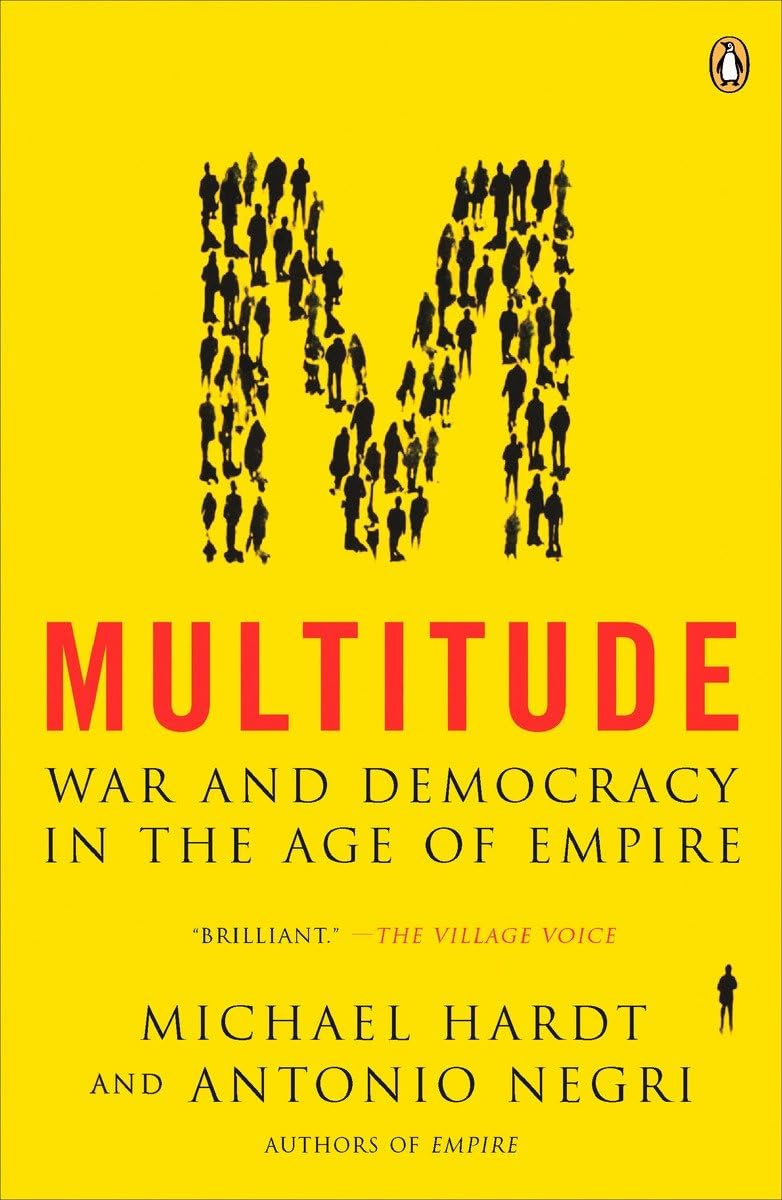



In their international bestseller Empire , Michael Hardt and Antonio Negri presented a grand unified vision of a world in which the old forms of imperialism are no longer effective. But what of Empire in an age of “American empire”? Has fear become our permanent condition and democracy an impossible dream? Such pessimism is profoundly mistaken, the authors argue. Empire, by interconnecting more areas of life, is actually creating the possibility for a new kind of democracy, allowing different groups to form a multitude, with the power to forge a democratic alternative to the present world order.Exhilarating in its optimism and depth of insight, Multitude consolidates Hardt and Negri’s stature as two of the most important political philosophers at work in the world today. "This timely book brings together myriad loose strands of far left thinking with clarity, measured reasoning and humor." — Publishers Weekly , starred "Impressive… a rare and exciting work of synthesis." — Booklist , starred review "Brilliant." — The Village Voice "An inspiring marriage of realism and idealism." — Naomi Klein , author of No Logo Michael Hardt is a professor in the literature program at Duke University. Antonio Negri is an independent researcher and writer and a political prisoner recently released from house arrest in Rome, Italy. He has been a lecturer in political science at the University of Paris and professor of political science at the University of Padua. The possibility of democracy on a global scale is emerging today for the very first time. This book is about that possibility. It is about what we call the project of the multitude. The project of the multitude not only expresses the desire for a world of equality and freedom, not only demands an open and inclusive democratic global society, but also provides the means for achieving it. That is how our book will end, but it cannot begin there. The possibility of democracy is obscured and threatened today by the seemingly permanent state of conflict across the world. Our book must begin with this state of war. Democracy, it is true, remained an incomplete project throughout the modern era in all its national and local forms, and certainly the processes of globalization in recent decades have added new challenges, but the primary obstacle to democracy today is the global state of war. In our era of armed globalization, in fact, the modern dream of democracy may seem to have been definitively lost. War has always been incompatible with democracy. Traditionally, democracy has been suspended during wartime and power confided temporarily in a strong central authority to confront the crisis. When today the state of war is not only global in scale but also long-lasting, with no end in sight, then the suspension of democracy also becomes indefinite or even permanent. Democracy thus appears to be entirely irretrievable, buried deep beneath the weapons and security regimes of our global state of war. Never has democracy been more necessary than today, in this situation of global conflict. No other path will provide a way out of the fear, insecurity, and domination that permeate our world at war; no other path will lead us to a peaceful life in common. Democracy, it would seem, has never been more impossible or more necessary. This book is the sequel to our book Empire , which focused on the new, global form of sovereignty. That book attempted to interpret the tendency of global political order in the course of its formation; that is, to recognize how, from a variety of contemporary processes, a new form of global order is emerging that we call empire. Our point of departure was the recognition that contemporary global order can no longer be understood adequately in terms of imperialism as it was practiced by the modern powers, based primarily on the sovereignty of the nation-state extended over foreign territory. Instead, a “network power,” a new form of sovereignty, is emerging today that includes as its primary elements, or nodes, the dominant nation-states along with supranational institutions, major capitalist corporations, and other powers. This network power we claim is “imperial,” not “imperialist.” Not all the powers in empire’s network, of course, are equal. On the contrary, some nation-states have enormous power and some almost none at all, and the same is true for the various other corporations and institutions that make up the network—but despite inequalities they must cooperate together to create and maintain the current global order along with all of its internal divisions and hierarchies. Our notion of empire thus cuts diagonally across the debates that pose unilateralism and multilateralism or pro-Americanism and anti-Americanism as the only global political alternatives. On the one hand, we argued that no nation-state, not even the most powerful one, not even the United States, can “go it alone” and maintain global order without collaborating with the