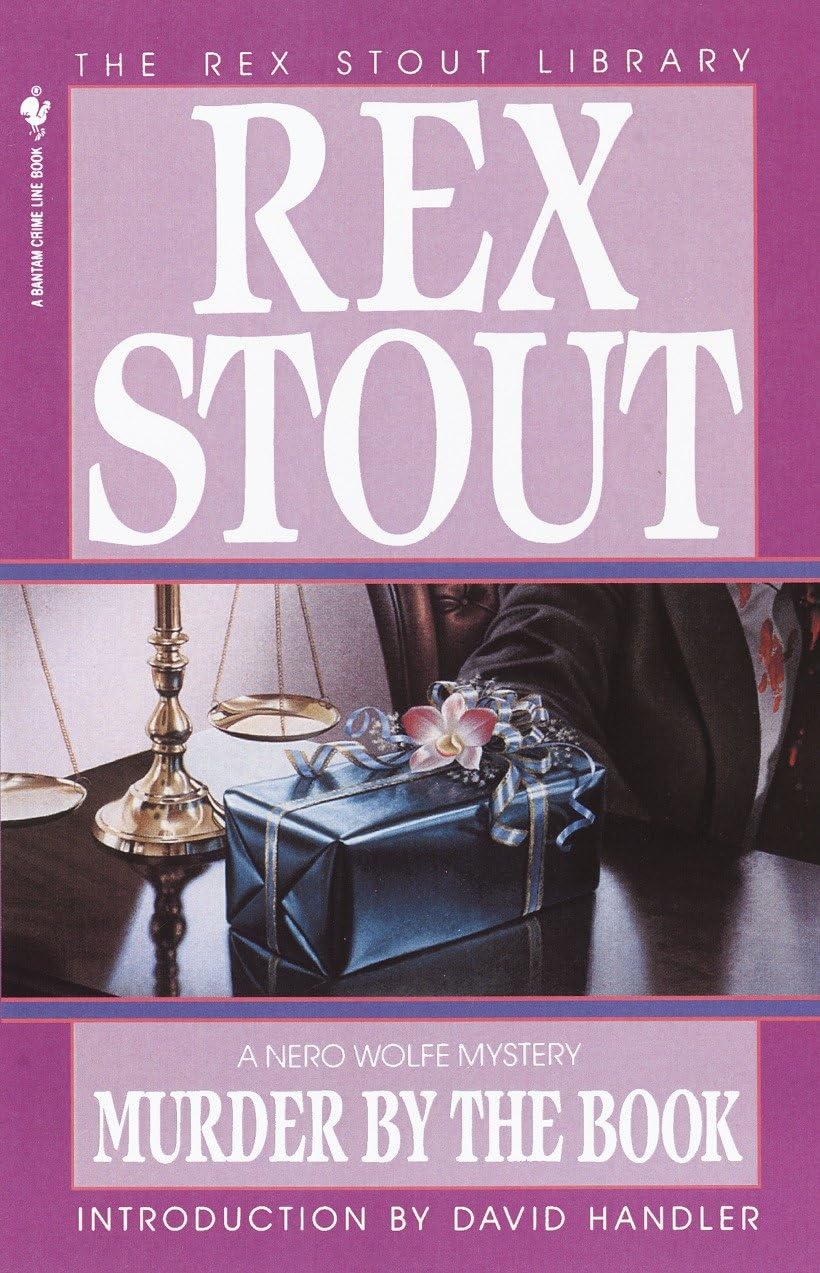



“It is always a treat to read a Nero Wolfe mystery. The man has entered our folklore.”— The New York Times Book Review Introduction by David Handler It wasn’t Leonard Dykes’s writing style that offended. But something in his unpublished tome seemed to lead everyone who read it to a very unhappy ending. Now four people are dead, including the unfortunate author himself, and the police think Nero Wolfe is the only man who can close the book on this novel killer. So the genius sleuth directs his sidekick to set a trap . . . and discovers that the truth is far stranger—and far bloodier—than fiction. A grand master of the form, Rex Stout is one of America’s greatest mystery writers, and his literary creation Nero Wolfe is one of the greatest fictional detectives of all time. Together, Stout and Wolfe have entertained—and puzzled—millions of mystery fans around the world. Now, with his perambulatory man-about-town, Archie Goodwin, the arrogant, gourmandizing, sedentary sleuth is back in the original seventy-three cases of crime and detection written by the inimitable master himself, Rex Stout. “It is always a treat to read a Nero Wolfe mystery. The man has entered our folklore.” — The New York Times Book Review Rex Stout (1886–1975) wrote dozens of short stories, novellas, and full-length mystery novels, most featuring his two indelible characters, the peerless detective Nero Wolfe and his handy sidekick, Archie Goodwin. Chapter 1 Something remarkable happened that cold Tuesday in January. Inspector Cramer, with no appointment, showed up a little before noon at Nero Wolfe’s old brownstone on West Thirty-fifth Street and, after I had ushered him into the office and he had exchanged greetings with Wolfe and lowered himself into the red leather chair, he said right out, “I dropped in to ask a little favor.” What was remarkable was his admitting it. From my chair at my desk I made an appropriate noise. He sent me a sharp glance and asked if I had something. “No, sir,” I told him courteously, “I’m right on top. You just jolted that out of me. So many times I’ve seen you come here for a favor and try to bull it or twist it, it was quite a shock.” I waved it away tolerantly. “Skip it.” His face, chronically red, deepened a shade. His broad shoulders stiffened, and the creases spreading from the corners of his gray-blue eyes showed more as the eyelids tightened. Then, deciding I was playing for a blurt, he controlled it. “Do you know,” he asked, “whose opinion of you I would like to have? Darwin’s. Where were you while evolution was going on?” “Stop brawling,” Wolfe muttered at us from behind his desk. He was testy, not because he would have minded seeing either Cramer or me draw blood, but because he always resented being interrupted in the middle of a London Times crossword puzzle. He frowned at Cramer. “What favor, sir?” “Nothing strenuous.” Cramer relaxed. “A little point about a homicide. A man’s body fished out of the East River a week ago yesterday, off Ninetieth Street. He had been—” “Named Leonard Dykes,” Wolfe said brusquely, wanting to make it brief so he could finish the puzzle before lunch. “Confidential clerk in a law office, around forty, had been in the water perhaps two days. Evidence of a severe blow on the head, but had died of drowning. No one charged by last evening. I read all the homicide news.” “I bet you do.” That having slipped out by force of habit, Cramer decided it wasn’t tactful and smiled it off. He could smile when he wanted to. “Not only is no one charged, we haven’t got a smell. We’ve done everything, you know what we’ve done, and we’re stopped. He lived alone in a room-and-bath walk-up on Sullivan Street. By the time we got there it had been combed—not torn apart, but someone had been through it good. We didn’t find anything that’s been any help, but we found one thing that might possibly help if we could figure it out.” He got papers from his breast pocket, from them selected an envelope, and from the envelope took a folded sheet of paper. “This was inside a book, a novel. I can give you the name of the book and the numbers of the pages it was found between, but I don’t think that has a bearing.” He got up to hand the paper to Wolfe. “Take a look at it.” Wolfe ran his eyes over it, and, since I was supposed to be up on everything that went on in that office so as to be eligible for blame if and when required, I arose and extended a hand. He passed it over. “It’s in Dykes’s handwriting,” Cramer said. “The paper is a sheet from a scratch pad there on a table in his room. There were more pads like it in a drawer of the table.” I was giving it a look. The paper was white, ordinary, six by nine, and at the top was the word “Tentative,” underscored, written with pencil in a neat almost perpendicular hand. Below it was a list of names: Sinclair Meade Sinclair Sampson Barry Bowen David Yerkes Ernest Vinson Dorian Vick Baird Arc