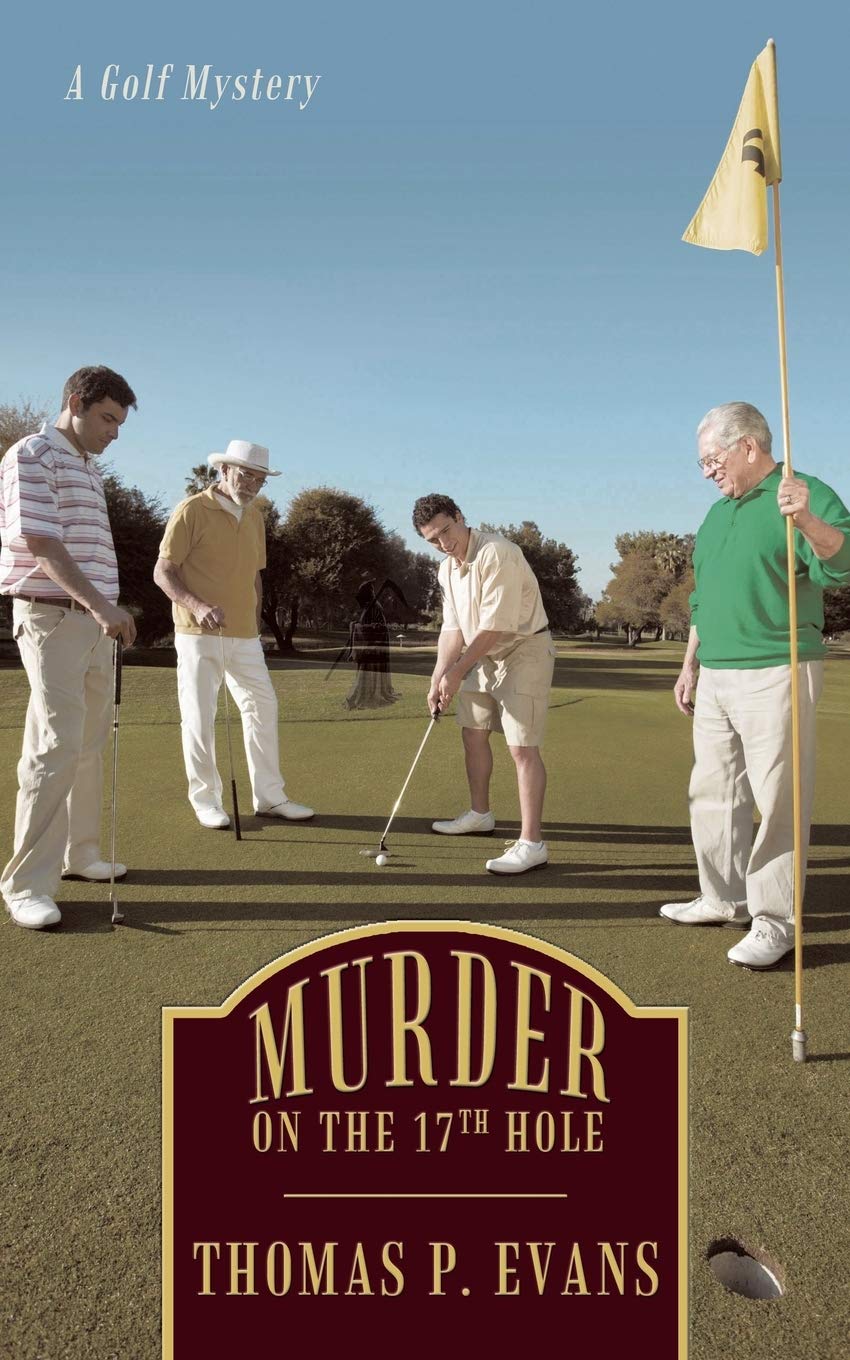



Web Miter is a retired business guru and a former Ceo of United Eastern, one of the largest corporations in the country. He's playing in a foursome in the Hartford Pro-Am, a Pga tour stop in the small town of Lordship, Connecticut, with pro golfer John Rollings. The best round of Miter's life ends tragically when an explosion rocks the seventeenth hole. Is it a random killing by golf terrorists, or is it a calculated murder committed by one of Miter's enemies? As Alco Insurance Company investigator Wayne Sedlock sifts through Miter's past, the list of suspects runs the gamut and includes an anti-outsourcing group, an Indian tribe jockeying for a new casino, and a group of ex-Marines who served with Miter in Vietnam. A crime that breaks new ground, Sedlock and Detective Richard Geany of Lordship, Connecticut, Police Department, sift through all of the clues to determine who had the motive and means to murder Miter on the course. Tom Evans recently retired after a 33-year career as a contract computer programmer in southern New England. He has also written 'Home from the War' and 'A Poverty of Thoughts.' Murder on the 17th Hole is his first work of fiction. He lives in southern Connecticut, and occasionally breaks 100 on the golf course. Murder On The 17th Hole A Golf Mystery By Thomas P. Evans iUniverse, Inc. Copyright © 2010 Thomas P. Evans All rights reserved. ISBN: 978-1-4502-0906-9 CHAPTER 1 Pro-Am The dream woke John Rollings almost every night. He couldn't read a putt ... He squatted and plumb-bobbed, closed one eye, then the other. He tried lining up the putt from off the green, then from just behind the ball. He adjusted for green's speed, told himself to aim two inches outside left of the cup and stroke it firm. In the dream, some mysterious caddy crouched behind him. "Everything breaks toward Indio," the caddy said confidently. "Dead center, slam-dunk it." When John turned to see who the caddy was, the caddy's face disappeared. What does he mean Indio? John thought. We're on the East Coast. It wasn't John's regular caddy, Chump. He took his putting stance, but he couldn't pull the trigger. John stood over his ball so long a PGA official showed up in his white shirt and bow tie. "Too much time," he said. "Two stroke penalty on Rollings." Then John sat upright in bed. He was sweating in his air- conditioned motel room. It was 3:18 A.M. His starting time in the Hartford Pro-Am was 10:32 A.M. Seven hours until tee time. A half hour before their starting time the 10:32 group was on the driving range warming up. Each of the three amateurs in the group had paid $6000 to play a round of golf with a PGA professional. Each of the three also had a caddy, as there were no golf carts allowed. "I'm Chump," a middle-aged, stocky caddy said by way of introduction. He wore a yellow shirt panel with "ROLLINGS" embroidered across the back of it. He walked down the line and shook hands with the amateurs. "I'm John Rollings's caddy and you may as well know where I got my name. My real name is Philip Williams, but when I started out caddying twenty years ago I always complained about the `chump change' caddies made on the tour back then. They shortened it to Chump and that's been my name ever since. You'll find John easy to play with. He enjoys giving the amateurs some pointers. It doesn't bother his game at all. But don't you be giving him pointers. He's been on the Tour for twenty years. You'll see. It'll be a very enjoyable round." Just then John Rollings showed up on the driving range. After playing hundreds of Pro-Ams over the years he'd found it was better if his caddy set the amateurs straight about what behavior of theirs could derail his round. John found it paid to keep on the good side of the amateurs. He was what they called a journeyman in the PGA golfing world. He had made a decent living hitting a golf ball, but he wasn't anywhere near the top golfers in earnings, many of whom flew from tournament to tournament in their private jets. But John found that many of the amateurs he played with were corporate executives, and often their companies owned corporate jets. More than once in years past one of his East Coast playing partners had his corporation's jet fly John and Chump to Florida or the West Coast. In fact one corporate president played as John's Pro-Am partner for ten years straight on a West Coast tour stop, and had his driver shuttle John and Chump anywhere they wanted to go when they were in town. John knew it paid to stay on the good side of the amateurs. Rollings shook hands with each of his amateur playing partners. There was Carl Buffsky, a short, balding man of about fifty who owned a machine shop in New Britain, who was an enthusiastic golfer, although with an 18 handicap, not a very good one. Unusual in Pro-Am events because he was so young was Jason Sombery, a recent graduate of Western Connecticut State, who carried a respectable two handicap. The only amateur appro