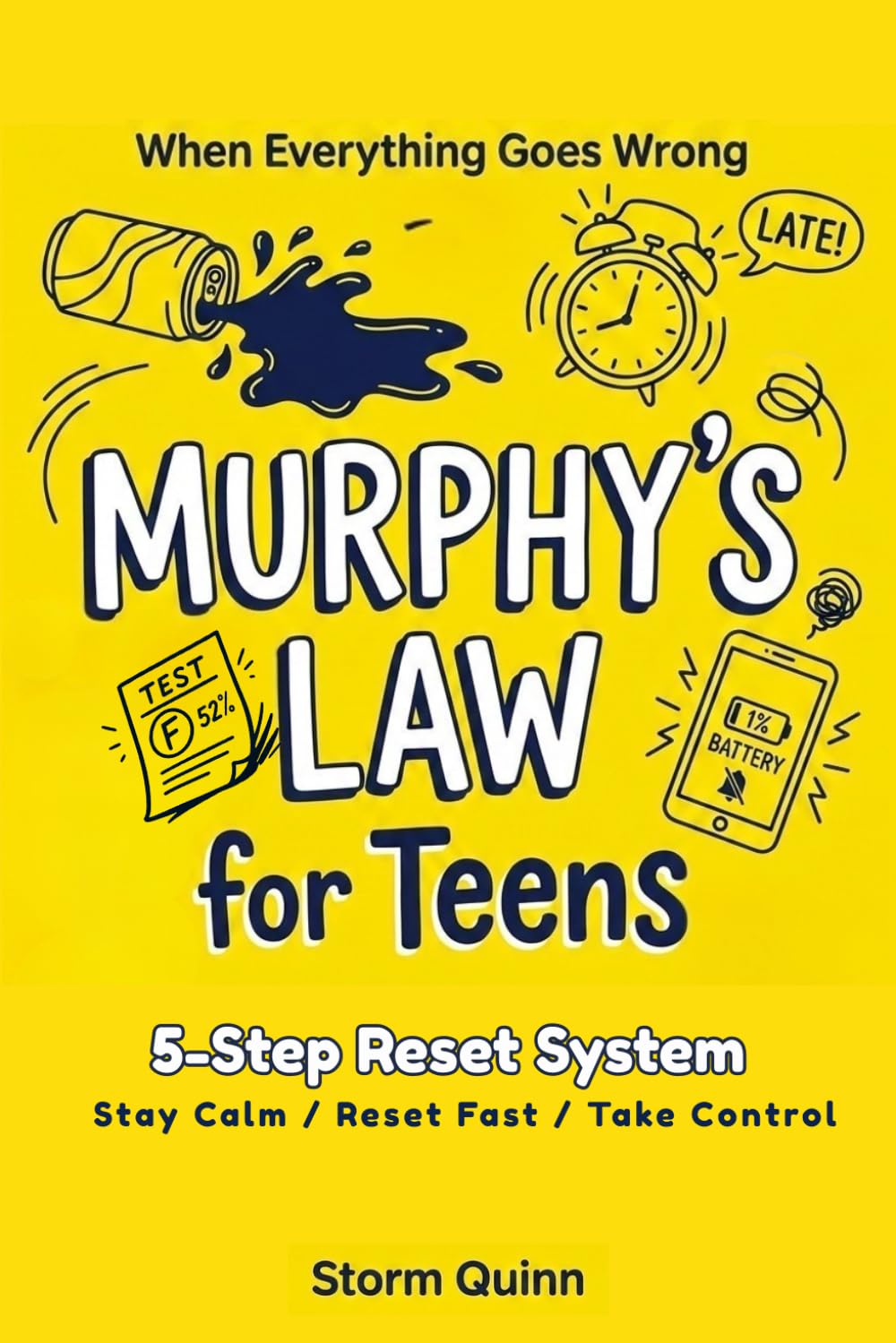
Murphy's Law for Teens: Practical Life Principles to Stay Calm, Reset Fast, and Take Control of Stress and Overthinking When Everything Goes Wrong
$14.99
by Storm Quinn



What do you do when everything goes wrong at once? You forget an important test. Your post gets ignored. The group chat goes silent. Your mind won’t stop overthinking at 2 AM. Everything feels out of control. Murphy’s Law for Teens gives you a clear, practical way to take control when things go wrong. This is not about avoiding problems. It’s about knowing exactly what to do when they happen. Inside this book, you’ll discover practical life principles and simple tools to help you: Stop overthinking fast and regain control - Stay calm under pressure and stressful situations - Reset your mind in seconds when everything spirals - Handle school, social pressure, and mistakes with clarity - Think clearly and make better decisions in real time At the core of the book is the Murphy Reset Method — a simple 5-step system you can use anytime life doesn’t go as planned. Each chapter includes: Real-life teen situations you instantly recognize - Clear explanations without complicated psychology - Practical tools you can actually use - A “use this in 60 seconds” section for immediate results This is not a book you read once and forget. It’s a tool you use when everything starts going wrong. You don’t need perfect decisions. You need a way to reset, refocus, and move forward. If you struggle with overthinking, stress, or feeling overwhelmed, this book gives you a system that works. Start now. Life does not wait until you feel ready. For teens, stress rarely shows up one problem at a time. It piles up. A mistake at school turns into overthinking. A bad conversation turns into self-doubt. One awkward moment can replay in your mind all night. When that happens, most advice feels either too vague, too complicated, or too far removed from real life. I wrote Murphy's Law for Teens to be different. This book is built for the moments when life feels messy, unfair, loud, and out of control. It does not ask teens to be perfect, always positive, or endlessly motivated. Instead, it gives them a practical way to pause, reset, think clearly, and move forward when things go wrong. At the heart of the book is a simple idea: you may not control every situation, but you can learn how to respond with more calm, clarity, and confidence. Inside, readers will find: relatable teen situations instead of abstract theory - practical tools they can use at school, at home, and in social situations - short, clear explanations without heavy jargon - a repeatable reset process for stressful moments - immediate-use takeaways that help in real time I wanted this book to feel useful, direct, and encouraging. Something a teen can actually reach for after a bad day, before a stressful conversation, or during a spiral of overthinking. Not just a book that sounds good on a shelf, but one that earns its place by helping when it matters. If you are a teen reading this, my hope is simple: you realize that one bad moment does not define you, one mistake does not ruin everything, and stress does not have to run your life. If you are a parent, family member, or gift-giver, I hope this book becomes a practical support tool that helps the teen in your life feel more grounded, capable, and understood. When everything feels like it is going wrong, the goal is not to panic faster. The goal is to reset faster. That is what this book is here to help with. Q&A Q: Who is this book for? A: This book is written for teens who deal with stress, overthinking, pressure, frustration, and moments when life feels like it is spiraling. It is especially helpful for readers who want practical tools, not long lectures. Q: What age range is this best for? A: It is best suited for teens and young adults, especially middle school and high school readers who are learning how to manage pressure, emotions, mistakes, and everyday challenges with more clarity. Q: Is this a therapy book or a clinical mental health guide? A: No. This is not a clinical workbook or a substitute for professional support. It is a practical self-help guide with simple life principles and reset tools teens can use in everyday situations. Q: What kinds of problems does the book talk about? A: The book covers situations teens often recognize immediately: school pressure, social stress, awkward moments, mistakes, emotional overload, second-guessing, and late-night overthinking. Q: What makes this different from other teen self-help books? A: The focus is on practical use. The book keeps explanations simple, uses relatable scenarios, and gives readers tools they can apply quickly instead of offering abstract motivation that fades after one chapter. Q: What is the Murphy Reset Method? A: It is the core framework in the book: a simple step-by-step way to stop the spiral, regain perspective, and respond more clearly when something goes wrong. It is designed to be easy to remember and realistic to use. Q: Is this book written in a way teens will actually read? A: Yes. The tone is direct