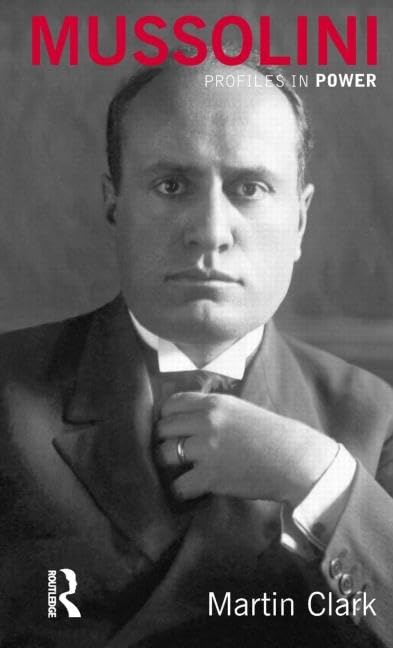



Benito Mussolini was a brilliant Socialist journalist who in 1914 declared war, put himself at the head if the anti-Socialist movement in Italy, manoeuvred himself into power by 1933 and ruled the country until overthrown in 1943. He was a dynamic but insecure personality, who appeared dictatorial but always had to share power with the military and bureaucratic establishment. Mussolini founded an Empire in Africa and tried to 'make Italians' in his own heroic, war like image, but in fact failed to even control his own family! In June 1940, when France fell, he could not resist joining in the Second World War on the German side, although Italy was not equipped for serious fighting. His rule ended in Military disaster and personal humiliation. This new biography focuses both on Mussolini's personality and on the way he exercised power, and regards these two issues as closely linked. It sees him as a man with all the talents needed to attain power but few of those needed to exercise it well. This book primarily focuses on how Mussolini had absolutely the wrong personality for a successful political leader. '...a highly readable account, packed with information, full of references to present-day politics and with a fair number of light-hearted asides to the reader. Clark is a master of the moderating synthesis and has no place for moral outrage.' Paul Corner, Journal of Modern Italian Studies 2006 Mussolini is remembered as one of the two most important Fascist dictators of the twentieth century. He seized power in Italy in 1922 and ruled the country until overthrown in 1943. But his rule ended in military disaster and personal humiliation, and he was executed by anti-Fascist partisans in 1945. This readable and witty biography focuses both on Mussolini¿s personality and on the way he exercised power, and regards these two issues as closely linked. It: Considers him as a man with all the talents needed to attain power but few of those needed to exercise it well in the long run. Indeed, he had absolutely the wrong personality for a successful political (and a fortiori military) leader. He was a dynamic but insecure man, who appeared dictatorial but always had to share power with the military and bureaucratic Establishment, and greatly resented the fact. - Reflects on the nature of government and on how things work in modern societies, and on how far politics and individuals make a difference. - Argues that Mussolini¿s appeal rested on embodying robust masculine virtues ¿ courage, responsibility, patriotism ¿ that are now distinctly old-fashioned, but still have very widespread support. That is why his admirers still regard him as the ¿Last Man in Europe¿ On the 60th anniversary of Mussolini¿s death, Martin Clark¿s portrayal of the Fascist dictator¿s leadership bears a striking resemblance to the rule of contemporary politicians, obsessed by media spin and short-term triumphs at home and abroad. Clark argues that Mussolini pioneered a ¿mediacracy¿ ¿ rule by journalists attempting to ensure that all social institutions, and even the private sphere, conform to government dictates. The Fascist stress on political correctness may have been quite different in subject-matter from today¿s, but was similar in its attempts to make certain extremely common things unsayable and even unthinkable. Martin Clark is former Reader in Politics at the University of Edinburgh. He is author of many books on Italian history, including Longman titles Modern Italy 1871-1995 and The Italian Risorgimento . Martin Clark