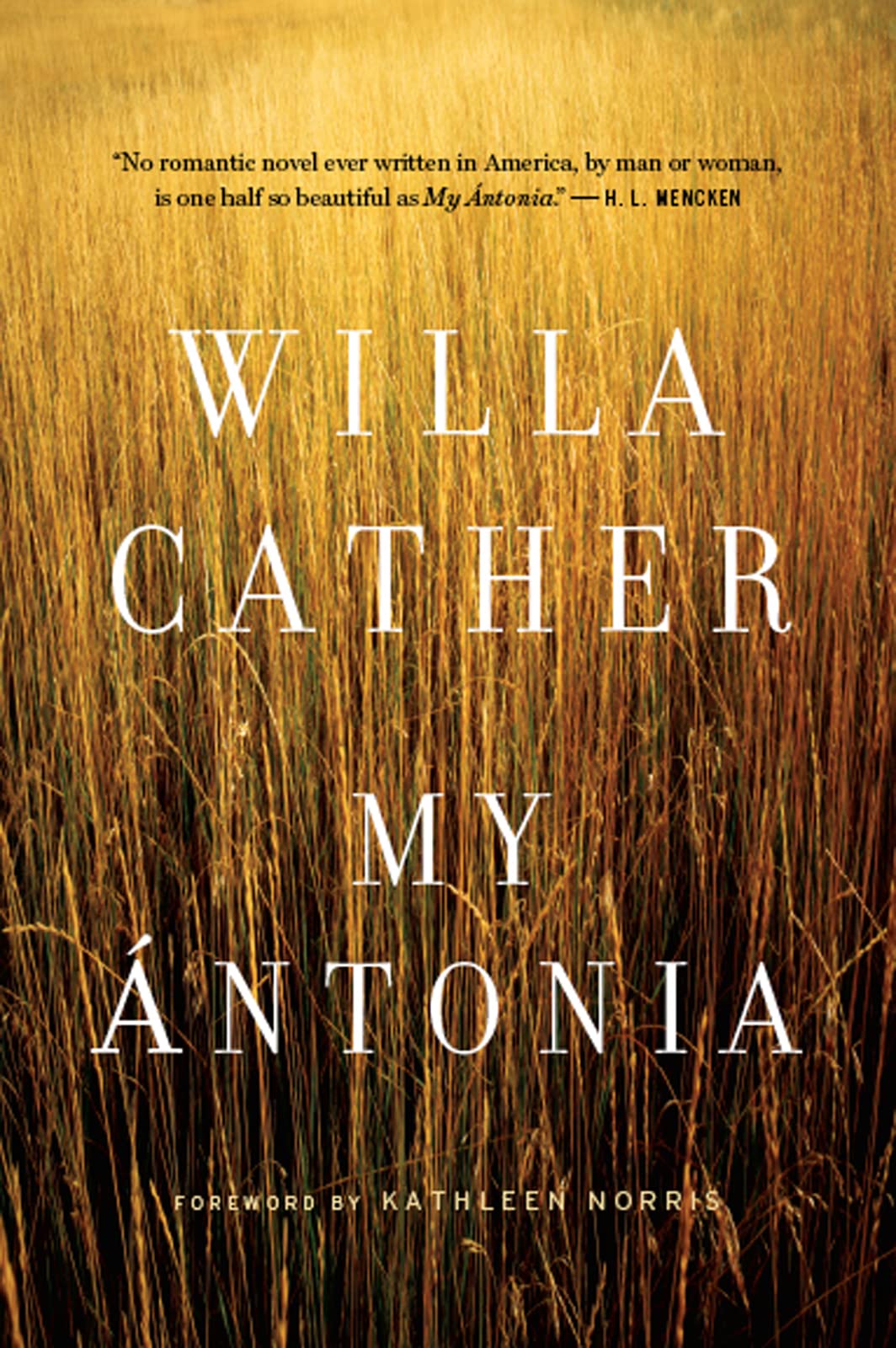
My Antonia: A Timeless American Classic About an Immigrant Woman's Life on the Nebraska Plains
$6.07
by Willa Cather



One of the most significant American novels of the twentieth century, Willa Cather’s heartfelt novel is the unforgettable story of an immigrant woman’s life on the hardscrabble Nebraska plains. Through Jim Burden’s affectionate reminiscence of his childhood friend, the free-spirited Ántonia Shimerda, a larger, uniquely American portrait emerges, both of a community struggling with unforgiving terrain and of a woman who, amid great hardship, stands as a timeless inspiration. With a Foreword by Kathleen Norris It seems almost sacrilege to infringe upon a book as soulful and rich as Willa Cather's My Ántonia by offering comment. First published in 1918, and set in Nebraska in the late 19th century, this tale of the spirited daughter of a Bohemian immigrant family planning to farm on the untamed land ("not a country at all but the material out of which countries are made") comes to us through the romantic eyes of Jim Burden. He is, at the time of their meeting, newly orphaned and arriving at his grandparents' neighboring farm on the same night her family strikes out to make good in their new country. Jim chooses the opening words of his recollections deliberately: "I first heard of Ántonia on what seemed to be an interminable journey across the great midland plain of North America," and it seems almost certain that readers of Cather's masterpiece will just as easily pinpoint the first time they heard of Ántonia and her world. It seems equally certain that they, too, will remember that moment as one of great light in an otherwise unremarkable trip through the world. Ántonia, who, even as a grown woman somewhat downtrodden by circumstance and hard work, "had not lost the fire of life," lies at the center of almost every human condition that Cather's novel effortlessly untangles. She represents immigrant struggles with a foreign land and tongue, the restraints on women of the time (with which Cather was very much concerned), the more general desires for love, family, and companionship, and the great capacity for forbearance that marked the earliest settlers on the frontier. As if all this humanity weren't enough, Cather paints her descriptions of the vastness of nature--the high, red grass, the road that "ran about like a wild thing," the endless wind on the plains--with strokes so vivid as to make us feel in our bones that we've just come in from a walk on that very terrain ourselves. As the story progresses, Jim goes off to the University in Lincoln to study Latin (later moving on to Harvard and eventually staying put on the East Coast in another neat encompassing of a stage in America's development) and learns Virgil's phrase " Optima dies ... prima fugit " that Cather uses as the novel's epigraph. "The best days are the first to flee"--this could be said equally of childhood and the earliest hours of this country in which the open land, much like My Ántonia , was nothing short of a rhapsody in prairie sky blue. --Melanie Rehak "My Ántonia is about how travel transforms us, for better or worse. ...The vast American landscape seems to have imprinted itself on Cather’s soul and prose: Her plainspoken sentences, free of modifying flourishes, take the shape of the land itself. You can almost hear the wind beneath the words." - Wall Street Journal, Mary Morris “No romantic novel ever written in America, by man or woman, is one half so beautiful as My Ántonia ." - H. L. Mencken "For the beauty of the writing, I would say that my go-to is actually My Antonia by Willa Cather, which is a book I first read in high school and found slightly boring but beautiful, and then read again in my 20s and was just totally enraptured by and then have gone back to again and again and again as a beautiful piece of writing" - Rebecca Traister An enduring literary masterpiece first published in 1918, this hauntingly eloquent classic is an inspiring reminder of the rich past we have inherited. Willa Cather's lustrous prose, infused with a passion for the land, summons forth the hardscrabble days of the immigrant pioneer woman on the Nebraska plains, while etching a deeply moving portrait of an entire community. As Jim Burden revisits his childhood friendship with the free-spirited Antonia Shimerda, we come to understand the sheer fortitude of homesteaders on the prairie, the steadfast bonds cultivated there, and the abiding memories that such vast expanses inspire. Holding the pastoral society's heart, of course, is the bewitching Antonia, whose unfailing industry and infectious enthusiasm for life exemplify the triumphant vitality of an era. WILLA CATHER (1873–1947), the Pulitzer Prize–winning author of more than fifteen books, was one of the most distinguished American writers of the early twentieth century. My Antonia By Willa Silbert Cather Mariner Books Copyright © 1995 Willa Silbert Cather All right reserved. ISBN: 039575514X Chapter One I first heard of Ántonia on what seemed to me an i