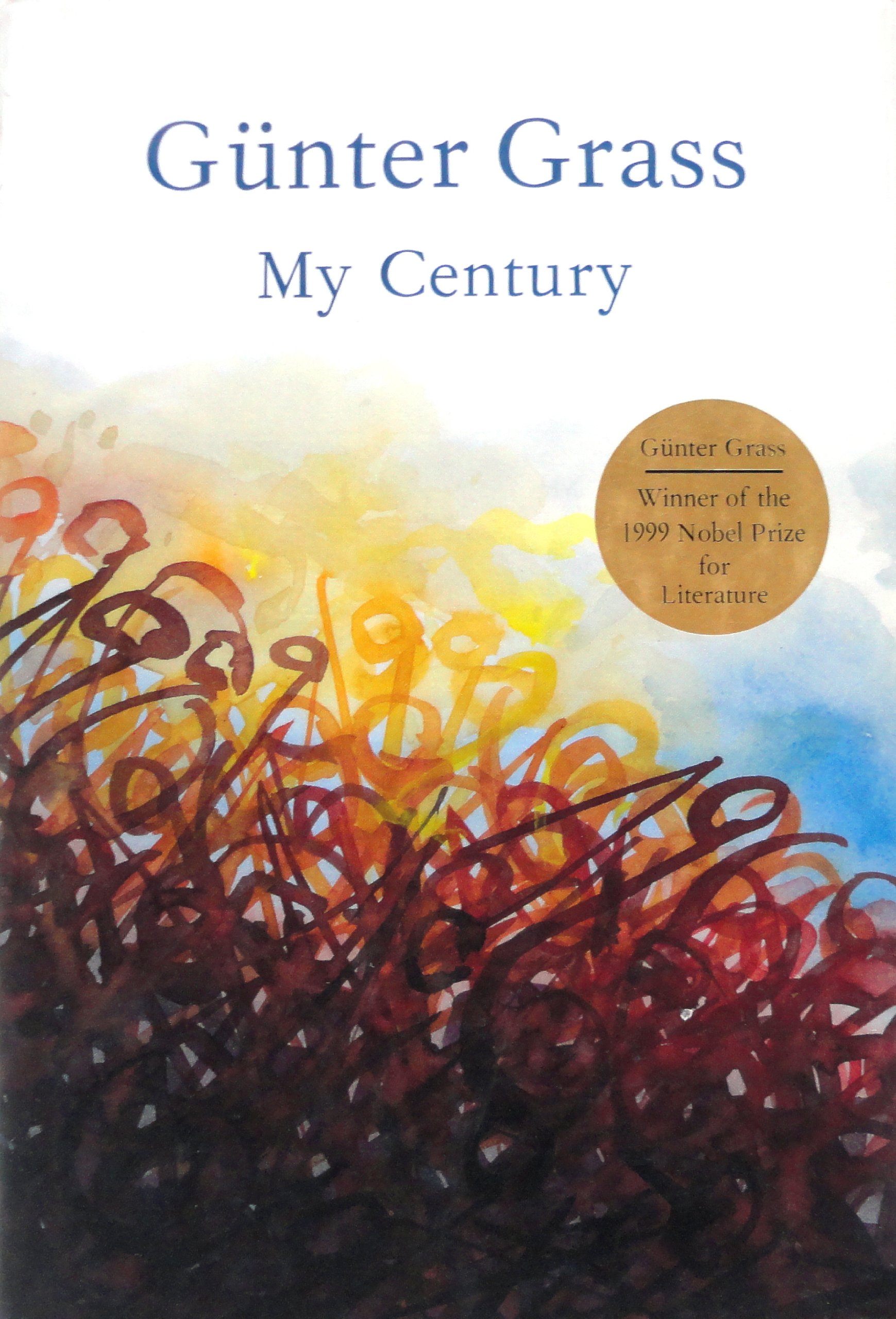



Germany's most critically acclaimed writer presents his latest collection of stories--one for every year of this century, offering an interlocking history of murder, war, wondrous technological achievement, persecution, athletic prowess, scientific advancement, and megalomania. 25,000 first printing. Perhaps it's fitting that the 1999 winner of the Nobel Prize for literature, Günter Grass, should be the one to see the old millennium out in style. His My Century is comprised of 100 short chapters, one for each year of the 20th century, each told by a different narrator. And of course, since Grass is German, the century he refers to is German as well--a fact that could prove a little daunting to readers not familiar with the intricacies of that country's history. "1900," for example, throws us smack in the middle of the Chinese Boxer Rebellion from a German soldier's point of view. "1903" jumps us into the head of a young student who, clad in a new boater, admires the first Zeppelin, buys a copy of Thomas Mann's latest book, Buddenbrooks , and attends the launching of the world's largest ship, Imperator , among other historical events. "1904" is concerned with a miners' strike and "1906" is all about German-Moroccan foreign relations. Yet as year succumbs to year and one narrative voice piles on top of the next, My Century becomes more than the sum of its parts. And Grass always manages to surprise. The chapters "1914" through "1918," for example, rather than being narrated by the usual suspects--young soldiers in the trenches, worried mothers at home, embittered war widows or shell-shocked veterans--are relayed by a '60s-era young woman who brings two great German chroniclers of the war together. As the now-elderly Erich Maria Remarque ( All Quiet on the Western Front ) and Ernst Jünger ( On the Marble Cliffs ) meet and spar over the course of several meals, their reminiscences of the Great War present two radically different views. Jünger, for example, says: "I can state without compunction: As the years went by, the flame of the prolonged battle produced an increasingly pure and valiant warrior caste..." Remarque's response is to laugh in Jünger's face: Come on, Jünger! You sound like a country squire. Cannon fodder quaking in oversized boots--that's what they were. Animals. All right, maybe they were beyond fear, but death never left their minds. So what could they do? Play cards, curse, fantasize about spread-eagled women, and wage war--murder on command, that is. Which took some expertise. They discussed the advantages of the shovel over the bayonet: the shovel not only let you thrust below the chin; it gave you a good solid blow, on the diagonal, say, between neck and shoulder, which then cut right down to the chest, while the bayonet tended to get caught between the ribs and you had to go all the way up to the stomach to pull it loose. It may be Remarque and Jünger talking, but the prose is pure Grass. The years leading up to and including World War II are narrated by a variety of voices: a communist in a forced-labor camp in 1936; a schoolboy "playing" Spanish Civil War with his classmates in 1937. The events of Kristallnacht, November 9, 1938, become inextricably linked with the November 9, 1989, fall of the Berlin Wall, as a German schoolteacher gets in trouble with the Parent-Teacher Association for his "obsession with the past." Indeed, it is the way Grass mixes past and present, the voices of the famous and the ordinary, that lends such power to My Century ; and by the time he brings the reader up to the last weird and wonderful chapter, his century has become ours as well. --Alix Wilber The most recent recipient of the Nobel prize, Grass here offers a collection of stories, which, though not exactly linked, coalesce to form a unified vision of the 20th century. The title's simultaneous aspirations to both sweeping grandeur and a highly individual story are artfully maintained in the text. Each year is represented by a two- or three-page vignette, each told by a different anonymous narrator. The plots of the pieces are small to nonexistent, the sorts of musings and memories one turns over while riding a subway or rummaging through an attic. And, truth be told, they are not always completely engaging when read scattershot or with pauses between chapters. By book's end, however, they amount to a kinetic vision of a city square--unknown people filled with personal preoccupations come together to form a shifting pattern recognized only by the reader endowed with a bird's-eye view. A fine addition to literary fiction collections in both public and academic libraries. -Eric Bryant, "Library Journal" Copyright 2000 Reed Business Information, Inc. The conceit Grass has adopted is not without possibilities, but he fails to realize them. -- The New York Times Book Review , Peter Gay Gunter Grass, born in Danzig, Germany, in 1927, is Germany's most celebrated contemporary writer. He is a