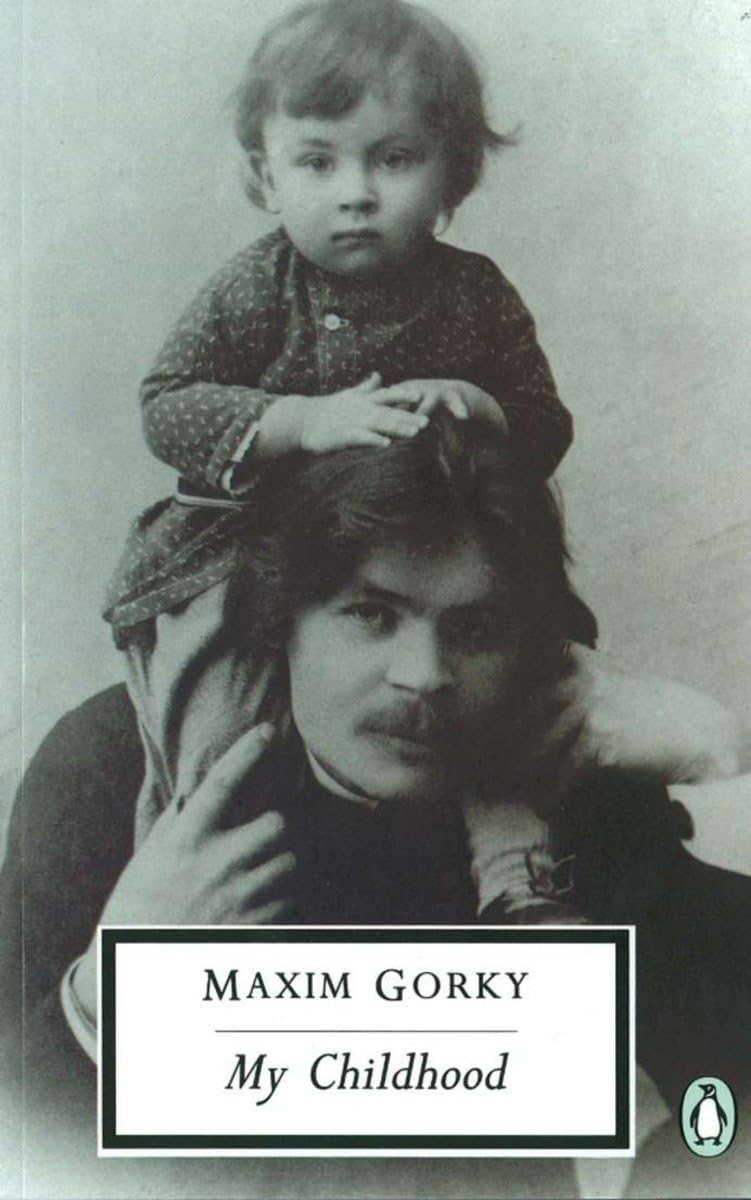



Coloured by poverty and horrifying brutality, Gorky's childhood equipped him to understand - in a way denied to a Tolstoy or a Turgenev - the life of the ordinary Russian. After his father, a paperhanger and upholsterer, died of cholera, five-year-old Gorky was taken to live with his grandfather, a polecat-faced tyrant who would regularly beat him unconscious, and with his grandmother, a tender mountain of a woman and a wonderful storyteller, who would kneel beside their bed (with Gorky inside it pretending to be asleep) and give God her views on the day's happenings, down to the last fascinating details. She was, in fact, Gorky's closest friend and the epic heroine of a book swarming with characters and with the sensations of a curious and often frightened little boy. For more than seventy years, Penguin has been the leading publisher of classic literature in the English-speaking world. With more than 1,700 titles, Penguin Classics represents a global bookshelf of the best works throughout history and across genres and disciplines. Readers trust the series to provide authoritative texts enhanced by introductions and notes by distinguished scholars and contemporary authors, as well as up-to-date translations by award-winning translators. Select Guide Rating Maxim Gorky is the pen-name of Alexei Maximovich Peshkov, who was born in 1868 in the city of Nizhny-Novgorod, now renamed after him. After his father’s death, he spent his childhood with his mother and grandparents in an atmosphere of hostility. He was turned out of the house when his mother died and was left to work in various jobs—in a bakery, in an ikon-maker’s shop, on barges—until his unsuccessful attempt at suicide. For three years he wandered in the south like a tramp before publishing his first story, "Makar Chudra," in a Tiflis newspaper. After his return to Nizhny, he worked on another newspaper, in which many of his stories appeared; he quickly achieved fame and soon afterward his play The Lower Depths was a triumphant success at the Moscow Arts Theatre. By now active in the revolutionary movement, he was arrested in 1905 by the Tsarist government but released following a petition signed by eminent statesmen and writers. While in America in 1906, he savagely attacked American capitalism and wrote his bestselling novel, Mother . During the First World War, he was associated with the Marxist Internationalist Group, and in 1917 he founded New Life, a daily devoted to left-wing socialism, but which outspokenly attacked Kerensky and Lenin’s "Communist hysteria." In 1921 he went to Italy, where he wrote My Universities , the third part of his great autobiographical trilogy: the other parts are My Childhood and My Apprenticeship. He returned to Moscow in 1928, and from then on he was a champion of the Soviet cause. In 1936 he died—allegedly poisoned by political enemies—and was given a hero’s funeral in Red Square. Ronald Wilks studied Russian language and literature at Trinity College, Cambridge, and later Russian literature at London University, where he received his PhD in 1972. He has translated The Little Demon by Sologub; My Childhood , My Apprenticeship, and My Universities by Gorky; The Golovlyov Family by Saltykov-Shchedrin; and four volumes of stories by Chekhov: The Kiss and Other Stories, The Duel and Other Stories, The Party and Other Stories , and The Fiancée and Other Stories.