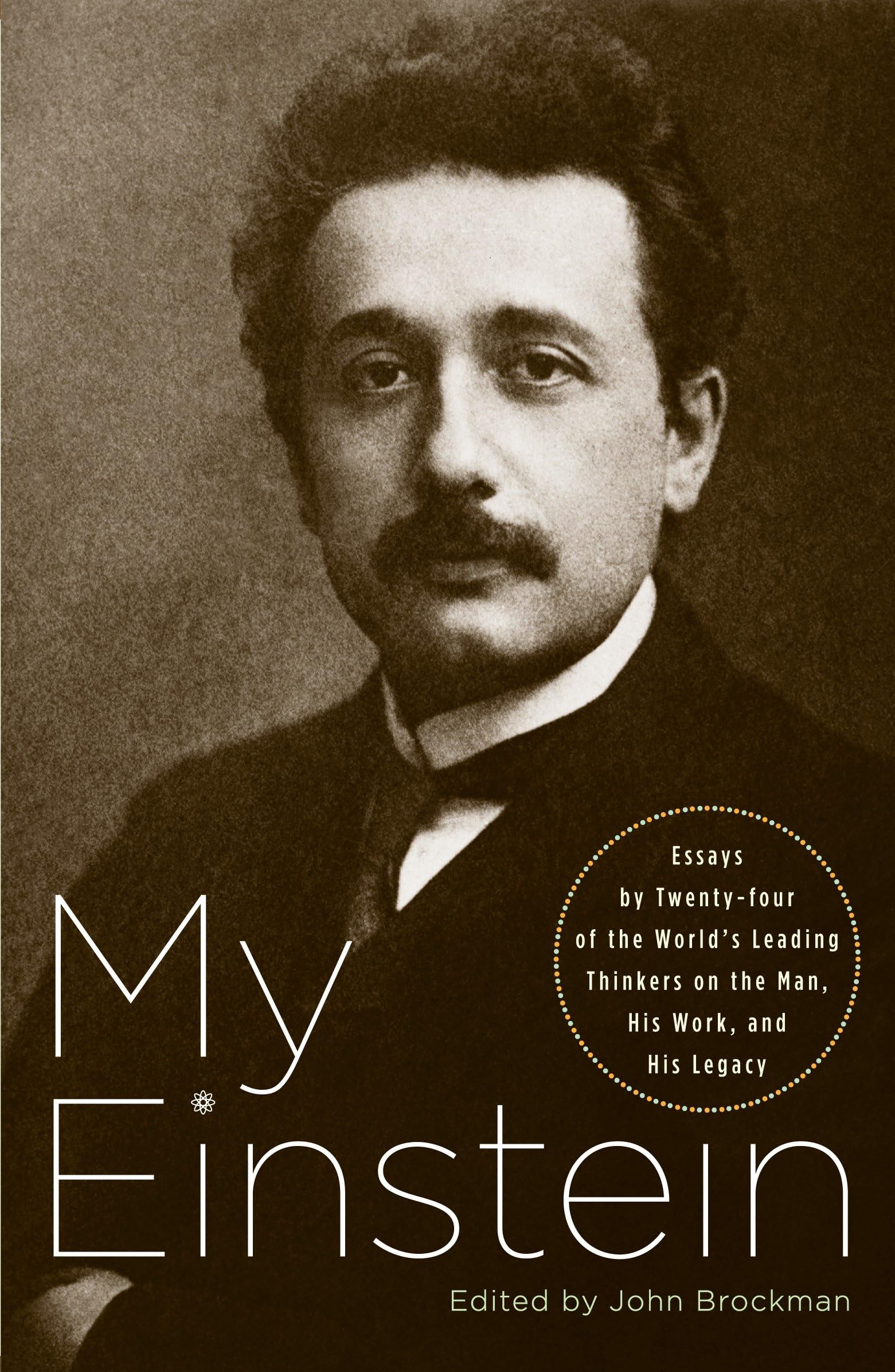
My Einstein: Essays by Twenty-Four of the World's Leading Thinkers on the Man, His Work, and His Legacy
$11.60
by John Brockman



In this fascinating volume, today’s foremost scientists discuss their own versions and visions of Einstein: how he has influenced their worldviews, their ideas, their science, and their professional and personal lives. These twenty-four essays are a testament to the power of scientific legacy and are essential reading for scientist and layperson alike.Contributors include:• Roger Highfield on the Einstein myth• John Archibald Wheeler on his meetings with Einstein• Gino C. Segrè, Lee Smolin, and Anton Zeilinger on Einstein’s difficulties with quantum theory• Leon M. Lederman on the special theory of relativity• Frank J. Tipler on why Einstein should be seen as a scientific reactionary rather than a scientific revolutionary “ My Einstein delivers even more than its lengthy title promises.” — TheWashington Post “These essays are irresistible.” — The Buffalo News “ My Einstein is a gem of a book that celebrates not only Einstein the scientist but also Einstein the man, even though it is a collection of essays written by scientific figures ... The result is a remarkably well-rounded figure.” — Deseret Morning News “Excellent.” — Tucson Citizen John Brockman has edited nearly 20 books and is the author of three: By the Late John Brockman , The Third Culture , and Digerati: Encounters with the Cyber Elite. He is the founder and CEO of Brockman Inc., an International literary and software agency, president of Edge Foundation, Inc., and publisher and editor of Edge, a website presenting the third culture in action. A well-known computer and Internet entrepreneur and visionary, his work is frequently featured in the media. Einstein When He's at Home ROGER HIGHFIELD is the science editor of the Daily Telegraph in London. He has carried out research at Oxford University and the Institut Laue-Langevin in Grenoble, where he became the first to bounce a neutron off a soap bubble. He is the author of Can Reindeer Fly?: The Science of Christmas; The Science of Harry Potter: How Magic Really Works; and coauthor (with Paul Carter) of The Private Lives of Albert Einstein and (with Peter Coveney) of Frontiers of Complexity and The Arrow of Time. Here is the canonical Einstein: He begins life as a dullard and a dyslexic, yet he overcomes these obstacles to help lay the foundations of quantum theory, to change our view of space, and to transform time. Despite his towering achievements, he shows great humility. He pokes his tongue out for the cameras. He is disheveled. He hates socks. He is an eccentric genius with a warm heart. He is a pacifist (except when it comes to the Nazis). His face is wise and lined, his hair is white and wild; some call it a mane or even a halo. When describing the universe, Einstein resorts to religious terms. He has the aura of a saint. But he also has a dark secret: he invented the atomic bomb. The popular image of Einstein as archetypal eccentric boffin dates to half a century after the first flowering of his astonishing creative genius. The tangle-haired sage whose image has graced thousands of posters, coffee mugs, and T-shirts is an Einstein well past his scientific best, a faded version of the original. We should bury the sockless dustball who rolled around Princeton and restore the creative Einstein. This is the young Einstein, whom Paul Carter and I attempted to portray in our 1993 book The Private Lives of Albert Einstein, after conversations with relatives and with scholars such as Jurgen Renn, John Stachel, and Robert Schulmann. This is the passionate Einstein. This Einstein had a muscular and powerful build despite his indifference to most forms of exercise. He had regular features, warm brown eyes, a mass of curly black hair, and a raffish mustache. He was good-looking and enjoyed the company of women. They enjoyed his company, too. And, of course, he was a genius. That much was obvious early. Einstein was not stupid as a child. He did repeat himself, but he was not dyslexic, as is often asserted. Classmates at his primary school taunted him with the nickname "Biedermeier" ("Honest John"), most likely because of his blunt manner. But his mother, Pauline, wrote in August 1886 that the seven-year-old was at the top of his class "once again" and had received a "splendid" report card. He was brought up in a family that made its living from electrical engineering, an advanced technology of the day. Despite his love of a religious turn of phrase, Einstein found it impossible to conceive of a personal deity and had no belief in an afterlife. He has said that his reading of popular science ended his "religiosity" abruptly, at the age of twelve. He decided that the stories of the Bible could not be true and became a fanatical freethinker, convinced he had been fed lies. He did not invent the atom bomb. He did transform our view of space and time. His great scientific works began with a creative outpouring in 1905, when he was just twenty-six years old. Like almost every other