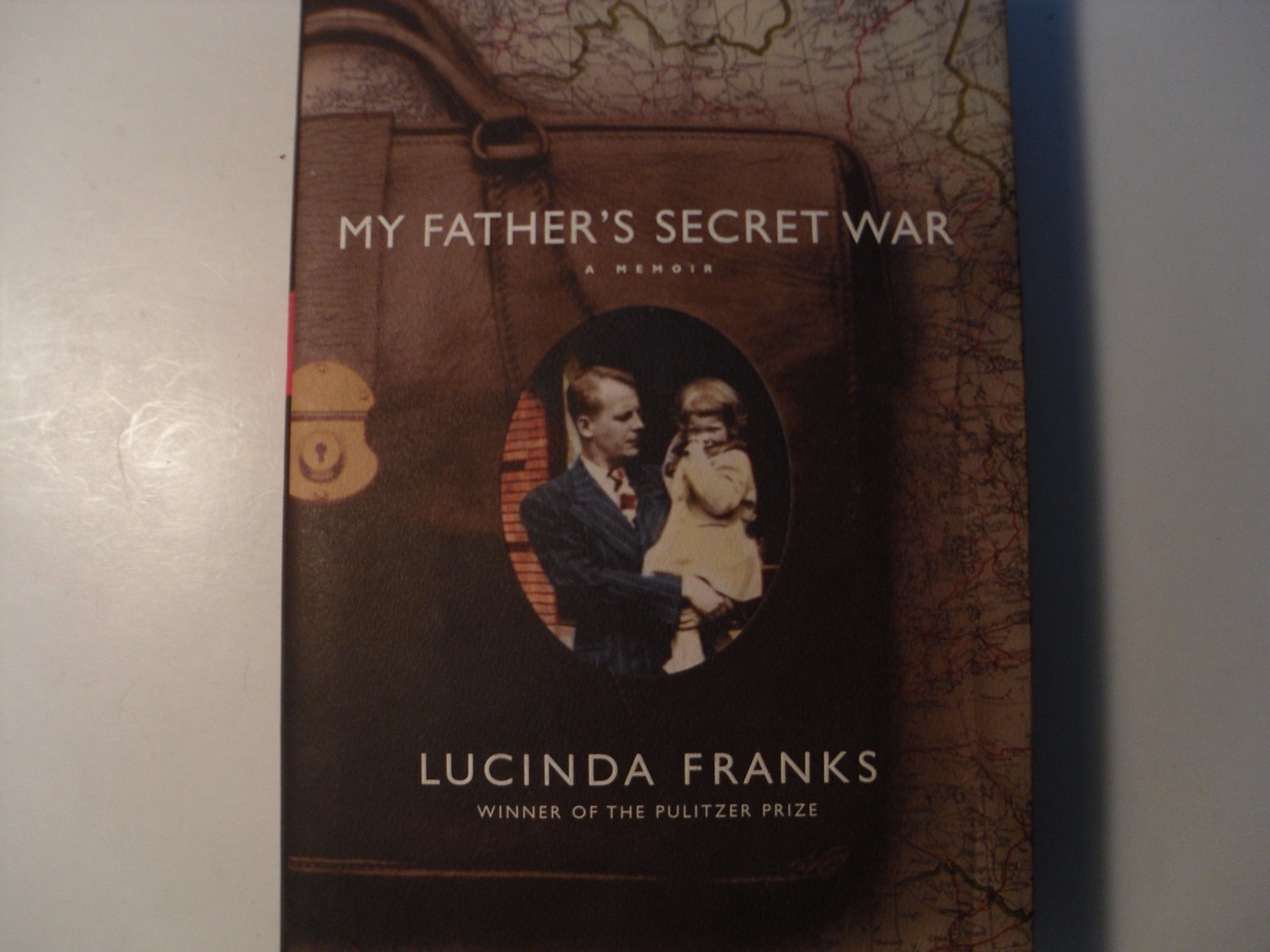



In this memoir, journalist Lucinda Franks describes her quest to learn to know her father. During World War II Thomas Franks served as spy in the Third Reich. In 1945 he was among the first soldiers into Ohrdruf, a subcamp of Buchenwald near the town of Gotha, Germany. As Tom's dementia progresses, Lucinda gathers fragments of his memories in order to understand her father and his secrets. When Franks' father began slipping into dementia, he began finally to speak about a part of his life he had always kept hidden. Franks knew her father had served in World War II, but she never suspected the truth--that he was a spy who risked his life behind enemy lines (in the guise of an SS officer) and, near the end of the war, visited one of the first concentration camps liberated by the Allies. Like Scott Turow's recent novel Ordinary Heroes , which tackled many of the same themes in a fictional context, Franks' memoir works on many levels. It's the story of a man who became a hero and spent the rest of his life keeping it a secret, but it's also an almost heartbreakingly tender story of reconciliation, of a daughter coming to know her father even as he is slipping away from her. The book is beautifully written, packed with raw emotion, deep affection, and newfound, unexpected respect for a man his daughter hardly knew until it was almost too late. David Pitt Copyright © American Library Association. All rights reserved " My Father's Secret War combines the heart-stopping suspense of a great thriller and the heart-melting pathos of a great family saga. It is an entirely new chapter in the complex history of fathers and daughters-and America." -- Mary Gordon " My Father's Secret War tells the story of a devoted daughter's search to understand a father broken and drained by the Second World War-a father who at the same time attracts, repels, and obsesses her. Lucinda Franks' memoir is a fascinating combination of sensitivity, suspense, and mystery told against the Nazi nightmare." -- Arthur Schlesinger, Jr. "A moving and rewarding novel . . . quirky, strong, well-realized characters." -- Library Journal "Here is one of the most original memoirs of our time-an unsparing double portrait of an elusive and mysterious man and the daughter determined to learn the fullest truth about his life. Richly documented by the author's research into U.S. military intelligence records and her father's private correspondence, My Father's Secret War moves with the dramatic and moral urgency of a Graham Greene novel." -- Joyce Carol Oates "Lucinda Franks' memoir tells a multileveled story of discovery and reconciliation. It is an important book, filled with history, superbly researched, and beautifully written. The fact that Franks' subject is her own father makes her achievement all the more remarkable." -- Patricia Bosworth, author of Diane Arbus: A Biography "Lucinda Franks' personal quest to learn more about 'her father's secret war' is a moving suspense story, brilliantly written and suffused with sensitivity and yearning." -- Elie Wiesel "Sensitive, affecting . . . Franks earnestly and perceptively confronts real emotional situations." -- Publishers Weekly One day, while trying to straighten up her elderly father's apartment, Franks discovered Nazi military paraphernalia, inspiring the Pulitzer-winning reporter and novelist ( Wild Apples ) to investigate what he really did during the Second World War. The painstaking inquiries are hampered by his reluctance to discuss his work in military intelligence, attached to the navy's Bureau of Ordnance. Some of that reluctance may have to do with the onset of dementia tearing away his memories, but he's also profoundly traumatized by some of his missions. In one moving passage, he is persuaded to describe his experience as one of the first American observers at a liberated concentration camp, every sentence still painful to get out even 50 years later. As Franks perseveres with her questions, she begins to understand how those experiences shaped their disintegrating postwar family life, but she acknowledges how difficult it is to achieve closure with this past, especially when she's afraid to confront the reality of his present condition. Even the most painful moments-as when she throws a particularly harrowing revelation back in her father's face to score revenge for adolescent resentments-are recounted with unflinching honesty as the military history takes a backseat to the powerful family drama. -- Publisher's Weekly, March 2007 Journalist Lucinda Franks won a Pulitzer Prize in 1971 for her national reporting. She has been writing for the New York Times since the mid-1970s, also contributing to The New Yorker , the New York Times Book Review, The Atlantic Monthly, The Nation, Travel and Leisure, People , and New York magazine, among others. Her novel, Wild Apples , was published in 1991. She is married to New York City district attorney Robert Morgent