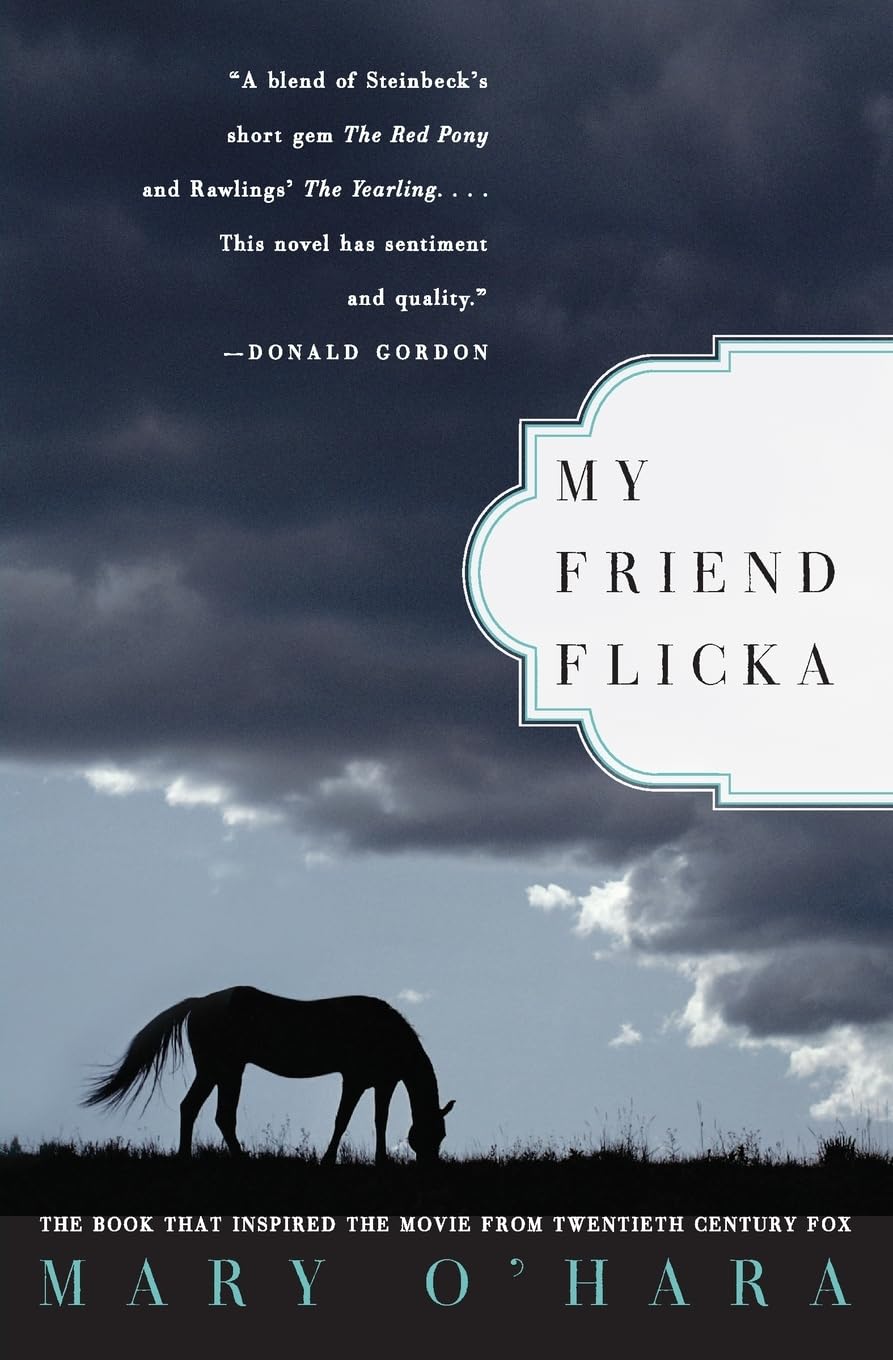
My Friend Flicka: A Novel About Taming a Wild Horse on a Wyoming Ranch for Kids (Ages 8-12)
$10.26
by Mary O'Hara



“A blend of Steinbeck’s short gem, The Red Pony , and Rawling’s The Yearling . . . . This novel has sentiment and quality.”— Donald Gordon A timeless favorite of adults and children alike, My Friend Flicka resides in “that borderland where some of the best-loved books in the English tongue hold their immortality.” ( New York Herald Tribune) A daydreamer and a time waster, young Ken McLaughlin spends his days on his family's Wyoming ranch with his head in the clouds, surrounded by endless blue skies, wide-open spaces, and beautiful horses. To his brusque, practical father, the boy is an enigma and a disappointment. Then one day, Ken's life is filled with new purpose when he finds Flicka, a magnificent filly as wild as she is fast. Though the strong bond between boy and horse only fuels his father's disdain, Ken's growing love for his friend Flicka is changing him—leading a once-aimless young man down the path to responsible adulthood, forging a new respect and understanding between father and son, and inspiring a fierce loyalty that nearly costs Ken his life. "A beautiful book....It will pass into that borderland where some of the best-loved books in the English tongue hold their immortality, on the shelf with Treasure Island , and Dumas and Dickens, and Mutiny on the Bounty .” - New York Herald Tribune “A blend of Steinbeck’s short gem, The Red Pony , and Rawling’s The Yearling ....This novel has sentiment and quality.” - Donald Gordon The classic story of an aimless teenager, a demanding father, and aspirited horse -- now a major motion picture from Twentieth Century Fox A daydreamer and a time waster, young Ken McLaughlin spends his days on his family's Wyoming ranch with his head in the clouds, surrounded by endless blue skies, wide-open spaces, and beautiful horses. To his brusque, practical father, the boy is an enigma and a disappointment. Then one day, Ken's life is filled with new purpose when he finds Flicka, a magnificent filly as wild as she is fast. Though the strong bond between boy and horse only fuels his father's disdain, Ken's growing love for his friend Flicka is changing him -- leading a once-aimless young man down the path to responsible adulthood, forging a new respect and understanding between father and son, and inspiring a fierce loyalty that nearly costs Ken his life. Mary O’Hara was born on July 10, 1885, in Cape May Point, New Jersey. She was a screenwriter during the silent film era and wrote several novels, including the range country trilogy My Friend Flicka, Thunderhead, and Green Grass of Wyoming . She also authored a novella, The Catch Colt , and Wyoming Summer , based on her diary of sixteen years. She died on October 14, 1980. My Friend Flicka By Mary O'Hara HarperCollins Publishers, Inc. Copyright © 2006 Mary O'Hara All right reserved. ISBN: 0060512628 Chapter One High up on the long hill they called the Saddle Back, behind the ranch and the county road, the boy sat his horse, facing east, his eyes dazzled by the rising sun. It seemed like a personage come to visit; appearing all of a sudden over the dark bank of clouds in the east, coming up over the edge of it smiling; bowing right and left; lighting up the whole world so that everything smiled back. The snug, huddled roofs of the ranch house, way below him, began to be red instead of just dark; and the spidery arms of the windmill in the Gorge glinted and twinkled. They were smiling back at the sun. "Good morning, mister!" shouted Ken, swinging his arm in salute; and the chunky brown mare he rode gave a wild leap. To keep his seat, riding bareback as he was, he clapped his heels into her sides, and she leaped again, this time with her head down. Stiff-legged and with arched back she landed; and then bucked. Once, twice, three times; and Ken was off, slung under her nose, hanging on to the reins. She backed away and pulled to get free, braced like a dog tugging at a man's trouser leg. "No you don't!" gasped Ken, sitting up to face her and clinging to the reins. "Not that time you didn't—" She jerked her head viciously from side to side. Ken's teeth set in anger. "If you break another bridle—" This thought made him crafty and his voice fell to a coaxing note. "Now Cigarette—be a good girl—thatsa baby—good girl—." Responsive to the change of tone, one of her flattened ears came forward as if to peer at him and see if he spoke in good faith. Reassured, she stopped pulling and moved up a step. Ken got warily to his feet and went to her head, still talking soothingly but with insulting words. "Thatsa girl—stupid face—whoa, baby—jughead—no sense at all—" and this last was the worst possible insult on the Goose Bar Ranch where a horse without sense was a horse without a right to existence. Cigarette was not wholly deceived but stood enjoying the stroking of Ken's hand and awaiting developments. "D'you think I'd ever ride a ornery old plug like you if I had a horse of my own like Howard's