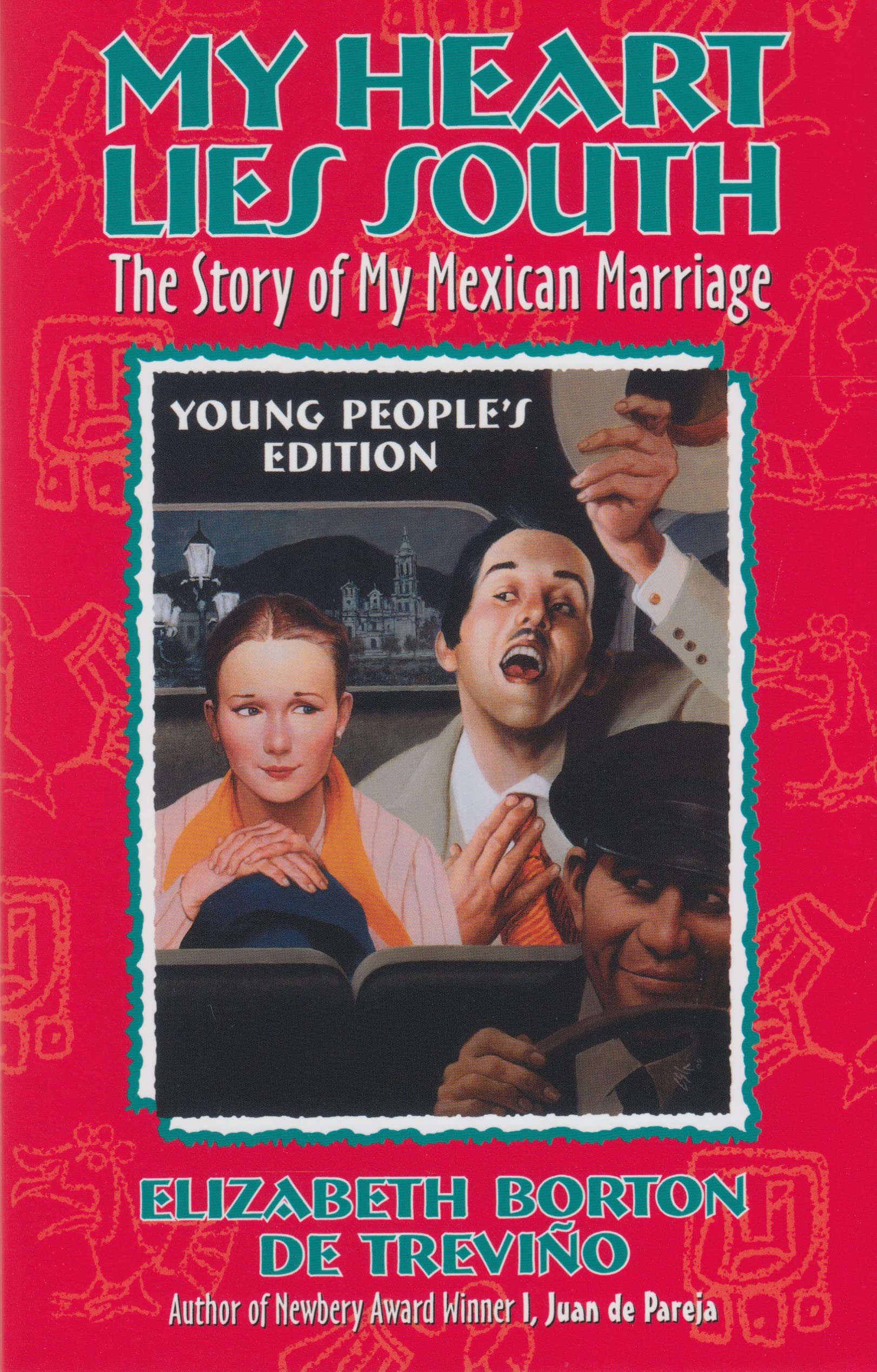
My Heart Lies South: The Story of My Mexican Marriage
$12.65
by Elizabeth Borton De Trevino



What happens when a thoroughly twentieth-century American lady journalist becomes a Mexican señora in nineteen-thirties' provincial Monterrey? She finds hersel—sometimes hilariously—coping with servants, daily food allowances, bargaining, and dramatic Latin emotions. In this vivid autobiography, Newbery Award-winning author Elizabeth Borton de Treviño brings to life her experiences with the culture and the faith of a civilization so close to the United States, but rarely appreciated or understood. This special young people's edition presents the humor and the insights of a remarkable woman and her contact with an era which is now past, but not to be forgotten. Mexico, 1930s RL7.4 Of read-aloud interest ages 12-up Elizabeth Borton de Treviño (1904-2001) was born in Bakersfield, California. After graduating from Stanford University, Elizabeth journeyed to Boston to study the violin. There, however, she ended up as a journalist for The Boston Herald where her music background and her fluency in Spanish established her as an interviewer of international celebrity. It was on one of her assignments for the paper that she went to Monterrey, Mexico and met her future husband, Luis de Trevino. The story of her courtship and marriage and her life in Monterrey is told in the best-selling memoir, My Heart Lies South . Throughout her lifetime Elizabeth grew in her love of the Mexican culture and in the faith she had adopted upon her marriage. “MISS BORTON!” bawled my city editor. I hurried up to his desk. “You’re always yammering about going to Mexico,” he said. “Here’s a bunch of due bills. Airplanes, trains, hotels. . . . Take ’em and see how far you get. When you run out of money, write something for us.” I got as far as San Antonio, and there I called on a man whose name the city editor had given me. “Look up this man,” my editor had said. “He loves every inch of the highway from Laredo to Mexico City. He’s always lecturing about it. If you can get as far as San Antonio, he can probably get you the rest of the way.” The name was William Harrison Furlong. Kindly big Bill Furlong took me under his wing, and personally drove me to Laredo, where, in answer to his insistent wire, the Monterrey Chamber of Commerce had dispatched its young public relations man to receive me, waft me across the border, and conduct me to Monterrey with the dignity due the newspaper I represented. Accordingly I sat in a hotel lobby in Laredo with Mrs. Furlong and Bill when the emissary from Monterrey arrived. It was very hot and the young Mexican who hurried into the lobby mopping his brow, only one hour late, was dressed in a short-coated white linen suit and carried a jipi-japa , which is the south-of-the-border version of the boater. This was my first glimpse of my husband. Tall and spare, with large sad black eyes, black curly hair, a fine beak of a nose, a small Spanish mouth outlined by a sparse black mustache, he is, he says, “the villain type.” He was tired and hot and he looked at the lady who was to be his charge with scant interest, politely bowing. “Hello Luis!” said Bill. “This is Miss Borton. When you get to Vallecillo, buy her an ice-cold beer.” Luis laughed nervously. There is nothing he likes better than a cold beer, but the lady he had taken across the border for the Chamber of Commerce two weeks before had resisted the beer with desperation as if it might be the first step in a seduction, and the lady last week had been Dorothy Dix, who was even then rather tired from pushing seventy or so and inclined to be tart with young men eager to waste her time in taverns. Luis spoke excellent English. The revolution had driven the Treviños with many other families to take refuge in the United States when Luis, the fifth son, was about eight. He had gone to school in Texas and Indiana, where he eventually dominated English in all but two particulars. The little confusion persists to this day: he cuffs when he has a cold on his chest, and due to the criminal negligence of his wife, the coughs of his shirts are frequently frayed. We bade the Furlongs farewell. I was turned over to the vaccination, immigration, and customs authorities, and at last, in a car which had been provided by the Chamber of Commerce, complete with chauffeur, we set out for Monterrey. I had my hair tied up in a scarf and I was wearing a large black hat as well as sun glasses. Now the sun began to go down and long violet shadows crept across the plain. I took off my hat. “Ah,” breathed Luis. I undid the scarf. “So?” remarked Luis. I took off the black glasses. “Wonderful,” he decided, aloud. He leaned toward me and looked at me soulfully. “Shall I sing you a song about love?” he asked. “Why yes,” I agreed, thinking this must be a gag. But he launched into “Palm Trees Drunk with the Sun,” went on to “The Sea Gulls,” and then sang “The Green Eyes,” in a light baritone voice. “Very nice,” commented the chauffeur from the front seat. “Now sing ‘Farolito.’ ” He s