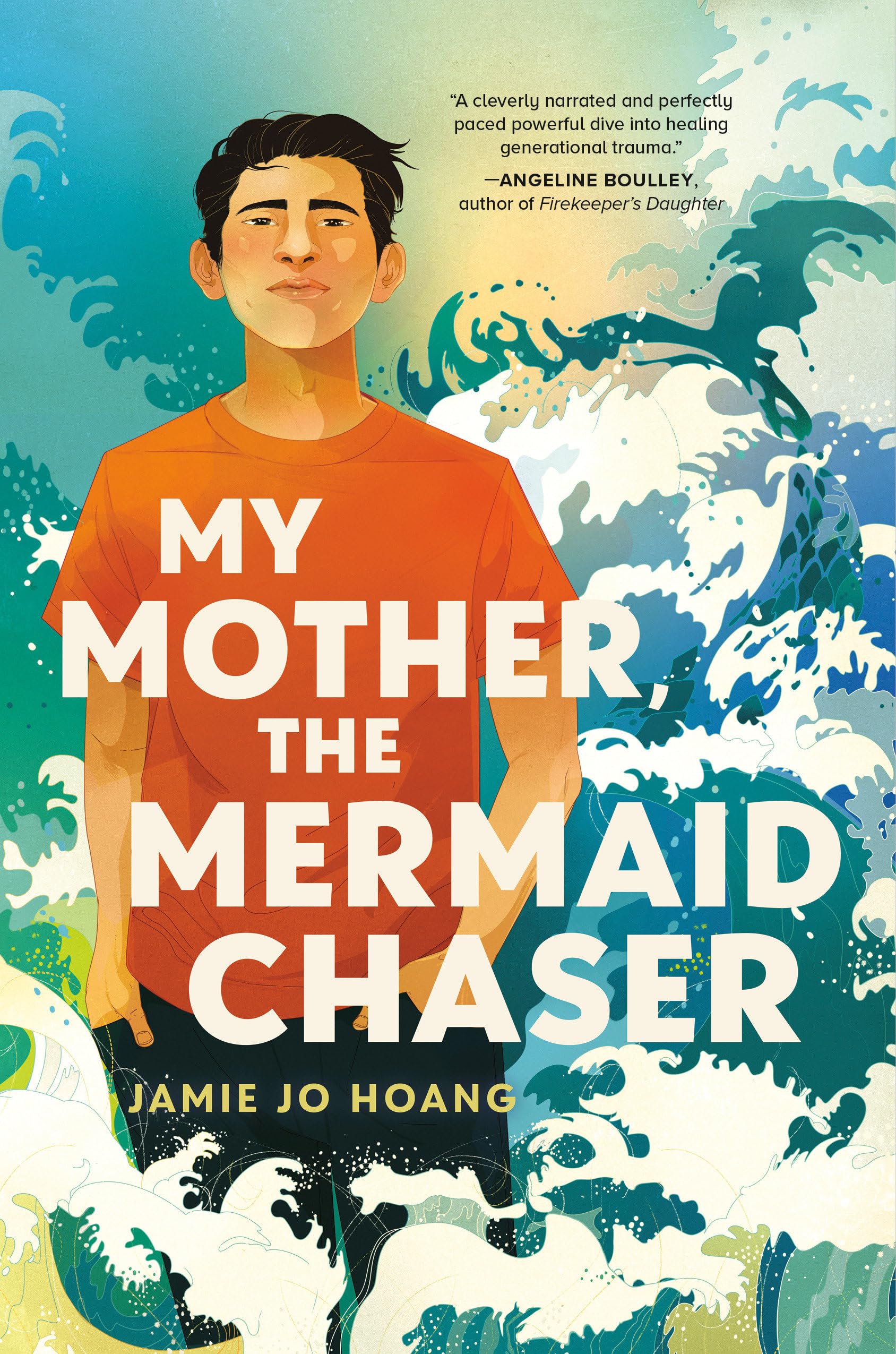



Told in dual POV, this gripping companion piece to My Father, the Panda Killer, follows a teenage son who defies his sister's wishes by searching for more information about their absent mother. Meanwhile, his mother's poignant backstory reveals her struggle with grief and longing, culminating in her heart-wrenching decision to leave her children. “A cleverly narrated and perfectlypaced powerful dive into healinggenerational trauma.” —Angeline Boulley, author of Firekeeper’s Daughter San Jose, 2008 : Paul yearns to know more about the mother who abandoned his family, but she is the only topic no one discusses. Now’s he’s in Vietnam, feeling displaced and considered an outsider. Plus, a ghost is haunting him even though he doesn’t believe in ghosts. His cousin and the grandmother he’s never met before now keep telling him that he’ll get answers only if he’s willing to open his ears. Vũng Tâu, 1975 : Ngọc Lan is eleven when her family breaks apart: her brother is drafted into the army; her father leaves on the last helicopter to the US. She and her sister are sent from Vietnam on a harrowing journey by boat. Only Ngọc Lan will survive. But what is the American dream when you are haunted by the death of your sister, missing your homeland; seeing ghostly mermaid sightings; lost in an abusive marriage; struggling as a parent? Told in the alternating perspectives of Paul and Ngọc Lan, My Mother, the Mermaid Chaser is a haunting story about the intergenerational effects of war, estranged family bonds, and how a teenager discovers a new connection to a lost part of himself. ★ " This story is a triumph of endurance, family, magical realism, and forgiveness." — School Library Journal , starred review " A haunting, compassionate tribute to the children of war." — Kirkus Reviews "Hoang’s dramatic coming-of-age novel is an intense exploration of grief, loss, and multigenerational trauma that ultimately leads to understanding, forgiveness, and even love." — The Horn Book " A haunting and beautiful reminder of the continual mending of the wounds from wars long past." —Kim Johnson, author of This Is My America "Jamie Jo Hoang tells an achingly tender story that explores healing and trauma, asking what role our memories play in the fabric of family." —Olivia A. Cole, author of Ariel Crashes a Train "This book will make you question the people and world you thought you knew while showing you a more complex and compassionate reality. You will be changed forever." —Joanna Ho, New York Times bestselling author "An emotionally gripping, gorgeously-written, and page-turning story. It is honestly a gem ." —Jennifer De Leon, author of Don’t Ask Me Where I’m From "Stunning! Brilliant! Profoundly beautiful !" —Ellen Oh, author of The Colliding Worlds of Mina Lee Jamie Jo Hoang is the daughter of Vietnamese refugees. She grew up in Orange County, CA—not the rich part—and worked as a docuseries producer before shifting to writing full-time. Her debut young adult novel, My Father, The Panda Killer , was named one of NPR's Books We Love and received an Honorable Mention from the Freeman Book Awards. Hoang is also the author of the award-winning adult novel Blue Sun, Yellow Sky , which was named one of the best books of the year by Kirkus Reviews and won a silver medal at the Independent Publishers Awards. Her work has been published in TIME , SALON , and Tiny Buddha . When she's not writing, Hoang loves to take long walks, travel, and scuba dive. She lives in house covered in Post-It Notes with her husband and son. Chapter 1 Paul I’ve never loved my parents. My mother left when I was four—no chance for love. And my dad, well, he’s not real lovable. To be clear, I don’t hate him. But love? No. We’re just not that kind of family. No one in my family says “I love you.” Correction. No one in my family used to say “I love you.” Last week, my sister, Jane, and I were watching Just Friends, a rom-com about a successful guy who returns home to his small town and finds that all his awkward tendencies have returned with him. Because we own the DVD, we’ve seen this movie at least six times, yet my sister laughed just as hard this time as she did when we first saw it. Anyway, the film ended, and Jane turned to me, eyes watering with laughter, and said, “I love you, Paul. Thanks for watching this with me.” At first, I thought I’d heard her wrong, but then this silence hung in the air, confirming that those were indeed the words she’d used. For my part, I avoided eye contact while staring at the rolling credits as though I really cared about who Jock #1 and Jock #2 were. Jane got up, grabbed my popcorn bowl, and went to the kitchen. She appeared to be acting totally normal; she seemed not to be sick in any way; she simply went about cleaning up without acknowledging this major bomb she’d just dropped in my lap. Then, yesterday, before dinner, Jane walked into the house exclaiming, “Oh my go