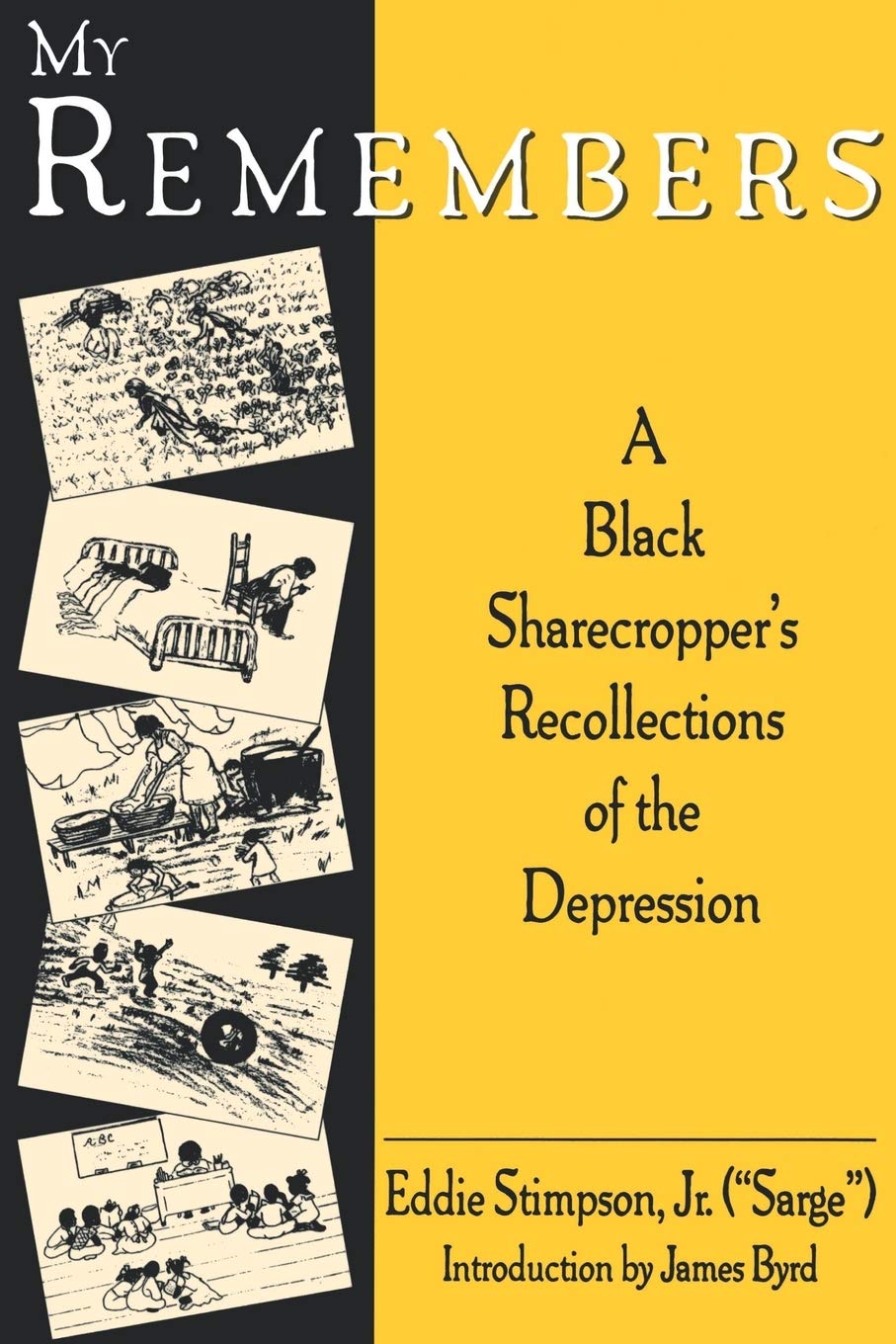
My Remembers: A Black Sharecropper's Recollections of the Depression
$12.23
by Eddie Stimpson Jr



In 1929, near Plano, Texas, Eddie Stimpson Jr., weighing 15-1/2 pounds, was born to a 19-year-old father and a 15-year-old mother. The boy, his two sisters and mother all “grew up together,” with the father sharecropping along the old Preston Road, the route used by many freedmen trying to escape Texas after the Civil War. His childhood was void of luxuries, but full of country pleasures. The editors have retained the simplicity of Stimpson's folk speech and spelling patterns, allowing the good-natured humility and wisdom of his personality to shine through the narrative. The details of ordinary family life and community survival include descriptions of cooking, farming, gambling, visiting, playing, doctoring, hunting, bootlegging, and picking cotton, as well as going to school, to church, to funerals, to weddings, to Juneteenth celebrations. This book will be of extraordinary value to folklorists, historians, sociologists, and anyone enjoying a good story. . . . Written in the style and language of what editor James Byrd refers to as "black folk speech," Eddie Stimpson, Jr.'s little book is less compelling as another personal account of the economic and racial oppression of black farmers than it is as a celebration of certain social values and experiences that still define the author's life today. Indeed, what is most striking in both the tone and message of My Remembers is the absence of any bitterness about what clearly were very tough times and, in contrast, the fond remembrance of things such as the value of farm work, friendship, loyalty, faith, family, self-respect, and, above all, shared community. Stimpson offers numerous stories about how his mother and father, along with other black and white families he knew, reached out to each other as well as to strangers in time of need. In one instance in 1937, his family fed and cared for fifteen white men and women whose bus had broken down near their home. Stimpson cannot recall a time that his mother turned "any one away from her door, especial shin they were hungry" (p. 150). Even the famous bank robber couple, Bonnie and Clyde, shared in the hospitality of the Stimpsons in the 1930s. Looking back, Sarge is deeply saddened by what he perceives has happened to the closeness of neighbors and friends that defined his own childhood, a loss he identifies with the decline of rural, small-town communities and the impersonalism of city life. . . . None of these reminiscences, however, even from such a charitable person as Sarge, can mask the harsh reality of black sharecropper life in the 1930s--a life that was always insecure and frequently violent, a life rooted in a racially exploitive environment. With all the love and generosity they showed in so many ways, the relationship of Stimpson's own mother and father was filled with conflict, infidelity, alcoholism, and finally, divorce. . . . Even Eddie, Jr., reflects at the end of his story some of his father's insecurity as he refers to himself as a "no body." But then his better self catches him, and he states: "I would like to think that some day some body would ask Where is that book a no body wrote? And some body will say Look on the book shelf and find My Remembers" (p. 154). One would hope that it is not simply the historian or the folklorist who discovers Eddie Stimpson, Jr., but all of us who need to be reminded of the simple truths that come from a humane and generous spirit. My Remembers is as much a history of character s it is of sharecropping in the 1930s. -- Mississippi Quarterly, Spring 1997, Robert L. Phillips, Jr., Editor A black sharecropper recalls the Depression years and presents the details of ordinary life as a sharecropper: items which will interest any folklorist and student of black history. Add black and white illustrations peppered throughout and you have a personal, involving autobiography and account. -- Midwest Book Review Always thoughtful and often witty, Stimpson guides the reader through the everyday stuff of a sharecropping family's existence in the 1930s and sometimes beyond: births, deaths, courtships, marriages, infidelities, violence, bootlegging, dances, church, school, cooking, cleaning, hunting, and, of course, farming. There are battles against the weather and disease, against poverty and the police, and against landlords and pesky little sisters. There is even a mysterious visit from the outlaws Bonnie and Clyde. Above all, however, this is the story of one African American family's steady determination to endure and live dignified and useful lives in the midst of great material want and disadvantage. This book, with illustrations by Burnice Breckenridge, has something for academics and lovers of a good read alike. -- The Alabama Review, July 1998, Brian Ward, University of Newcastle upon Tyne EDDIE STIMPSON, JR. , born in 1929, lived on a dirt farm while attending Shepton School, Allen Colored School and Plano Colored School. He spent 21 years in the Arm