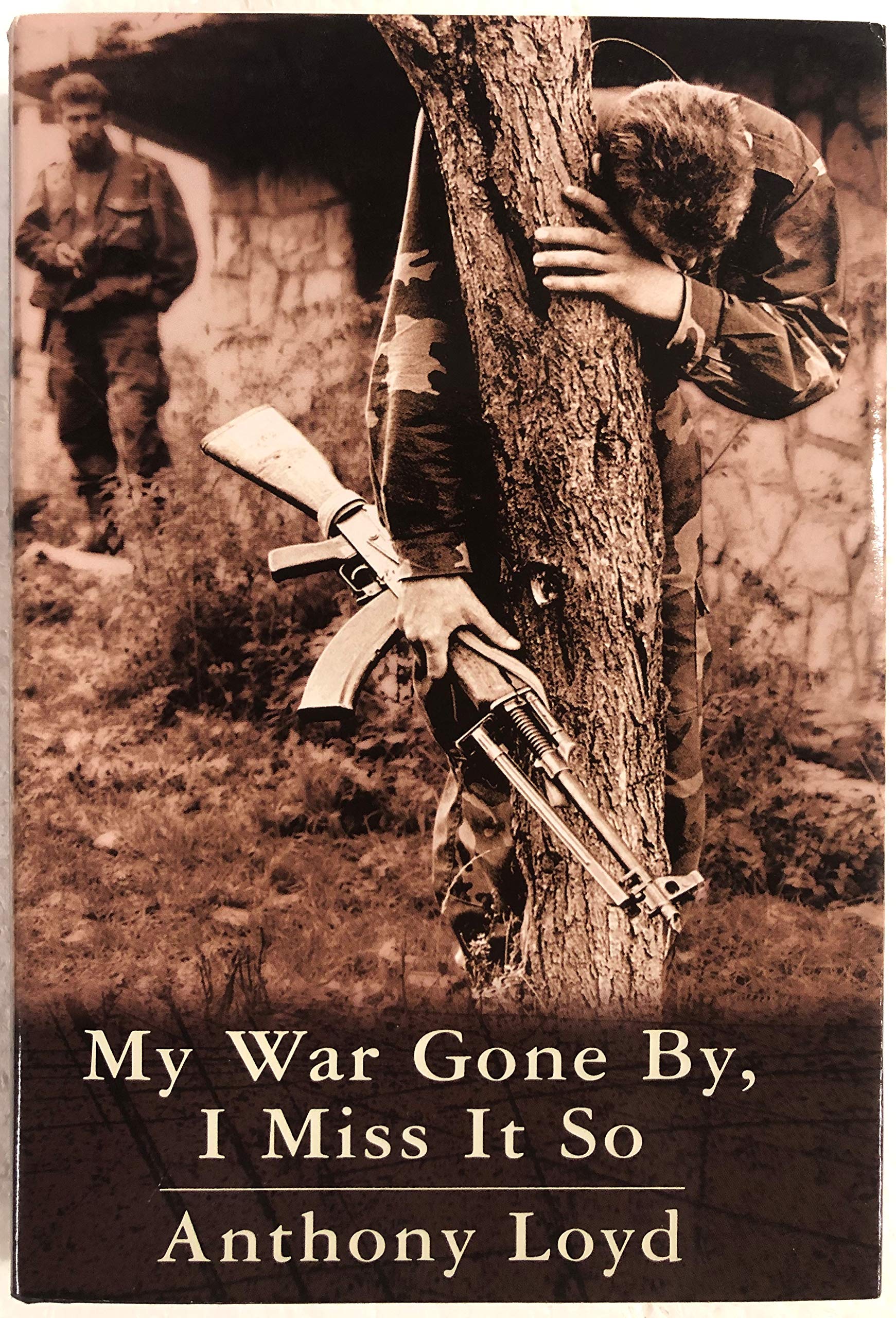



A former soldier who fled depression and drug addiction in England to cover Europe's bloodiest conflict since the Second World War recounts stories of brutality and compassion he recorded while in both Bosnia and Chechnya My War Gone By, I Miss It So is a fiercely compelling and beautifully written personal account of the Bosnian war. The book alternates between Anthony Loyd's experiences in Bosnia and personal reflections of his time in the British army, his parents' divorce, his estrangement from his father, and his heroin addiction. Loyd describes the war at eye level: detailing the way bodies look after they've been shot or blown up, looking through the sights of a Muslim gun trained on a Serb soldier, traveling with a French mercenary, and fleeing from advancing Serbs during battle. The book is filled with firefights and mutilated corpses and is not for the squeamish. Bosnia was "a playground where the worst and most fantastic excesses of the human mind were acted out." For Loyd, the high of battle substituted for the high of heroin and vice versa: "I had come to Bosnia partially as an adventure. But after a while I got into the infinite death trip. I was not unhappy. Quite the opposite. I was delighted with most of what the war had offered me: chicks, kicks, cash and chaos; teenage punk dreams turned real and wreathed in gunsmoke." Loyd's big break as a war correspondent came when another British journalist was wounded. He had arrived in Bosnia a war junkie, just trying to figure out what was going on and sell a few pictures to newspapers on the side. "Journalism in itself had never really interested me, I saw it only as a passport to war." He did not cover the war like most other journalists--he went right into battles. Loyd dismisses what other journalists did in Bosnia: staying at the Holiday Inn in Sarajevo, driving out to the UN headquarters in an armored car, and then returning to the relative safety of their hotel "to file their heartfelt vitriol with scarcely a hair out of place." Loyd, who did everything but carry a gun against the Serbs, scoffs at the idea of journalistic objectivity. "What good did reporting ever do in Bosnia anyway?" he sneers. In fact, he seems almost embarrassed not to be fighting himself. "I felt I was a pornographer, a voyeur come to watch." Lucky for the rest of us he did go to Bosnia. --Linda Killian Loyd, a war correspondent for the Times of London and a former British army officer, recounts his experiences as an independent journalist in embattled Bosnia-Herzegovina. Reared on his family's tradition of military glory and impelled by drug dependence, he sought the "high" of battle in the only war available. The stark, often lyrical quality of his prose accentuates the surreal atmosphere of wartime in Bosnia, "a playground where the worst and most fantastic excesses of the human mind were acted on." Loyd's account blends personal revelation with biting commentary on diplomacy and war. By turns horrifying, contemplative, and savagely funny, this memoir captures the peculiar ferocity of ethnic and religious civil strife. Particular targets of his scorn are the UN and European officials whose indecisiveness and moral relativism inhibited an effective response to the slaughter. This unforgettable work ranks with the great modern accounts of war and should be in every library.AJames Holmes, Fletcher Sch. of Law & Diplomacy, Medford, MA Copyright 1999 Reed Business Information, Inc. Loyd, a journalist and former officer in the British army with an admitted attraction to war and drugs, offers a stunning personal account of the war in Bosnia. Loyd traveled to Bosnia with a camera and no assignment, questioning whether he wasn't "a sluttish dilettante day-tripping into someone else's nightmare." When a British journalist is wounded, Loyd fills in for him and becomes a floater for other news organizations. He witnesses the absurdities and atrocities of war and meets a fascinating array of people: soldiers, civilians, journalists, snipers, bandits, black marketeers, and mercenaries, including a deserter from the French Foreign Legion who switches allegiances when he meets up with some buddies on the other side. Loyd intersperses his war accounts with recollections of visits home and a personal struggle with a heroin addiction that only takes a break when he's in Bosnia, the scene of an external hellish struggle. Loyd acknowledges the difficulty of describing the indescribable carnage and destruction of war, but is eloquent in his efforts, nonetheless. Vanessa Bush An extraordinary evocativion of the war in Bosnia that is also a painful personal story. The scion of a British military family, Loyd has served as a platoon commander in Northern Ireland and the Persian Gulf and covered eight wars as a journalist. Here he focuses for the most part on the the day-to-day grind and the periodic special tribal horrors of one of the less-covered parts of the Bosnian War: the conflict