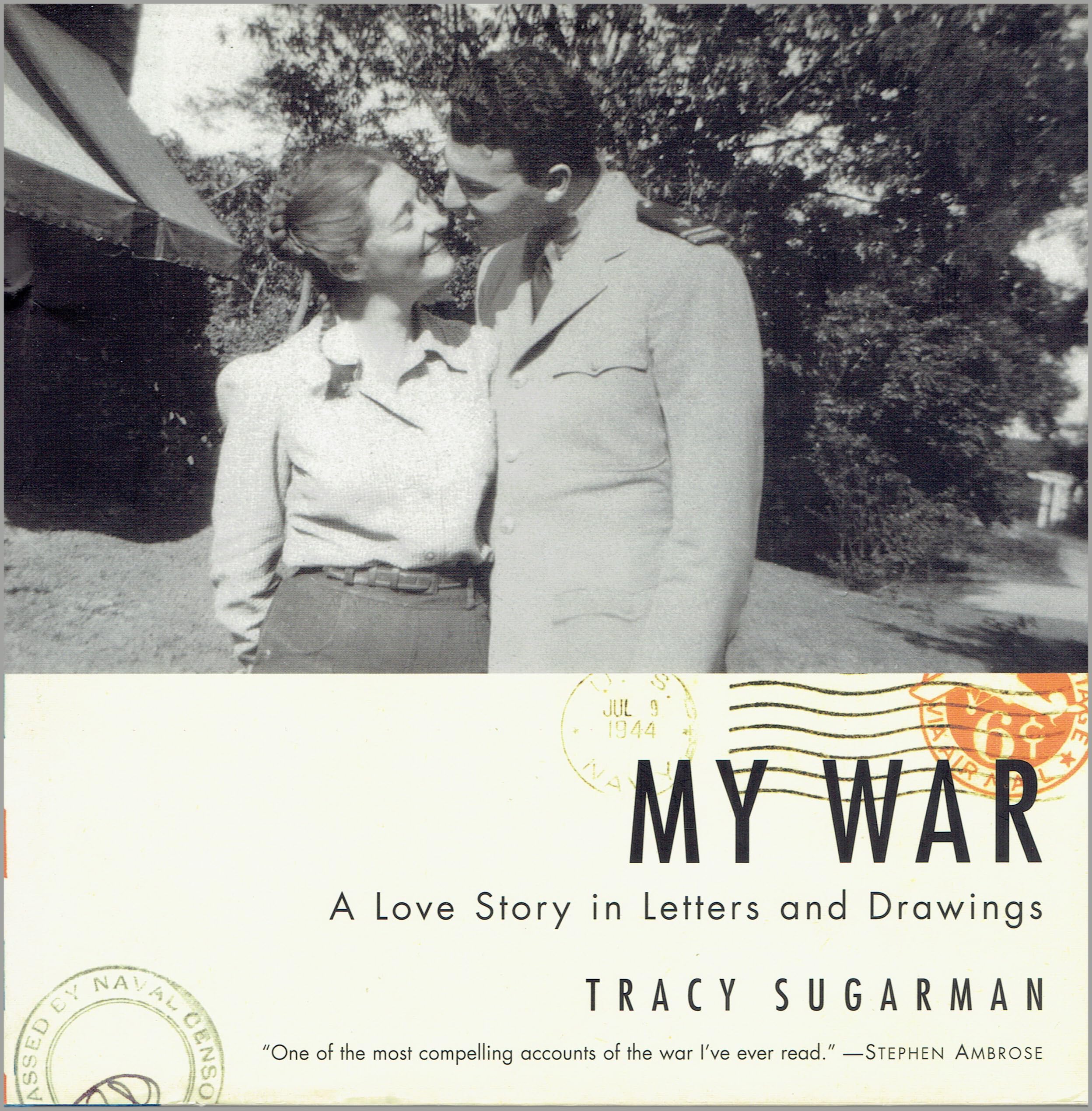



On December 7, 1941, when the Japanese were bombing Pearl Harbor, Tracy Sugarman was a young man studying to be an illustrator--and falling in love with a tawny-haired girl named June. But for Tracy, as for all Americans, everything changed that December dawn. Two years later, now married to June, Tracy was on a troopship bound for England, part of the massive Allied buildup for the liberation of Europe. On D-Day he landed on Utah Beach, one young ensign in the greatest military invasion in history. But Tracy Sugarman was not only a sailor. He was also an artist, who chronicled every aspect of his war in watercolors and sketches and in more than four hundred letters to his wife, who carefully saved everything her new husband sent her. Fifty years later, June Sugarman astonished her husband by showing him his long-forgotten pictures and words: lush watercolors and pen-and-ink drawings set down with breathtaking immediacy in the midst of war, and letters in which the young man poured out his feelings--about the terror and tedium of battle, his own ideals and hopes . . . and, always, his love for his wife. Here, selected from this treasure trove, are the drawings and watercolors that best portray the war Tracy Sugarman experienced. Interspersed throughout are excerpts of his loving and poignant letters home and, as the capstone of this extraordinary book, the single surviving letter from June to her husband. My War is a luminous, powerful account of a world at war--and a beautifully touching love story. When Ensign Tracy Sugarman packed his seabag and prepared to ship overseas in early 1944, his wife handed him a package containing sketch pads, pens, and a set of watercolors. Fifty years later, she reminded him of the upcoming 50th anniversary of D-Day, which in turn reminded him of the letters, drawings, and watercolors he had sent home. To his astonishment, June Sugarman took him down to the cellar and showed him several brown paper parcels which, when opened, revealed some 400 letters and 77 drawings and watercolors from his corner of World War II. My War consists of excerpts from those letters, accompanied by dozens of examples of Sugarman's work. In what Stephen Ambrose calls "one of the most compelling accounts of the war I've ever read," Sugarman gracefully describes his experiences in the Navy, from training sessions on the Chesapeake River to his stay in England preparing for the invasion, from the boredom aboard a Liberty ship in the English Channel to the horrors of Utah Beach on D-Day, and from the loneliness of a man away from his new wife to pride in the American forces: July 25--Off the coast of Normandy: This morning I saw the greatest manifestation of our airpower in all my months overseas, and in particular here in Normandy. For 2 hours we watched wave after wave of bombers move across the sky and head for the lines and Germany. It is one thing to read of thousands of planes attacking, and quite another to see it. It was incredible. No sooner would one wave pass over our heads than another would appear as tiny specks in the distance and with a grace of movement impossible to describe, they would arc across the whole roof of the heavens. Sugarman's obvious love for his wife suffuses all the entries with a warm, rosy glow. His account differs from many in that he never fired on the enemy and was fired upon only once. But, as he points out in his preface, this is his war, and "every sailor and soldier in World War II fought his own war." Perfect for fans of The Greatest Generation , My War is an excellent addition to any World War II library. --Sunny Delaney Often, history is best written as something intensely personal. And that's true with this volume, which not only offers a sampling of intense wartime love letters but also a large gallery of 80 pen-and-ink sketches, watercolors, and oils depicting the war (the paintings were seen only in black-and-white galleys by the reviewer). Sugarman was a young, newly married navy ensign assigned a role in the D-Day invasion of Normandy, initially ferrying GI's to the hell that was Utah Beach. Sugarman's wife kept all of his letters and artwork in brown paper parcels; in 1994, a conversation the couple was having about the 50th anniversary of D-Day brought them to light again and eventually into this book. Sugarman and his wife, June, were really latter-day romanticsAwhich is immediately apparent in his letters. What is not made clear, however, is why this fine artwork languished in the parcels for half a century. And there's a poignant sadness to all of this. Sugarman writes at the end: "On October 5, 1998, June died in my arms from a sudden heart attack. It was the only thing that could have interrupted our loving dialogue. She is missed daily by so many of us. Especially me. But remembered with much love. Much love."AChet Hagan, Historical Soc. of Berks Cty., PA Copyright 2000 Reed Business Information, Inc. There