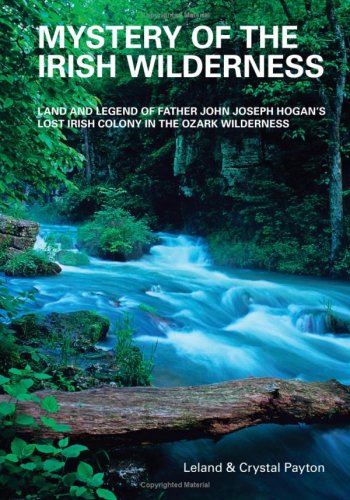
Mystery of the Irish Wilderness: Land and Legend of Father John Joseph Hogan's Lost Irish Colony in the Ozark Wilderness
$18.95
by Leland Payton



For 150 years, the fate of a pre-Civil War Irish settlement on the southern Missouri frontier has been shrouded in mystery. Most Irish who came to the United States in the mid-nineteenth century settled in cities. Mystery of the Irish Wilderness, a new all-color, photographically illustrated book, examines the extraordinary experiment of settling potato famine immigrants in the deep Ozark wilderness and the subsequent history of the place. Hikers and trail riders value the peace and quiet of the Irish Wilderness in southern Missouri. In the 1970s, native Ozarkers and environmentalists clashed over the creation of a no-timbering zone within the Mark Twain National Forest. The battle for The Irish, as preservationists called it, was won when Congress approved a 16,500 acre tract in 1984. One hundred twenty-five years earlier there was a deadlier conflict between locals and outsiders. During the Civil War, Union troops and rebel bushwhackers virtually depopulated the hills. Mixed in with southern highland pioneers were hundreds of recently arrived, impoverished Irish men and women led by a young Irish priest, Father John Joseph Hogan. After the war, many highlanders drifted back. The Irish colony vanished. As written accounts were few, legends grew in the country forever called The Irish Wilderness. Leland and Crystal Payton's new book Mystery of the Irish Wilderness not only sheds new light on these events, it examines a scenic country that has captured the imagination of locals, sportsmen and conservationists ever since. When the Eleven Point became a National Scenic River, Leland was hired by the U.S. Forest Service to photograph the region. Back then I dismissed a lot of this tale as myth, he reflects. I now know the story is real. Many themes come together in this story, explains Crystal: Immigration, war, and the challenges of being Catholic in a fundamentally Protestant culture. Going from Ireland in economic collapse to the wilds of the Missouri Ozark frontier required extraordinary courage and faith. Three decades after the settlement disappeared, J. J. Hogan, then Bishop of Kansas City, included an intriguing account of the founding of the Irish colony in his book, On the Mission in Missouri. Prevented by the Civil War from traveling to his Ozarks mission, Hogan never learned details of the fate of his brave settlement in the wilderness. As well as filling in details of its origin, the Payton's new book reveals information on the colony's demise that would have shocked him. In addition to researching published sources, the Paytons discovered rare unpublished documents relating to the venture. In the archives of the St. Louis Archdiocese is a small notebook Hogan kept that shed some light on the colony's financing. Old maps, local histories, gravestone inscriptions and government land records contributed more tantalizing clues to the still cryptic saga of the Irish Wilderness. Leland and Crystal Payton's MYSTERY OF THE IRISH WILDERNESS is a fascinating, deeply-researched, and beautifully illustrated book. I recommend it very highly to everyone interested in Missouri and Ozark region history, in the history of the Catholic church on the American frontier, and in the history of Irish immigrants in 19th-century America. --Kerby Miller author of Emigrants And Exiles: Ireland And The Irish Exodus To North America (1985) and Irish Immigrants In The Land Of Canaan (2003) Even the most unsuspecting pieces of land can be the most saturated in history. Mystery of the Irish Wilderness: Land and Legend of Father John Joseph Hogan's Lost Irish Colony in the Ozark Wilderness takes a look at the region in the southern United States known as the Irish Wilderness where a colony of Irish Potato Famine immigrants once lived, then left. Covering the entire history of the region, and enhanced with full color photographs, Mystery of the Irish Wilderness: Land and Legend of Father John Joseph Hogan's Lost Irish Colony in the Ozark Wilderness is highly library American history collections. --The Midwest Book Review Leland and Crystal Payton have collaborated on eleven well-reviewed books on popular culture and on the Ozarks and the Midwest. Abbeville, St. Martin's Press and Chronicle Books have published their work. They make their home in Springfield, Missouri.