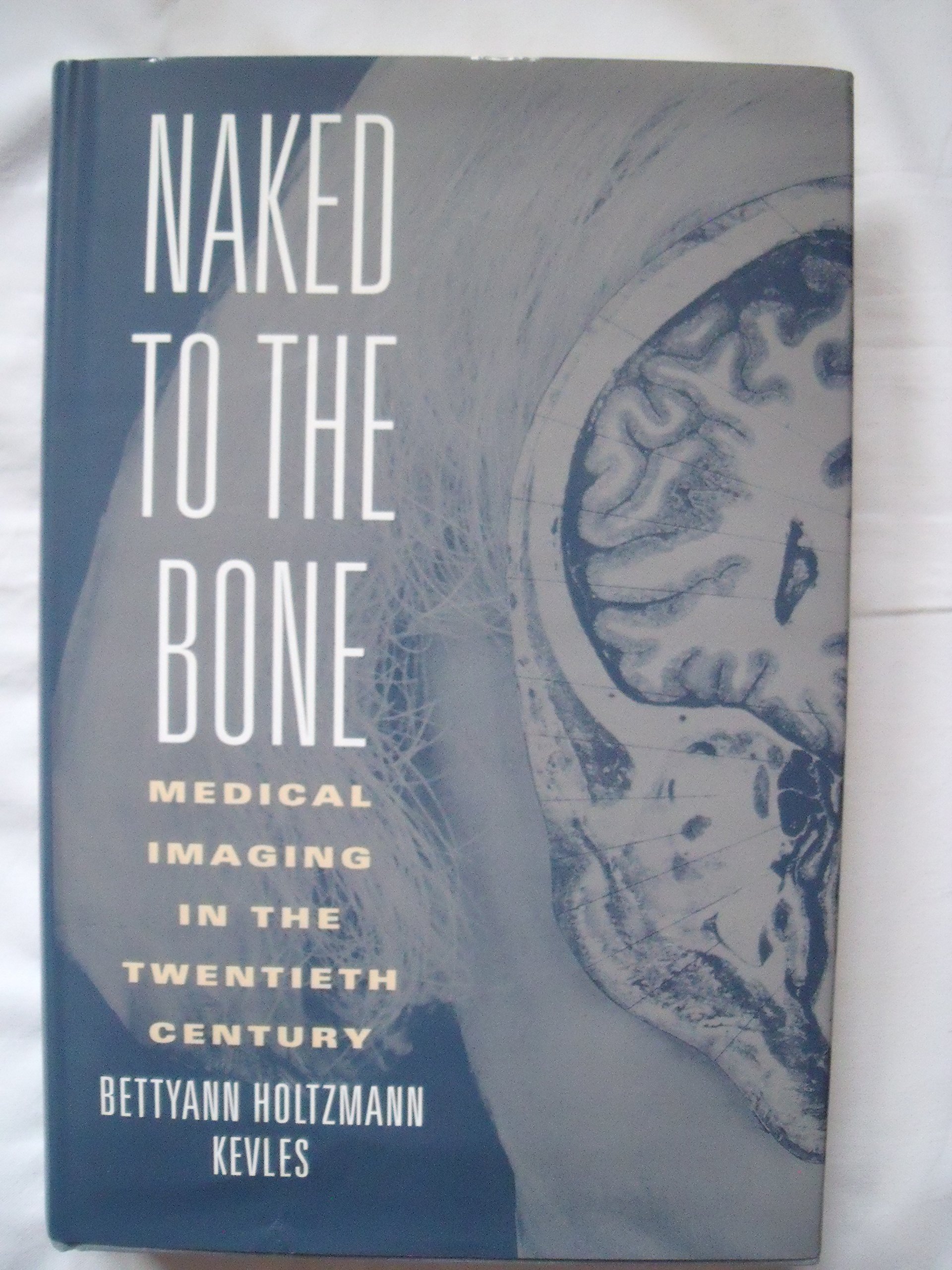
Naked to the Bone: Medical Imaging in the Twentieth Century (Sloan Technology Series)
$31.00
by Bettyann Holtzman Kevles



X-rays, fluoroscopy, ultrasound, CT, MRI, and PET scans--medical imaging has become a familiar part of modern health care today. A century ago, however, the idea of looking inside the living body seemed absurd. Wilhelm Roentgen's X-ray image of his wife's shadowy hand--with her wedding band "floating" around a white bone--convinced doctors to rush the new tool into use for diagnosis and treatment. By the 1920s, the technology was a commonplace wonder: army recruits had routinely lined up for chest X-rays during World War I, and children delighted in seeing the bones of their feet in the green glow of shoestore fluoroscopes. By the late 1960s, the computer and television were linked to produce medical images that were as startling as Roentgen's original X-rays. Computerized tomography (CT) and magnetic resonance imaging (MR) made it possible to picture soft tissues invisible to ordinary X-rays. Ultrasound allowed expectant parents to see their unborn children. Positron emission tomography (PET) enabled neuroscientists to map the brain. In this lively history of medical imaging, the first to cover the full scope of the field from X-rays to MR-assistant surgery, Bettyann Kevles explores the consequences of these developments for medicine and society. Through lucid prose, vivid anecdotes, and more than seventy striking illustrations, she shows how medical imaging has transformed the practice of medicine--from pediatrics to dentistry, neurosurgery to geriatrics, gynecology to oncology. Despite their formidable power to reveal the inner secrets of the body, no form of medical imaging can claim to be the product of a technological imperative. As Kevles points out, few of these costly inventions made it easily to the marketplace, and all are vulnerable to the changing economics of the health-care system. In the early years of X-rays, many doctors, technicians, and patients died from overexposure to the invisible radiation. Although we may still find delayed repercussions from these newer technologies, a different kind of danger may lie in our conviction that an early diagnosis is equivalent to a cure. Beyond medicine, Kevles describes how X-rays and the newer technologies have become part of the texture of modern life and culture. They helped undermine Victorian sexual sensibilities, gave courts new forensic tools, provided plots for novels and movies, and offered artists from Picasso to Warhol new ways to depict the human form. Naked to the Bone offers readers an unparalled picture of a key technology of the twentieth century. It is difficult for us to imagine how mysterious the inside of a living person seemed only 100 years ago, when x-rays were discovered. At that time only God could see a person in the mother's womb; now ultrasound baby pictures, like the one of Bettyann Kevles's grandson on the dedication page of Naked to the Bone , can be mailed out six months before the child is born. Kevles provides an excellent history of the technology of medical imaging--x-rays, CT, NMR, PET, ultrasound, and mammography--but builds on it to examine the wider ramifications of bodily transparency. Anyone going through the high-tech diagnostic gauntlet of the turn of the millennium will want to read this book. X-rays, CT scans, and other imaging technologies have been part of every major advance in clinical medicine in the century, and this book ably captures how new methods in diagnostic imaging heralded new treatments and how the quest for better treatments spawned the invention of better tools for "seeing" within the human body. Kevles, a science writer and reviewer, has done a good job of collecting vivid and apt anecdotes from the history of medical imaging and using them to illustrate the advances?and pitfalls?of the technology. The first half of the book is a particularly thorough and readable history of X-rays, which were the principal diagnostic tool of the first half of the 20th century; the remainder covers more than a dozen imaging devices and techniques, including ultrasound, mammography, PET scans, and the like, ending with a sort of poststructuralist chapter on "artists," whose palette now includes CT scans. This volume will be particularly useful in general collections with strong patronage in science, technology, and medicine and a wise acquisition for specialized collections in the history of science and technology.?Mark L. Shelton, Univ. of Massachusetts Medical Ctr., Worcester Copyright 1997 Reed Business Information, Inc. This readable and informative book takes us from Roentgen and his X rays in 1895 to computerized tomography, magnetic resonance imaging, positron emission tomography, and ultrasound. Kevles describes clearly the medical and scientific context within which each technique was invented, which by itself would make the book valuable. In addition, she shows the effects of those methods (and imaginative variations upon them) as they have appeared in literature, art, and movies, an