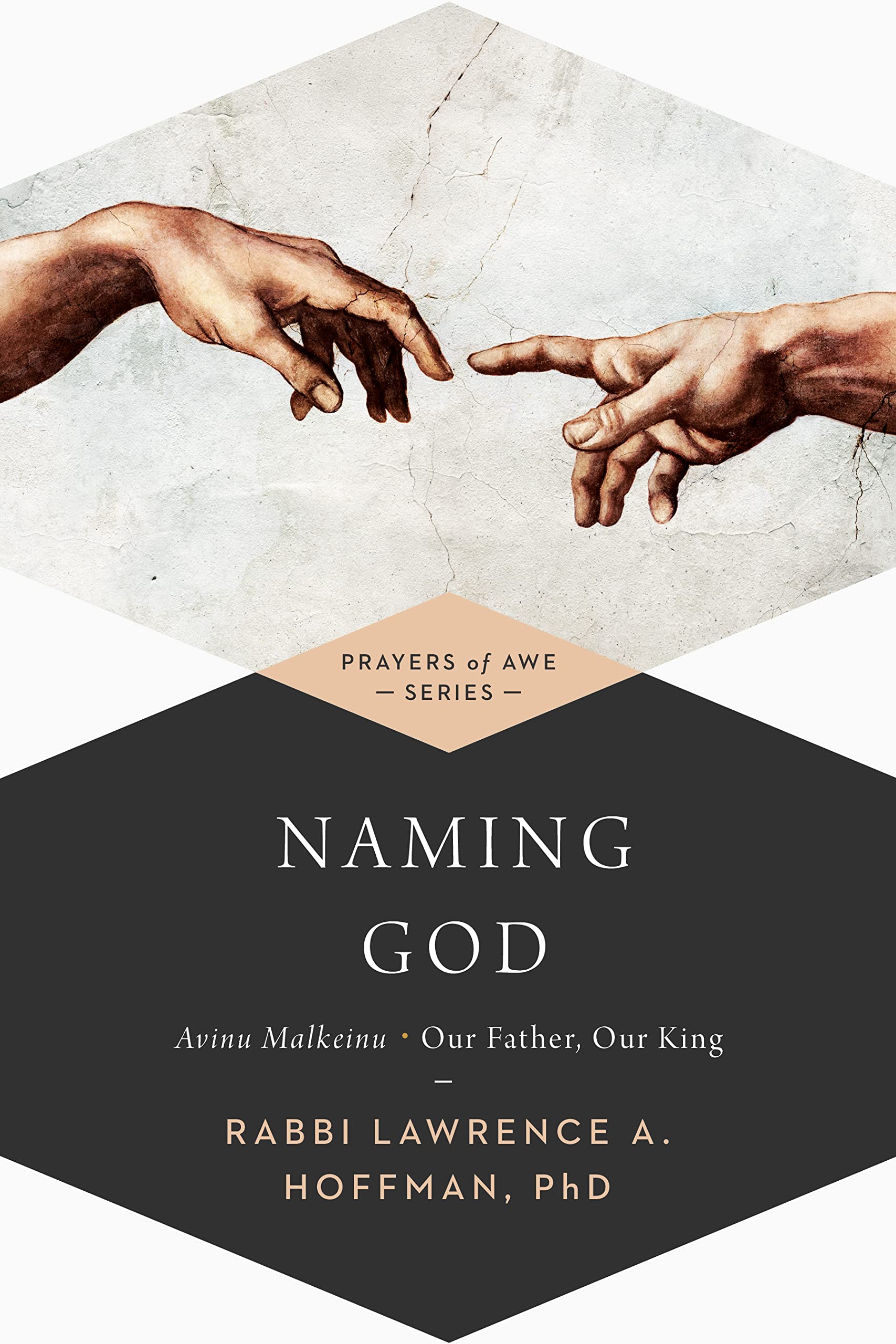
Naming God: Avinu Malkeinu―Our Father, Our King (Prayers of Awe, 6)
$18.00
by Rabbi Lawrence A. Hoffman



An illuminating in-depth exploration of the complexities—and perhaps audacity—of naming the unnameable. One of the oldest and most beloved prayers—known even to Jews who rarely attend synagogue—is Avinu Malkeinu ("Our Father, Our King"), a liturgical staple for the entire High Holy Day period. "Our Father, Our King" has resonance also for Christians, whose Lord's Prayer begins "Our Father." Despite its popularity, Avinu Malkeinu causes great debate because of the difficulties in thinking of God as father and king. Americans no longer relate positively to images of royalty; victims of parental abuse note the problem of assuming a benevolent father; and feminists have long objected to masculine language for God. Through a series of lively introductions and commentaries, almost forty contributors—men and women, scholars and rabbis, artists and thinkers from all Jewish denominations and from around the world—wrestle with this linguistic and spiritual conundrum, asking, “How do we name God altogether, without recourse to imagery that defies belief?” Contributors: Rabbi Bradley Shavit Artson • Rabbi Anthony Bayfield • Rabbi Will Berkowitz • Dr. Annette Boeckler • Dr. Marc Brettler • Dr. Erica Brown • Rabbi Angela Buchdahl • Rabbi Elliot Cosgrove • Rabbi Joshua Davidson • Rabbi Lawrence Englander • Lisa Exler • Rabbi Paul Freedman • Rabbi Elyse Frishman • Rabbi Shoshana Boyd Gelfand • Rabbi Edwin Goldberg • Rabbi Andrew Goldstein • Dr. Joel M. Hoffman • Rabbi Lawrence A. Hoffman • Rabbi Delphine Horvilleur • Rabbi Elie Kaunfer • Rabbi Karen Kedar • Rabbi Reuven Kimelman • Rabbi Daniel Landes • Liz Lerman • Rabbi Asher Lopatin • Catherine Madsen • Rabbi Jonathan Magonet • Rabbi Dalia Marx • Chazzan Danny Maseng • Ruth Messinger • Rabbi Charles H. Middleburgh • Rabbi Jay Henry Moses • Rabbi Jack Riemer • Rabbi Jeffrey Salkin • Rabbis Dennis and Sandy Sasso • Rabbi Marc Saperstein • Rabbi Jonathan P. Slater • Rabbi David Stern • Rabbi David Teutsch • Dr. Ellen Umansky • Edward van Voooen • Rabbi Margaret Moers Wenig • Dr. Ron Wolfson • Rabbi Daniel Zemel • Dr. Wendy Zierler Preparing for the comingHigh Holy Days,I opened my Machzor RuachChadashah ,saw it was publishedin 2003, andwas amazedto realise andthat this yearwill be the13th year of itsuse. How timeflies and where have the years vanishedsince, as a newly ordained rabbi, I joinedthe committee to edit its predecessor Gate of Repentance , which was originallypublished in 1973? The first Liberal Jewish Prayer BookVolume II (for High Holy Days) waspublished by our founding Rabbi Dr IsraelMattuck in 1923―and was used for 51years. I wonder how long our currentmachzor will last? Will it need revisingonce our new siddur appears, wheneverthat will be? Intriguing how a year endingin three seems to mark the publishing ofour High Holy Days prayer books. I have been honoured each year, alongwith Rabbi Dr Charles H Middleburgh, mycoeditor of Machzor Ruach Chadashah ,to submit an essay to Rabbi Laurence AHoffman's volumes on aspects of HighHoly Days liturgy. As well as good for our ego, for amongthe other contributors are names farmore well-known internationally thanours, we would like to think that it hasbeen an opportunity to make known toa wide readership the creativity of theBritish Liberal Jewish liturgy. This year'svolume, the sixth, has over 40 essays, allon just one prayer― Avinu Malkeinu . You might be thinking: how could somuch be written on just one prayer? Mostof the essays seek to solve the problem ofthe opening words; how could a modernnon-Orthodox Jew appeal to "Our Father,Our King"? Charles and I explain how weconsidered various alternatives to thatliteral translation. We rejected theeasy way out of just transliterating theHebrew, as some have done, making theopening verse " Avinu Malkeinu , we havesinned before you." An easy change was from 'King’ to'Sovereign’. After all, as we write, welive “in a country whose head of state isour Sovereign Lady Queen Elizabeth II”.An alternative for ‘Father’ was not quiteas easy. We chose ‘Creator’, based onthe fact that both parents have a part increating us, but we have to admit that itdoes not quite convey the aspect of Godas the close and caring parent. I wonder how Liberal Jews will feelthese High Holy Days, after 13 years ofuse? Did we get it right, or do they missthe literal translation? Do they preferthe alternative formula we have added“ Shechina Mekor Chayyeynu ―DivinePresence, Source of our lives”? Several essays in Hoffman’s bookcome to the conclusion that moreimportant than the actual words is themelody to which they are sung. Think of Kol Nidrey ... the traditional words areunacceptable to a Liberal Jew with itsclaim that just by reciting the formula ourpromises in the year past are cancelled.We happily use an alternative―which Isuspect few read through―but changethe music and so many would object. As you prepare for the High HolyDays, please think about what is mostimportant for YOU: the intellectual