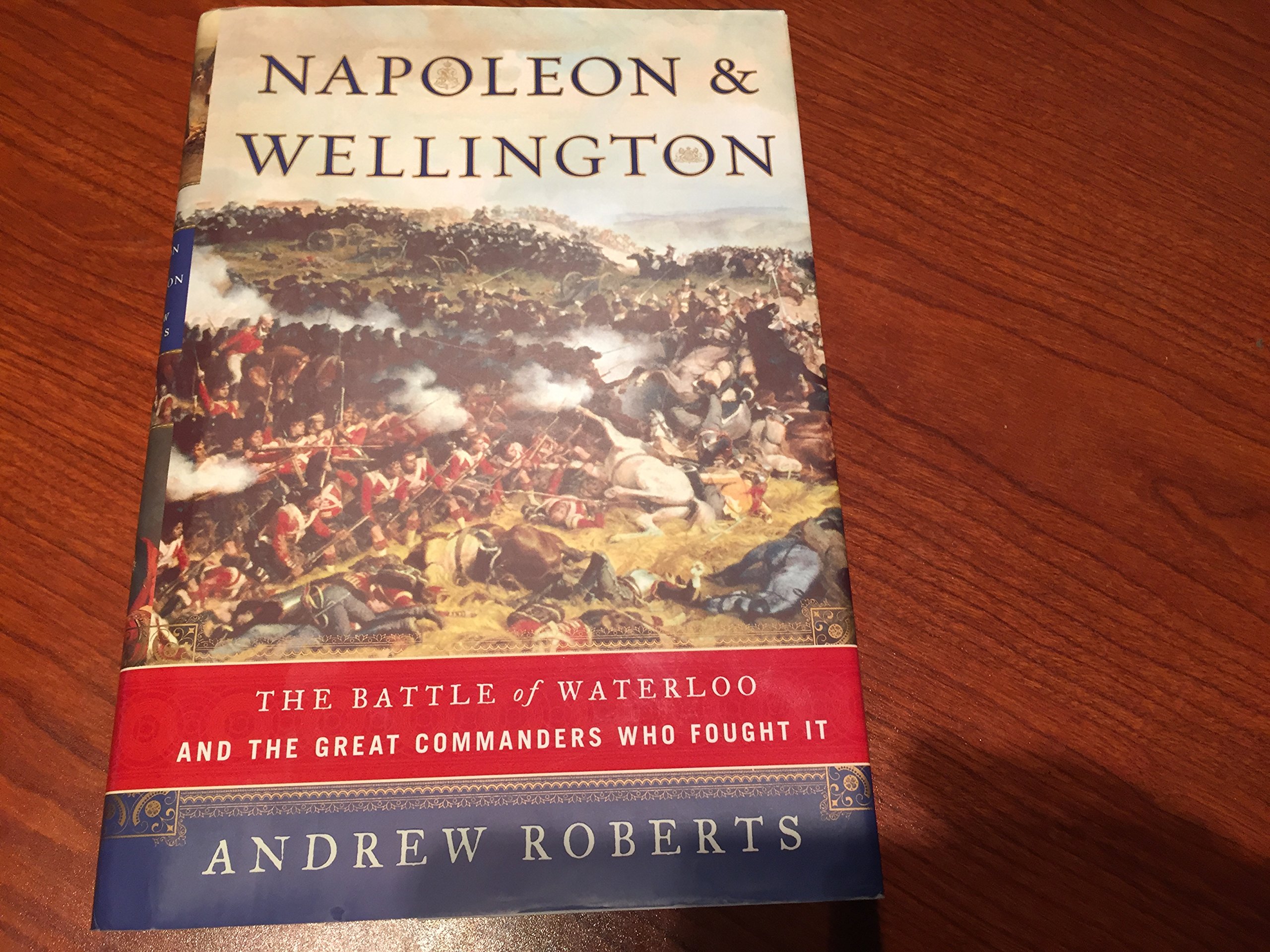
Napoleon and Wellington: The Battle of Waterloo--and the Great Commanders Who Fought It
$27.54
by Andrew Roberts



An award-winning historian explores the relationship between the French emperor Napoleon Bonaparte and the Duke of Wellington prior to and in the aftermath of the Battle of Waterloo, the most decisive battle of the nineteenth century. 35,000 first printing. Arthur Wellesley, the Duke of Wellington, spent a lot of time worrying about whether Napoleon Bonaparte, the emperor of France, was a gentleman. Napoleon accused his English foe of being a coward. Yet, Andrew Roberts shows in this dual biography, each accorded the other an odd respect, and, like wrestlers in a ring, studied his foe's moves intently all the way to their fateful encounter at Waterloo. Publicly, Bonaparte and Wellington professed to despise each other. "Even in the boldest things he did there was always a measure of ... meanness," said Wellington of the French emperor, adding later, "Bonaparte's whole life, civil, political, and military, was a fraud." Napoleon said that Wellington "has no courage. He acted out of fear. He had one stroke of fortune, and he knows that such fortune never comes twice." Yet the two, writes Roberts, were very much alike: social outsiders who found their greatness in the army, scholars of a sort, who brought scientific rigor to the study of topography and logistics, and men capable of inspiring great heroism in their soldiers. In the end, Roberts suggests, Wellington won his battle, but Napoleon won the war. This intriguing study shows how, and it affords much insight into the workings of these great rivals' minds. --Gregory McNamee Roberts (Eminent Churchillians; Salisbury: Victorian Titan) warns that this book is neither "a joint biography" of Napoleon and Wellington nor "a history of the Peninsular or Napoleonic Wars." Instead, it is a study of the personal relationship between the two men-a study that "concentrates on what each man thought, wrote and said about the other." With a 14-page bibliography of archives, historical works, and articles consulted and 18 pages of notes, it is almost too much of a good thing. Not only are we given Wellington's and Napoleon's recorded thoughts, conversations, and writings about each other (from "First Recognition: 1809-1810" to Waterloo and its aftermath) but we are also presented with various reports of what contemporaries remembered hearing (either firsthand or told by a third person), sometimes several years after the fact. That mild complaint aside, what justifies this work's addition to the ever-growing bibliography for these two historical figures is Roberts's in-depth analysis of "the three battles" in which his two principals were engaged: the battle of Waterloo (a victory for Wellington), the battle of their funerals ("the honours about evenly divided"), and their "third and final battle-the struggle for primacy in their posthumous reputations." This final struggle is still being waged. Recommended for all public libraries and academic libraries as well. Robert C. Jones, formerly with Central Missouri State Univ., Warrensburg Copyright 2002 Reed Business Information, Inc. Improbable as it may seem, Roberts has found an original angle on the Battle of Waterloo. It is the personal relationship between the two commanders who conducted the clash that finished the Napoleonic era. Although they never met or corresponded, Wellington and Napoleon wrote and talked enough about each other, especially after the battle, to have created a relationship once removed. Had they met, one can be certain the loathing would have been mutual, as Wellington was an aristocrat and, like most high Tories, he was contemptuous of the Corsican upstart, while Napoleon sneeringly referred to Wellington as a "sepoy general." The self-crowned emperor soon changed his mind after Wellington's victories against French marshals in Spain; this evolving appraisal by each man for the other's professional military ability is the backbone of Roberts' narrative. Abundantly detailed and ably directed to its climax of June 18, 1815, Roberts' intriguing story adds much to a perennially popular topic. Gilbert Taylor Copyright © American Library Association. All rights reserved Christopher Hibbert The Sunday Times Well written and well organized, his study of the relationship between the emperor and the Duke of Wellington is as entertaining as it is instructive, and is original and judicious both as military and personal history. -- Review Andrew Roberts studied Modern History at Cambridge, and his previous books include The Holy Fox, Eminent Churchillians, The Aachen Memorandum (fiction) and Salisbury: Victorian Titan. He writes regularly for the Sunday Telegraph and reviews widely. He lives in London, England. CHAPTER ONE: 'A Fine Time for an Enterprising Young Man' 1769-1799 The Revolution is over. I am the Revolution. NAPOLEON The similarities between Napoleon and Wellington are, at first sight, extraordinary. They were born in the same year -- 1769 -- although controversy exists in