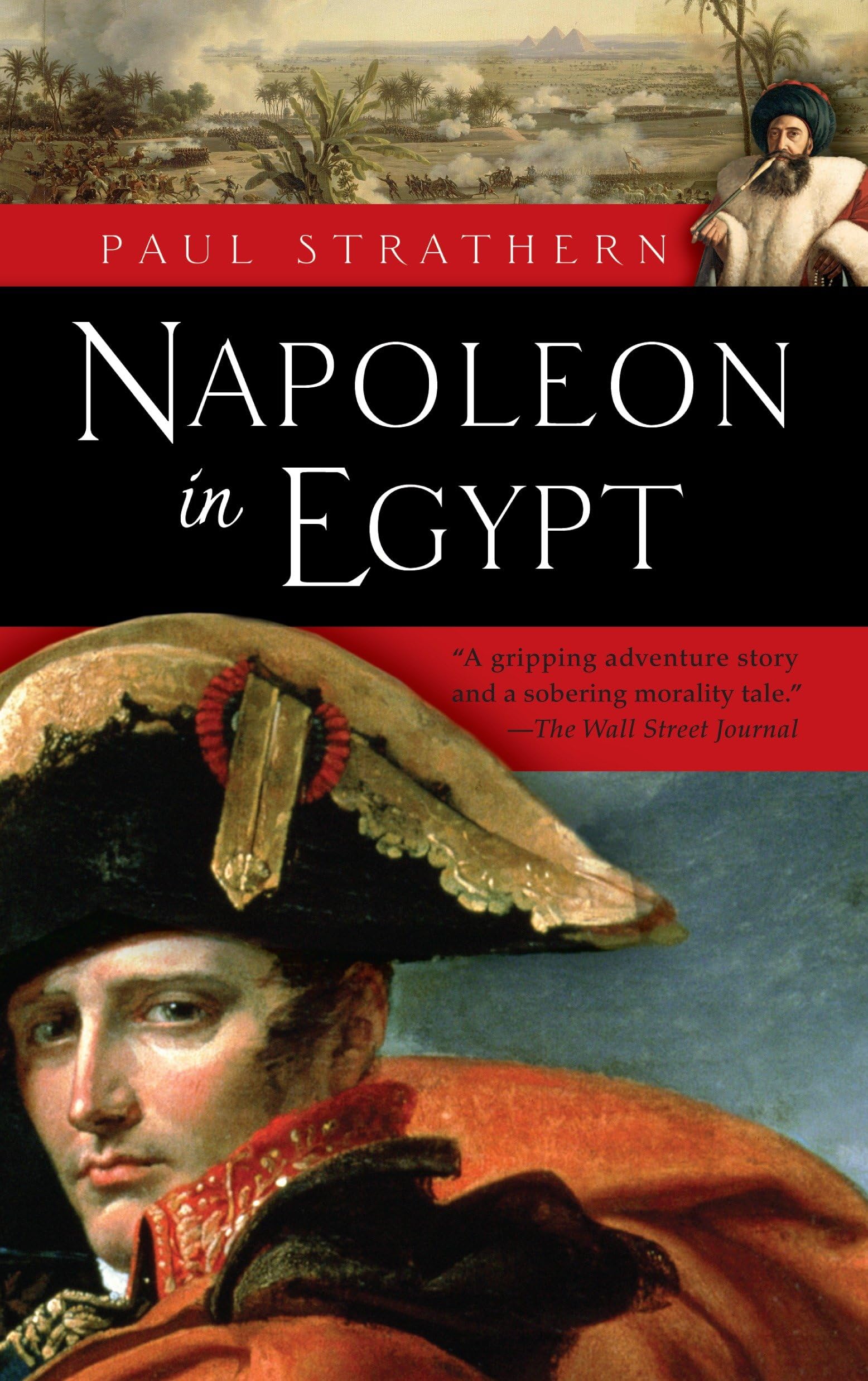



In 1798, Napoleon Bonaparte, only twenty-eight, set sail for Egypt with 335 ships, 40,000 soldiers, and a collection of scholars, artists, and scientists to establish an eastern empire. He saw himself as a liberator, freeing the Egyptians from oppression. But Napoleon wasn’t the first—nor the last—who tragically misunderstood Muslim culture. Marching across seemingly endless deserts in the shadow of the pyramids, pushed to the limits of human endurance, his men would be plagued by mirages, suicides, and the constant threat of ambush. A crusade begun in honor would degenerate into chaos. And yet his grand failure also yielded a treasure trove of knowledge that paved the way for modern Egyptology—and it tempered the complex leader who believed himself destined to conquer the world. “A compelling narrative of an epic collision between two civilizations…. Evok[ing] the incredible hardships endured by French soldiers in an unforgiving land. At the same time, he offers a poignant view of a Muslim society overwhelmed by invaders. … Strathern’s skillful use of memoir and other primary sources brings to life one of the most fascinating campaigns in military history.”— Library Journal , starred review “In between the battle scenes, Strathern paints a portrait of Napoleon the man, sketching his humiliation over wife Josephine’s infidelities and his implausibly lofty ideals, which spawned a generation of Romantic artists.”— Kirkus Reviews “Paul Strathern’s enthralling description of this bizarre imperial adventure reads like Conrad’s Heart of Darkness ….As a piece of storytelling, it is a masterpiece.” —Daily Telegraph “As a stirring narrative of doomed military endeavour, [Strathern’s] book could hardly be bettered.” — Sunday Times “Ambitious and wonderfully detailed saga...Strathern admirably balances the various legacies of the expedition while keeping the focus on its military character.” — Financial Times Magazine “Those looking for an exciting, comprehensive narrative history of the whole expedition are advised to hunt down [this book].” —Tom Reiss, author of The Orientalist “Very entertaining and well-written book. Strathern is very careful about his sources . . . so that a finely balanced picture emerges.” — Times Literary Supplement “A well-written, fast-paced narrative . . . This book is a welcome and readable addition to the ever-growing library of books about this French colossus.” — BBC History Magazine “[Strathern] has written a stirring narrative of the Egyptian adventure, which simultaneously demonstrates how Napoleon’s experiences in Egypt foreshadowed many aspects of his later rule in France.…This is popular narrative history at its best.” — Independent ”Superb . . . Strathern tells the appalling tale of the forced marches across endless deserts . . . with commendable gusto.” — Sunday Telegraph "Illuiminating.... Napoleon in Egypt is undoubtedly the finest account of the Savants and their contribution to the fields of archaeology, ancient history, and botany to date.... A necessary addition to any Napoleonic shelf."— Christian Science Monitor Paul Strathern studied philosophy at Trinity College, Dublin. He has lectured in philosophy and mathematics and is a Somerset Maugham Prize–winning novelist. He is the bestselling author of several books of nonfiction, including the series Philosophers in 90 Minutes and The Big Idea: Scientists Who Changed the World. Chapter One The Origins of the Egyptian Campaign Since earliest times, Egypt had been a source of wonder to the European eye. The ancient Greek historian Herodotus, visiting the country in the mid fifth century BC, encountered the following scene: "During the flooding of the Nile only the towns are visible, rising above the surface of the water like the scattered islands of the Aegean Sea. While the inundation continues, boats no longer keep to the channels and rivers, but sail across the fields and plains. On a journey far inland you can even sail past the pyramids." Less than two centuries later, the Macedonian Greek Alexander the Great conquered Egypt, completing this task in a matter of months, but remaining long enough to found the city of Alexandria, whose site he selected in 331 BC at what was then the western mouth of the Nile delta. After this, in what appeared to be a characteristic act of hubris, but was in fact an attempt to win over the local priesthood, Alexander sacrificed to the sacred bull Apis and had himself crowned pharaoh. He then set off east on his campaign of conquest against the Persians, during which he planted the seeds of Greek culture across a great swath of Asia. Eight years later, having extended his conquests to the limits of the known world, Alexander died after a drinking bout in Babylon, and his body was brought back to Alexandria to be buried in a magnificent tomb, made of gold and glass, whose site has since been lost. In Roman times, Egypt would become the granary of the Me