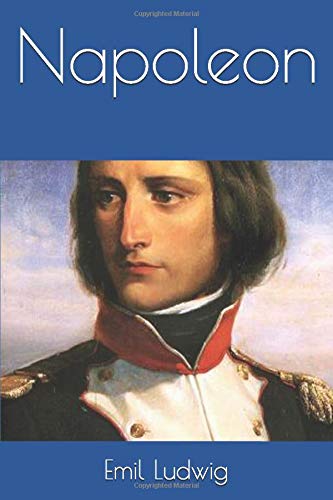



BOOK DESCRIPTIONMore than two hundred years have passed since the battle of Waterloo, which sealed Napoleon’s fate. Still, Napoleon continues to fascinate. A recent biographer introduced him as ‘Napoleon the Great’. Here is a man, it seems, who single handedly crushed the monarchic superpowers of his day to create an enlightened empire, which, although soon vanishing from the pages of history, left a lasting legacy in the cultural, political and legal landscape of Europe. No wonder that the German-Swiss-Jewish writer Emil Ludwig felt attracted by this colossal figure. Ludwig was an expert in the historical and psychological study of great men, whom he believed to be important drivers of history. In the two and half decades which lay between his portraits of Goethe (1920) and Sigmund Freud (1946), Ludwig wrote many memorable political and historiographic works, which reached millions. His biography of Napoleon, first published in 1924 in German, however, remains Emil Ludwig’s magnus opum. The book was especially popular in the US. Among the work’s many admirers was the American author Tom Wolfe, who, under the impression of Ludwig’s work, ventured into his own abortive enterprise to write a biography of Napoleon. Ludwig’s portrait of Napoleon is openly sympathetic. Like his idol, the classical German writer Goethe, who had personally met Napoleon in Weimar in 1808, Ludwig was captivated by Napoleon’s energetic personality. But there was also another factor at play. Ludwig saw himself as a representative of the “other Germany”, which was oriented towards the West and steeped into its classical liberal tradition. In his view – and this is a recurring theme in his books – this Germany had been crushed by the ascendancy of the militaristic Prussian state in the 19th century, a development which ultimately led to Hitler. Prussia had also defeated Napoleon, tying the fate of Ludwig’s “other Germany” and that of the late French Emperor. Ludwig’s focus on the lives of great men was controversial in his times – and is even more so today. The philosopher Hannah Arendt once reproached him with contributing to the idolization of great men in politics. However, Ludwig was no blind admirer of those he portrayed. On the contrary. Living in a time which swarmed with real and supposed great men, he was well aware of the destructive force that the individual could unleash upon society, if it possessed both the unrestricted power, the will and the ability to do so. He reserved his admiration for the common man, which he saw best represented in his times by President Truman. “Especially in politics,” Ludwig said in 1945, “the best man is that inconspicuous reliable worker who, without excessive ambitions, fulfills his civic duty. The celebrities of politics are, everyone on his species, fantastic monsters, bizarre exceptions.”This new edition makes this important work again accessible to the broader public. The fact that such an important writer and thinker like Emil Ludwig should have been forgotten is an historical injustice which needs to be corrected.