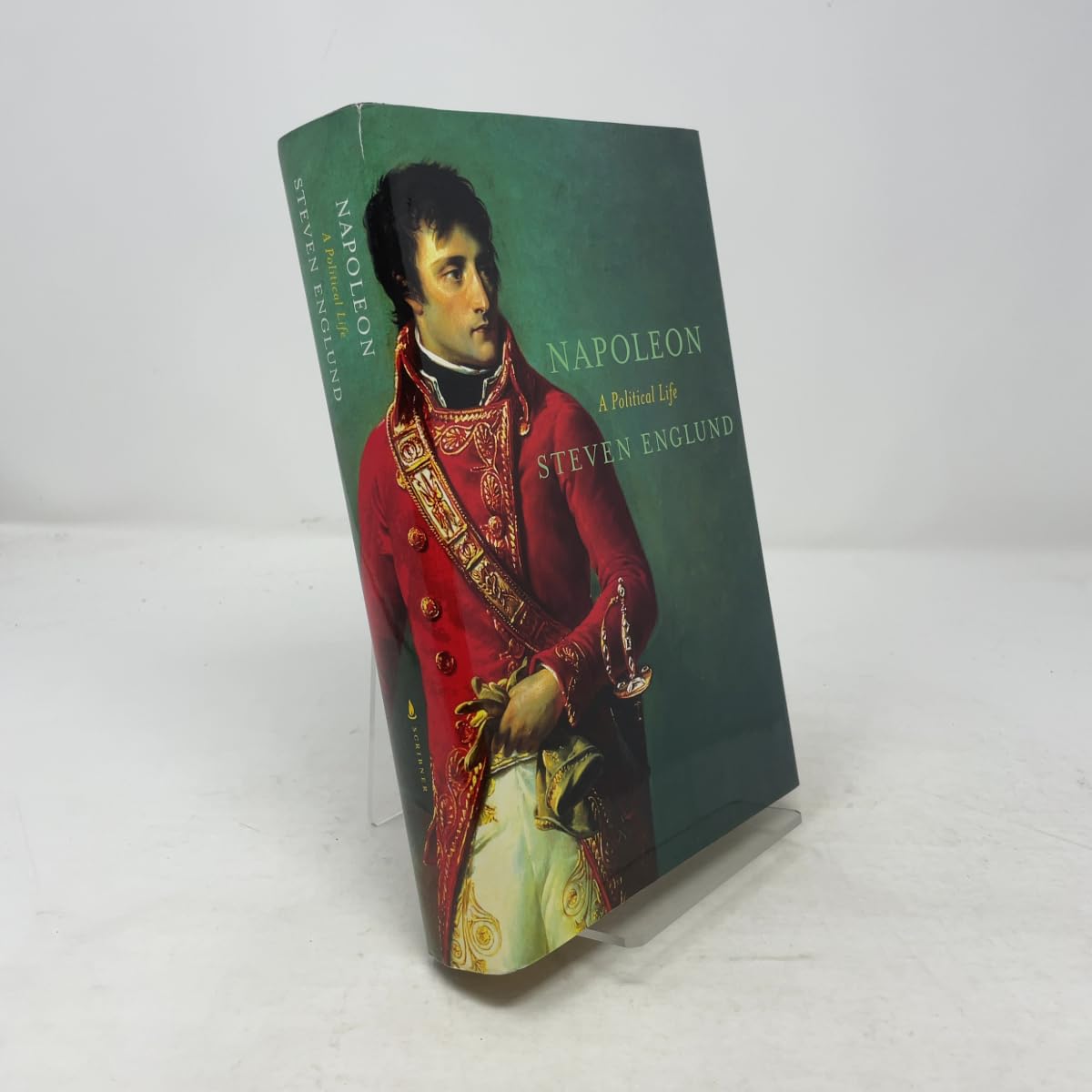



A definitive new political biography of the legendary military leader draws startling new conclusions about the life of Napoleon Bonaparte as it charts his remarkable rise and fall, detailing his devotion to the French Revolution and his seminal influence on the face of nineteenth-century European history. 40,000 first printing. Napoleon is most frequently lionized for his military genius; however, he always placed his military talents at the service of his larger political and personal goals. Historian Englund's biography focuses on Bonaparte's political goals, achievements, and methods. Some recent scholarship has emphasized Napoleon's Corsican origins and his supposed lifelong resentment of French arrogance, but Englund asserts that Napoleon was deeply committed to the ideals of the French Revolution, which allowed outsiders like him to rise as far as their talents could take them. Despite his later efforts to create a family dynasty based upon considerable political repression, Napoleon, Englund insists, remained devoted to many liberal, republican ideals. Englund is an excellent writer whose vivid prose brings the man and his times to life. Although his admiration for his subject seems to lead him to de-emphasize Napoleon's egotism and cynicism, this is still a valuable addition to our knowledge of one of the most compelling personalities in history. Jay Freeman Copyright © American Library Association. All rights reserved **starred review** Remarkable . . . Englund has produced a definitive work that belongs in every European history collection. -- Library Journal, November 15, 2003 A great work of empathy by a deeply knowing biographer . . . one of this new century's towering achievements in biography. -- The New York Sun, January 14, 2004 An all-encompassing study . . . Englund is a stylish writer . . . A rigorous contribution to the literature surrounding Bonaparte and his time. -- Kirkus Reviews, October 20, 2003 Englund takes the measure of his flawed character with an unusually nuanced sense of proportion. . . . masterful . . . Englund should be commended. -- The Washington Post, March 7, 2004 Englund's fluent and engaging narrative perfectly captures its epic and dramatic qualities. . . . a veritable tour de force. -- The Times (of London) Literary Supplement, February 20, 2004 [A] lively biography . . . [Englund] provides readers with a fuller view of the man and his actions. -- The New York Times Book Review, February 22, 2004 The Napoleon industry continues to produce books at a relentless pace. How can a reader keep up? We've had several recent biographies and a procession of studies on nearly every aspect of Napoleoniana, from his wives to his youthful literary exertions. Even the minutiae of his life and times send historians scurrying to the archives -- consider the scholar who spent seven years researching a single 1813 military campaign in Prussia. But with all the ink spilt on Napoleon, perhaps the most studied figure in human history, it is sometimes hard to get a clear fix on this man, who was small in stature but larger than life. A lively debate persists about the nature of his reign and the content of his character. Was he merely an upstart Corsican and craven dictator or a visionary leader and herald of modernity? He was a hero to Byron and Hegel in his own time, but in ours there has been a pronounced tendency to see him as a forerunner of Hitler, Stalin and 20th-century totalitarianism. Steven Englund, in his strikingly argued new biography, would have us think otherwise. Though the author, a freelance university lecturer, concedes that Napoleon would not have been a particularly nice man to have dinner with, he pointedly argues that Napoleon's rule, while dictatorial and authoritarian, was a far cry from Hitler's or Stalin's. Nor was it nearly as inhuman: "We search the annals of the First Empire in vain for crushing acts of pure evil, on the order of the Gulag, the Final Solution, the Night of the Long Knives." Still, if he has not quite reinvented Napoleon as an enlightened dictator, Englund takes the measure of his flawed character with an unusually nuanced sense of proportion. He is an animated, often witty stylist, who isn't reluctant to take shots at his subject's titanic self-regard: "Napoleon Bonaparte," Englund quips, "was a self made man, and he worshipped his creator." Thankfully, however, Englund goes light on the psychology. Napoloeon was a narcissist, yes, but hardly a warped little man with a mother fixation. ("True, he was short, at five feet three," Englund notes, "but not dramatically so for the era.") Englund's special focus is on Napoleon's "evolution as a political animal" and his dual identity as a warrior and statesman. The author rightly stresses Napoleon's complex, nettlesome entanglement with the ideals and consequences of the French Revolution, which "framed his consciousness and his conscience." It had profoundly altered the r