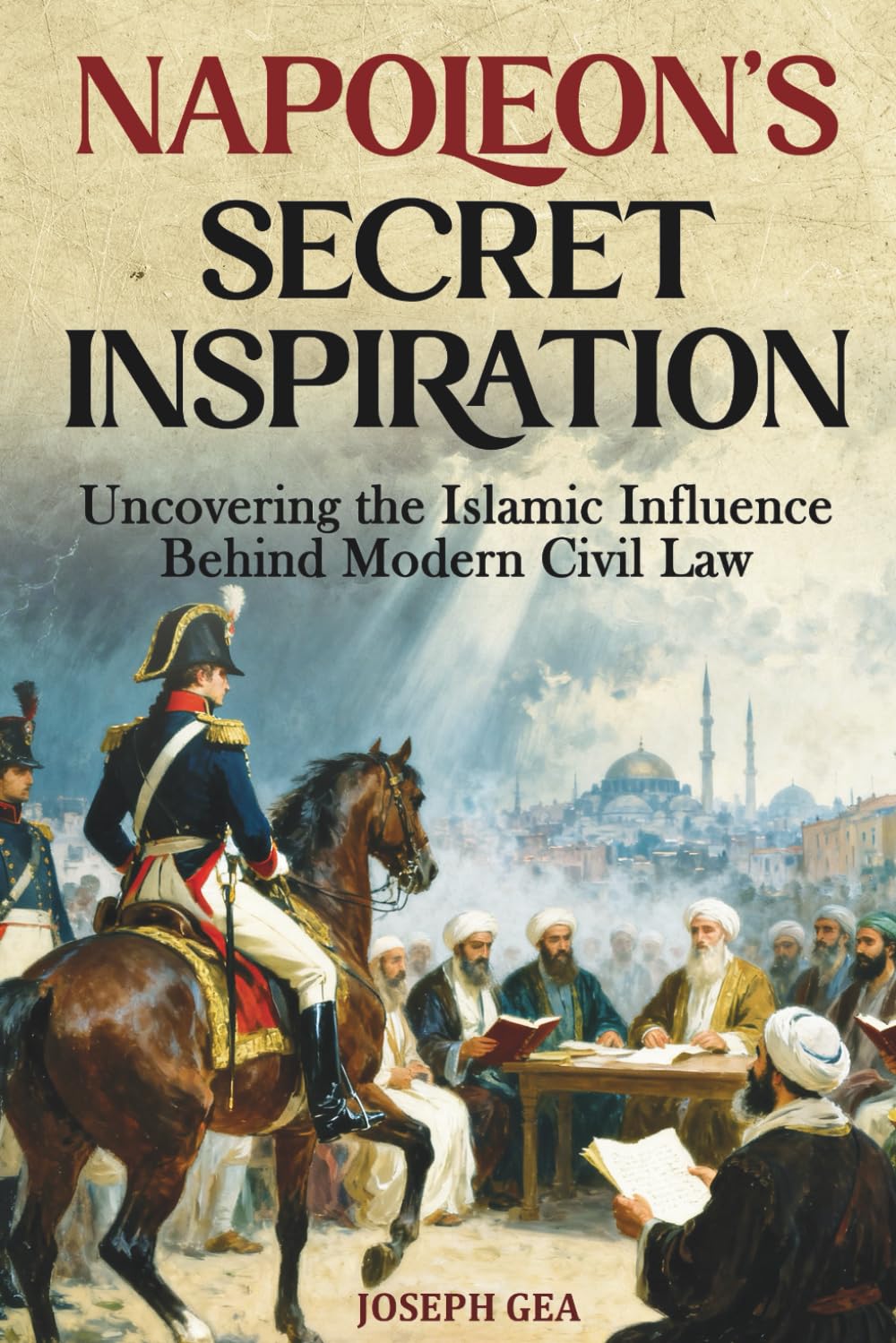
Napoleon’s Secret Inspiration: Uncovering the Islamic Influence Behind Modern Civil Law
$14.99
by Joseph Gea



What if one of the foundations of modern European law was shaped far from Europe? Napoleon Bonaparte is remembered as a conqueror and the architect of modern French law. Imam Malik ibn Anas is remembered as a jurist and guardian of Islamic legal tradition. History almost never places them side by side. This book does. Rather than shouting “imitation” or “plagiarism,” this study follows something more subtle—and more unsettling: convergence. When Napoleon entered Egypt in 1798, he encountered not only an ancient civilization, but a legal order that worked. Islamic courts, especially those shaped by the Maliki school, governed daily life with quiet stability: law applied consistently, authority endured, and society functioned without codified European frameworks. Years later, when Napoleon reshaped France through the Civil Code, many of the solutions he enforced echoed principles long embedded in Islamic jurisprudence. Was this coincidence, independent rediscovery, or quiet learning without acknowledgment? This book explores that question with rigor, restraint, and honesty. Inside, you’ll discover: • Why Napoleon believed law could be stronger than armies • How Islamic courts maintained order without Western-style codification • How Imam Malik’s emphasis on restraint, continuity, and custom created durable stability • How Napoleon limited judges, simplified law, and enforced predictability—and why that mattered • Where the paths of Napoleon and Imam Malik converge and where they clearly diverge • Why legal influence is often harder to admit than invention • How powerful legal ideas travel silently across civilizations This is not a book about religion versus secularism. It is a book about power, order, and what actually works. It does not claim that Napoleon “copied” Islamic law. Instead, it shows how effective governance tends to obey certain truths—regardless of culture, century, or belief. Napoleon emerges not as a copyist, but as a synthesizer. Imam Malik appears not as a relic, but as an architect of durability whose ideas echo far beyond his own world. This book is for: • Readers of history who want depth without academic dryness • Thinkers interested in law, power, and governance • Anyone curious about how civilizations quietly learn from one another • Readers who suspect that modernity is more inherited than admitted Why this book matters Because law remembers even when history forgets. Because influence does not always announce itself. And because some of the most important connections in history are the ones no one wanted to name. If you believe history is more complex—and more connected—than we’re usually told, this book is for you.