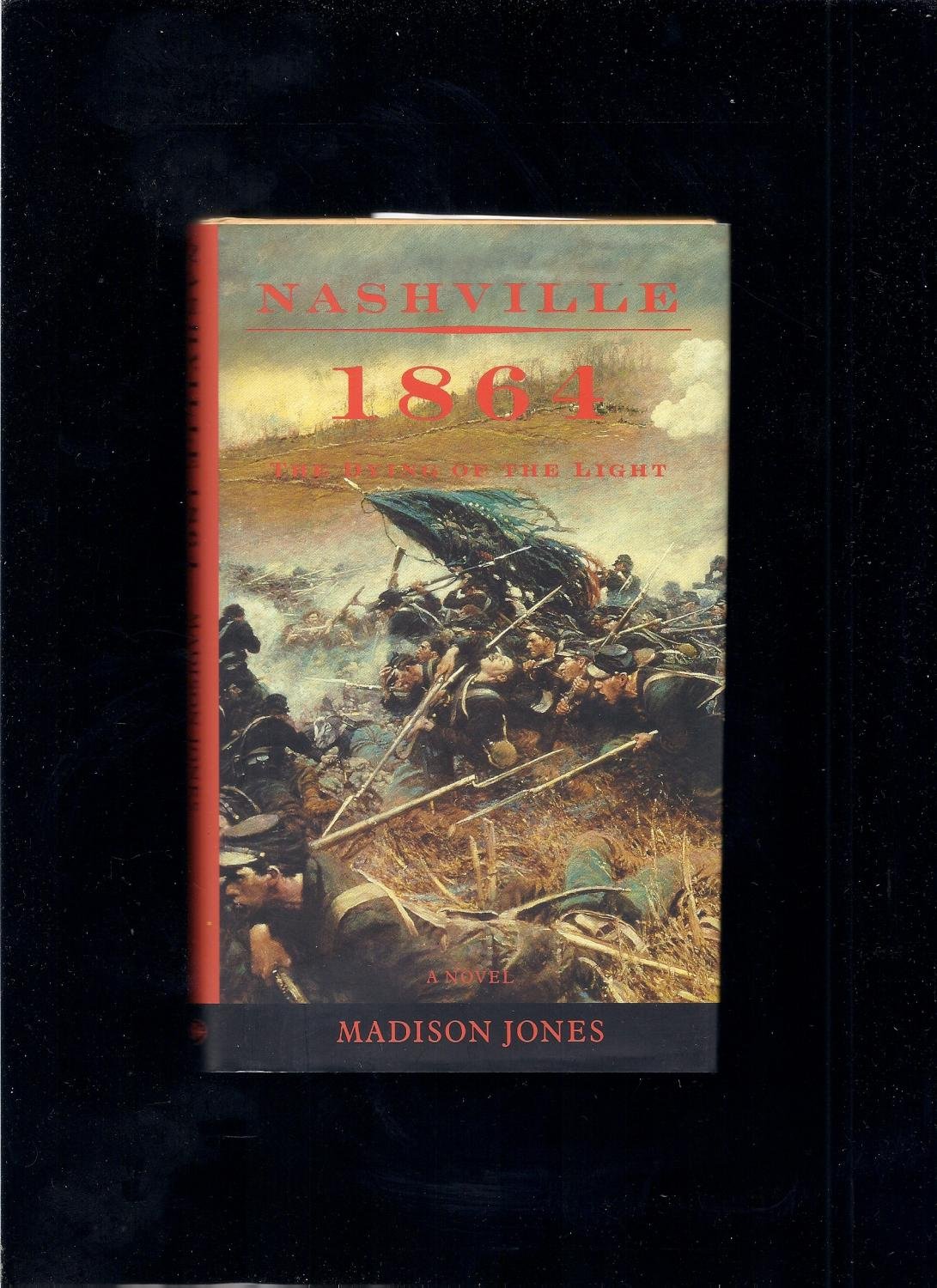



War is Hell. YA?An important addition to Civil War literature. Jones tells of the occupation of Nashville, Tennessee, by Union soldiers. However, the perspective from which he writes makes the story especially appealing to young people. Now a grown man, the main character recalls the events of the war and its impact on his family when he was 12. Steven and his family live just outside Nashville and are trying to hold on as the war rages around them. His father has gone off to fight with the Confederates, and the family has heard nothing from or about him. Steven, with the certainty of youth, sets off with his slave companion, Dink, to locate his father, give him some food, and return with word of his condition. Jones writes with a tender and understated simplicity to convey the confusion and tragedy the boys experience as they muddle through fog, smoke, and cannon and gun fire. The scene in which the boys witness the ambush of black Union troops is particularly touching. Dink is deeply shaken by the sight, and Steven finally says, "They were Yankees too, come to take our country away from us. We got to fight back." To which Dink replies after a silence, "They was niggers just like me."?Cynthia J. Rieben, W. T. Woodson High School, Fairfax, VA Copyright 1998 Reed Business Information, Inc. A somber, spare portrait of the Confederacy's twilight, as witnessed by a 12-year-old. The plot has the simplicity of a folk tale. Steven Moore sets out to find his father, a soldier, on the eve of a great battle, and becomes an eyewitness to the carnage. Jones, the author of seven previous novels (To the Winds, 1996, etc.), has the measured cadence of southern voices down perfectly. The book is purportedly a memoir written by Moore decades after the events it describes, as he seeks to make sense of what he experienced. In December 1864, the ragged, shell-shocked Confederate army under Gen. Hood moves to confront the Union forces outside Nashville. Steven's younger sister is seriously ill, his mother exhausted, their farm, close to Nashville, menaced by Union forces, so he decides to bring his father, an officer in Hood's forces, home. He takes Dink, one of his family's slaves, with him. Dink, who is Steven's age, views the trip, at first, as a curious adventure. But their encounter with a black Union soldier, who tells Dink that he is free, confuses and disturbs him. The boys reach Hood's army just as the battle of Nashville begins. Steven discovers that battles are entirely unlike his imaginings: They are confused, bloody, terrifying events. Dink is killed, and a wounded Steven begins a hallucinatory journey with the retreating Confederates. These scenes have a raw power and harsh originality that set them apart from most recent fiction about the War. The narrative, though, suffers by seeming so entirely partisan. Dink is a cipher. The grown Steven's rhapsodic celebration of the Confederate soldier, and his defense of slavery- -while perfectly believable in this character--diminish the book's power somewhat. The story would have benefitted from some authorial distance. It seems, finally, too partisan to be entirely compelling. A flawed but intermittently powerful work. -- Copyright ©1997, Kirkus Associates, LP. All rights reserved. An important addition to Civil War literature. -- School Library Journal, Jan. 1998 In Nashville 1864, a riveting, harrowing, important small book, Madison Jones has shown how and why our history is so filled with regret. -- Fred Chappell, Raleigh News and Observer, Aug. 31, 1997 On Madison Jones: "He's so much better than the ones all the shouting is about."--Flannery O'Connor On Nashville 1864: "This particular episode of a large and tragic history has never been so powerfully voiced."--Madison Smartt Bell, author, All Souls' Rising Madison Jones is professor emeritus of English at Auburn University. Here we are on honored ground. The story of two friends, one white and one black, going off together to face unknown dangers, has its roots in that most paradigmatic of American novels, "The Adventures of Huckleberry Finn," and recurs in various forms in the work of William Faulkner. It encapsulates in miniature many of the greatest themes of American history and literature, from the burden of slavery and race to the longing for exploration and the new. It is momentous business, and Madison Jones rises to it. . . .Brief though it is, "Nashville 1864" is populated by a large cast of thoroughly believable characters, it moves forward with irresistible narrative force, and it is written in prose of the utmost elegance. It is, in all respects, a splendid piece of work. Used Book in Good Condition