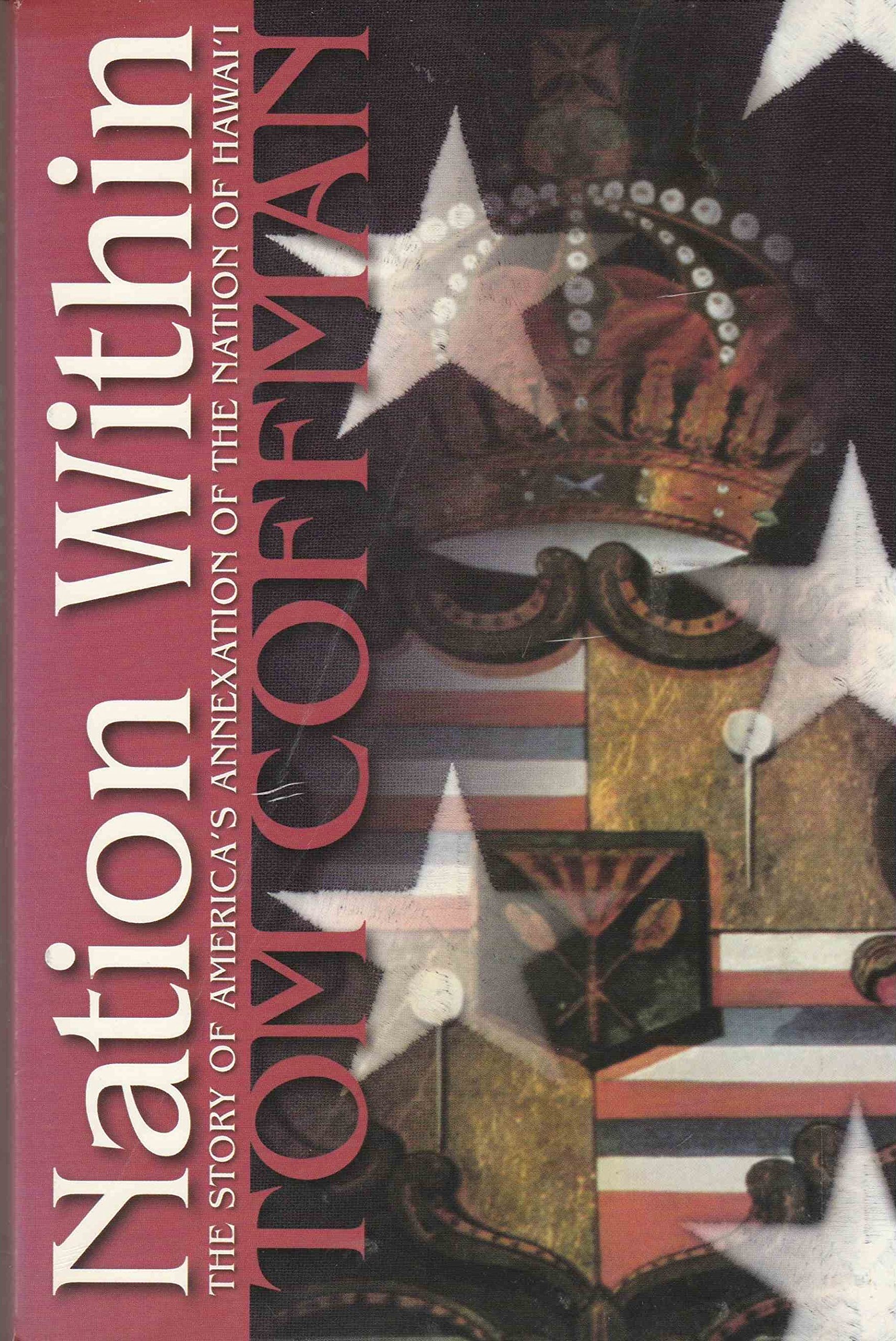
Nation Within: The Story of America's Annexation of the Nation of Hawaii
$39.20
by Tom Coffman



The Honolulu Star-Bulletin called this book "a new vision of Hawaiian history," a nation-to-nation story that brings the once-independent nation of Hawai'i to life. As the 19th century wanes, America incessantly pressures the native government for ever-greater control, then conspires with missionary descendants to overthrow the island government. Long-buried evidence reveals that the native Hawaiians, far from being passive, engage in a five-year resistance against annexation. The American axis that runs between Washington and Honolulu, thwarted in its ambition, desperately turns to an insult of Japanese immigrants and a dangerous provocation of Japan. Native Hawaiian lobbyists in Washington again stymie an annexation treaty. But the American drive to expand into a first-rate power is relentless, finding new opportunities when the U.S.S. Maine blows up in Havana Harbor. " ... Coffman has gracefully constructed a new vision of Hawaiian history, broader perhaps than any produced in the last 100 years ... a stunning, trans-oceanic story ..." -- Kehaulani Lum, Honolulu Star-Bulletin "... moves to center stage an American well-known for many other things, but seldom connected with Hawaiian history -- Theodore Roosevelt ..." -- A.A. Smyser, Contributing Editor, Honolulu Star-Bulletin "Astronomers peer into the daunting depths of space, attempting to find black holes ... historians like Tom Coffman are looking backward, only a century, and see a black hole blanking out the events of 1898." -- Burl Burlingame, author and historian "The book answers big questions. Were the overthrow and annexation isolated events, idiosyncratic to an island nation? Or were the events an outgrowth of American manifest destiny? What were the international implications? Who were the key players, here, and in Washington? What drove them and what were the interrelationships?" -- Chuck Freedman, Honolulu Advertiser "Tom Coffman has gone on a far-reaching treasure hunt for long-buried facts, revealing for the first time the full array of events and shifting international forces that led to the overthrow and annexation of the Kingdom of Hawaii ... not to be missed ... " -- Herb Kawainui Kane, artist/historian Having survived the brutal cold of Washington's winter, the Hawaiian delegation welcomed spring. Having survived yet another campaign to annex their homeland to America, they took a brief moment to remark cheerfully on the survival of Hawai'i as an independent nation. Perhaps the moment for America to take over Hawai'i had come and gone, and perhaps the Hawaiians could now get their country back. The queen of Hawai'i had been living in a hotel in Washington during most of 1897, and the delegates of the native political societies had arrived toward the end of the year, in the dead of winter, to support her with the most ambitious of their many petitions. The delegation had come from mass rallies in Hawai'i against annexation that had been attended by thousands of Hawaiians, who now were nearly one quarter of the earth's surface away. At one of the rallies against annexation, a speaker had likened the Kingdom of Hawai'i to a house, which had been built by the great king, Kamehameha. A handful of foreigners had taken over the house, and they had given the Hawaiians a lei stand in return, where the Hawaiians were expected to reside and sell flowers. Would the Hawaiians live in the lei stand? "Agole," the crowd had shouted back. No, never. When the delegates to Washington closed their eyes they could remember the faces, the families, and the petitions passing from hand to hand for people to sign their names. As a result of the petition drive, the Hawaiian delegation had arrived in Washington with thirty-eight thousand signatures protesting America's proposed annexation of their country, and they were eager to call the petitions to the attention of influential Americans. Considering that only forty thousand or so Hawaiians survived, it was surely true, as their opponents said, that some of the signatures were duplicates, and some were the names of children, and perhaps some were names of the dead. But the petitions nonetheless were a virtual census of the Hawaiian nation, as Hawaiians still called themselves, and the petitions said eloquently that in spite of everything that had happened, they wanted to be what they had been, a nation in the world system of nations. Used Book in Good Condition