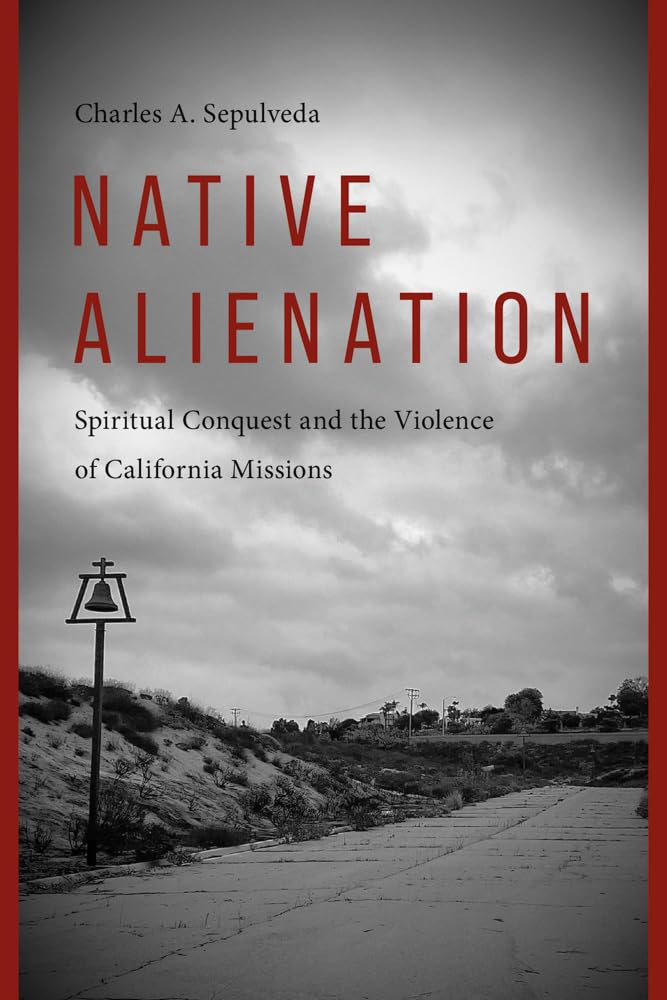
Native Alienation: Spiritual Conquest and the Violence of California Missions (Indigenous Confluences)
$30.00
by Charles Sepulveda



Challenges the romantic portrayal of Spanish missions Sites of slavery and spiritual conquest, the California missions played a central role in the brutal subjugation of the region’s Indigenous peoples. Mainstream California history, however, still largely presents a romanticized portrait of the creation of the twenty-one Spanish missions between San Diego and Sonoma in the late eighteenth and early nineteenth centuries. Providing a corrective to this benign historiography, Charles A. Sepulveda reconstructs the violence toward Native people as well the resistance and refusals of his ancestors and other Native people during and after the Spanish genocide. The conquest enforced the attempted spiritual possession of Native souls and the physical position of Native bodies and the land. At the same time, it strengthened the Spanish view of California’s Indigenous people as disposable. Sepulveda demonstrates how enslavement was a key method of conquest, putting to rest the myth of the Spanish as benevolent and beneficial. Centering the experiences of Native peoples, Sepulveda brings to light the gendered dimensions of the conquest and genocide. His fuller history confronts the erasure of Indian individuality and resistance and historicizes the relationship between enslavement, dispossession, and environmental degradation. He also illuminates the mission system’s central role in destroying Indigenous people’s relationships to the land while examining the practice’s centuries-long impact on the lives of Native people. A groundbreaking reconsideration, Native Alienation transforms our understanding of California Indian history. "Offers a much-needed, well-documented, and appropriately scathing critique of Catholic missions and their participation in the cultural genocide of Native Californian people. This is a valuable contribution to Indigenous history and Indigenous religious studies, painting a powerful portrait of political and religious colonial history as well as contemporary California Indian cultural and spiritual retrieval."―Suzanne Crawford O'Brien, author of Religion and Culture in Native America "Focusing on the region currently called California, Sepulveda examines the ghosts of missionization, colonization and dispossession – the “afterlife” of violation. No longer shrouded with misnomers like “progress” or “religious conversion,” he calls out their true name: genocide, enacted with unimaginable cruelty by Spanish priests and soldiers in the name of spiritual and physical possession. Sepulveda points out that while resistance, survival and empowerment run like a thread through California Indian history, it has come with a price: whatever empowerment we gain, we cannot walk away as if unscathed by such a history, but must carry it with us, acknowledging what has been irreparably lost, and what must be reinvented. To ignore it is to ignore the crime that was colonization, and which continues to be committed against our sovereignty. This is a wise and sobering project."―Deborah A. Miranda, author of Bad Indians: A Tribal Memoir "Carefully researched, with accounts of specific California Indians, Native Alienation offers a powerful account of both violence and resistance. . . . [Sepulveda's] attention to gendered violence offers an added level of depth to his analysis."― Ethnic and Racial Studies " Native Alienation is an important intervention into Spanish mission-era historiography and contributes significantly to the political project of reclaiming California Indian narratives and modes of research for a collective anticolonial voice."― News from Native California "[Sepulveda] makes a strong argument that historians have not fully recognized the complexity of Indian resistance to the sudden Spanish presence on their land and largely failed to incorporate a native perspective . . . [T]houghtful and well written."― Pacific Historical Review "While this is a work of history, it is equally, if not more, informed by the author’s training in ethnic studies. As such, the author uses a multidisciplinary approach, combining Black studies, Chicanx studies, and even literary studies. This is arguably the work’s most striking feature: It expands the typically insular field of California mission history. . . . Overall, this monograph is a thought-provoking contribution to the field of mission studies, which will be of great value to those in California history, ethnohistory, and Native American and Indigenous studies."― American Historical Review "Sepulveda’s history is steeped in an ethos of care and relationality that endures to the close of the book. . . . Beyond its vital contributions to California history, California Indian studies, and California mission studies, Native Alienation is a significant contribution to the literature in comparative colonial history."― California History Challenges the romantic portrayal of Spanish missions Charles A. Sepulveda (Tongva and Acjachemen) is a