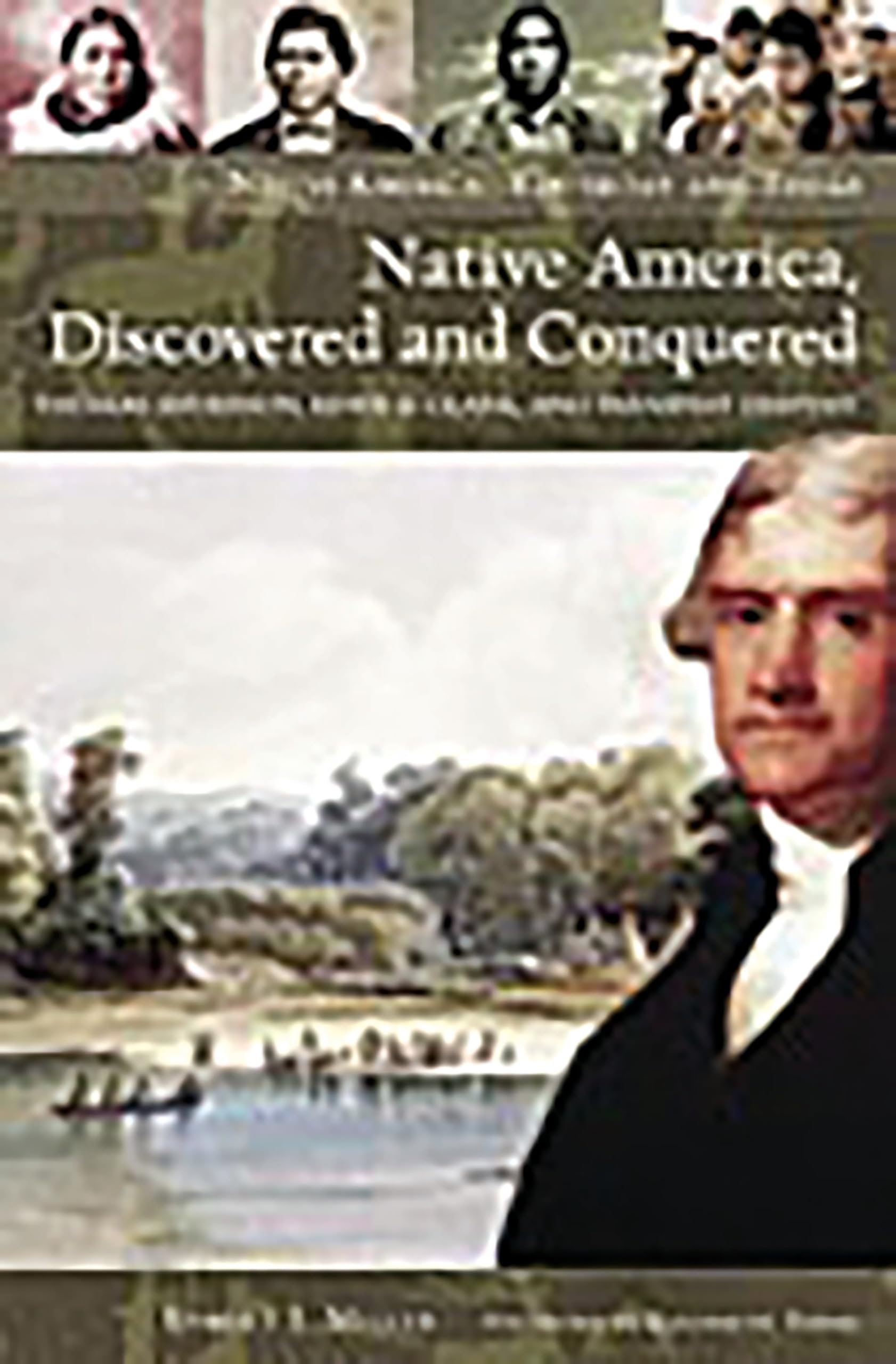
Native America, Discovered and Conquered: Thomas Jefferson, Lewis & Clark, and Manifest Destiny (Native America: Yesterday and Today)
$58.52
by Robert J. Miller



Manifest Destiny, as a term for westward expansion, was not used until the 1840s. Its predecessor was the Doctrine of Discovery, a legal tradition by which Europeans and Americans laid legal claim to the land of the indigenous people that they discovered. In the United States, the British colonists who had recently become Americans were competing with the English, French, and Spanish for control of lands west of the Mississippi. Who would be the discoverers of the Indians and their lands, the United States or the European countries? We know the answer, of course, but in this book, Miller explains for the first time exactly how the United States achieved victory, not only on the ground, but also in the developing legal thought of the day. The American effort began with Thomas Jefferson's authorization of the Lewis & Clark Expedition, which set out in 1803 to lay claim to the West. Lewis and Clark had several charges, among them the discovery of a Northwest Passage―a land route across the continent―in order to establish an American fur trade with China. In addition, the Corps of Northwestern Discovery, as the expedition was called, cataloged new plant and animal life, and performed detailed ethnographic research on the Indians they encountered. This fascinating book lays out how that ethnographic research became the legal basis for Indian removal practices implemented decades later, explaining how the Doctrine of Discovery became part of American law, as it still is today. “In rationales for the invasion of the Americas, one legal instrument stands out in high relief: Europe's so-called Doctrine of Discovery. In the first third of the 19th century, it morphed into the purely US doctrine of Manifest Destiny. Modern US historians know this much, but nearly none know the legal complexity or sweep of these ideas. When they are laid shockingly bare, as in Miller's important book, they are quickly seen to have been both idiotic and revered. Americans easily grasped the Doctrine of Discovery's ten legalisms for land seizure and incidental genocide before the 20th century, with the later Manifest Destiny dashing even the pretense of Native rights. Miller walks readers through deep, consistent evidence that Thomas Jefferson patterned his Louisiana expansionism upon the legal pretexts of discovery, setting up removal in the process. Miller carefully traces the racist, greedy religiosity of Manifest Destiny next used to seize Indian land, especially in Oregon, showing it also as the basis for laws applied to Native Americans that appallingly continue in effect into the present. A must read. Essential. All libraries serving students of any period of US history.” ― Choice “This is an easy-to-read, informative, and well-researched book. Miller manages to describe a complex international doctrine in layman terms and keep the readers' interest along the way. It will be enjoyed by those studying legal, U.S. or Native American history.” ― Tribal College Journal “This history has been examined thoroughly by previous scholars; what Miller adds to the discussion is a thorough study of Jefferson's infatuation with the principle and a determination to link doctrine of discovery to the emergence of the American belief in Manifest Destiny….Miller's thoroughly researched and determined argument is significant for at least three other reasons. First, he points out that the doctrine of discovery was not only the foundation of American territorial and political hegemony over our nation's indigenous peoples, but that it is a living, breathing principle that courses through contemporary American Indian law and political calculations. Second, the book complements an important and expanding historiography on the ideology and cant of Euro-American conquest. Finally, Miller does not simply lament the tragedies wrought by the doctrine of discovery; he offers the United States an honorable way out of the legal miasma produced by two centuries of adherence to the doctrine” ― Oregon Historical Quarterly “[T]akes a fresh approach in placing the discovery doctrine at the center of analysis of the Lewis and Clark expedition, and he proves an interesting discussion of the explorers' use of rituals and symbols that echoed earlier European practices….[M]iller's legal insights provide a useful contribution to scholarship on Jefferson, Lewis and Clark, the Louisiana Purchase, the Pacific Northwest, American expansionism, and U.S. Indian policy.” ― American Historial Review “[P]ersuasive in making his case that a central legal ideology played a crucial role in justifying American assertions of jurisdiction over western territory and Native peoples. Miller convincingly demonstrates that Jefferson understood and applied elements of the doctrine of discovery in the late eighteenth and early nineteenth centuries….[M]iller's legal insights provide a useful contribution to scholarship on Jefferson, Lewis and Clark, the Louisiana Purchase, the Pacific No