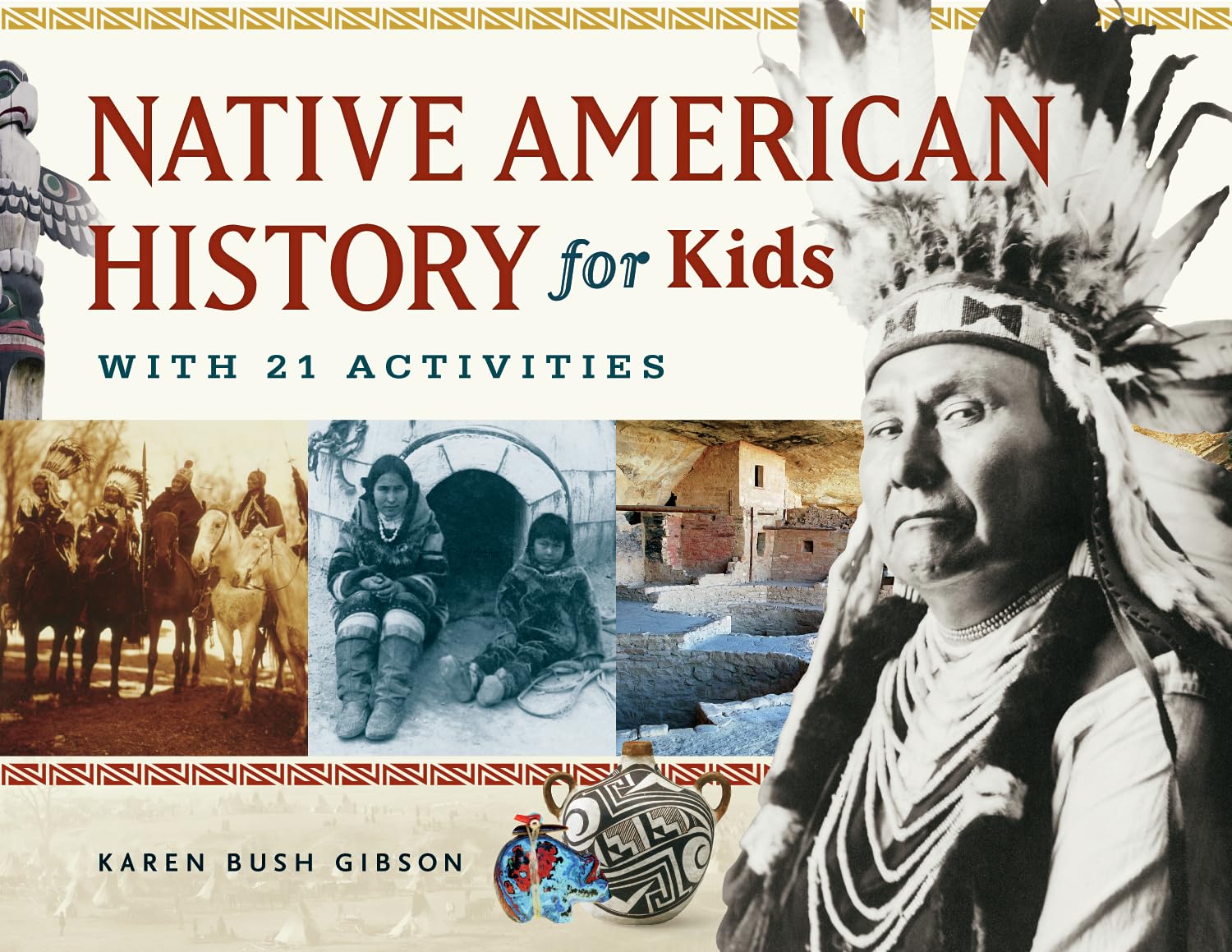
Native American History for Kids: With 21 Activities (35) (For Kids series)
$15.15
by Karen Bush Gibson



As the first Americans, hundreds of indigenous bands and nations already lived in North America when European explorers first set out to conquer an inhabited land. This book captures the early history of these complex societies and their 500-year struggle to survive against all odds from war, displacement, broken treaties, and boarding schools. Not only a history of tribal nations, Native American History for Kids also includes profiles of famous Native Americans and their many contributions, from early leaders to superstar athlete Jim Thorpe, dancer Maria Tallchief, astronaut John Herrington, author Sherman Alexie, actor Wes Studi, and more. Readers will also learn about Indian culture through hands-on activities, such as planting a Three Sisters garden (corn, squash, and beans), making beef jerky in a low-temperature oven, weaving a basket out of folded newspaper strips, deciphering a World War II Navajo Code Talker message, and playing Ball-and-Triangle, a game popular with Penobscot children. And before they are finished, readers will be inspired to know that the history of the Native American people is the history of all Americans. Gr 5-8-In an attractive format containing eight chapters, the text of this comprehensive look at Native tribes covers origin theories, Southwestern tribes, East Coast tribes, participation in Anglo wars, the Plains Indians, the destruction of the Native American cultures, and the resurgence of tribal rights and cultural pride. Each chapter contains a lucid summation of the topic under consideration, augmented with black-and-white illustrations and a craft or project tied into the subject matter. For example, "Fighting the White Man's Wars" discusses the French and Indian War, the American Revolution, and the war history of the nations of the Southeast. Sidebars cover the origin of scalping, Native American slavery, and brief biographies of notable individuals. The project for this chapter gives step-by-step instructions for constructing a model trading post. The background and instructions for all projects are admirably clear and well laid out for either students working alone or for class projects. This title is particularly well suited for classroom use. It is an excellent introduction to a vast and often ignored history.-Ann Welton, Helen B. Stafford Elementary School, Tacoma, WA (c) Copyright 2010. Library Journals LLC, a wholly owned subsidiary of Media Source, Inc. No redistribution permitted. Although it is part of the For Kids series, this gripping, highly readable overview will draw teens and even some adults into the history of Native Americans, from early times and the arrival of European settlers up to the present. The examples of racism are horrifying, including the early-twentieth-century Supreme Court ruling that Christian people had to govern “an ignorant and dependent race. Also horrifying are the accounts of forced assimilation, including the cruel boarding schools for American Indian children. Throughout, Gibson spotlights important individuals, from Geronimo and Sitting Bull to World War II heroes, athletes, the founders of American Indian Movement (AIM), writers, and political leaders. And she details American Indians continuing, contemporary struggle for cultural preservation and civil rights. Accompanying the historical chapters are challenging activities, such as “Decipher a WWII Navaho military code” and “Write a journal entry as a student in an Indian boarding school.” The lack of documentation for direct quotes is unfortunate, but a glossary, bibliography, and annotated lists of up-to-date Web sites are included in this useful resource. Grades 6-10. --Hazel Rochman "an excellent introduction to a vast and often ignored history."-- School Library Journal Karen Bush Gibson is the author of eight books on Native American culture, including The Arapaho , The Pawnee , The Chickasaw , and Plank Houses .