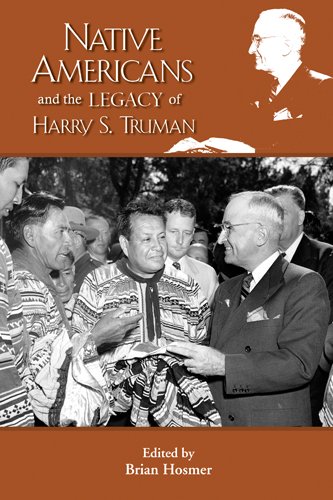
Native Americans and the Legacy of Harry S. Truman (Truman Legacy Series, 4)
$65.69
by Brian Hosmer



President Truman was sympathetic to the plight of "our First Americans," but did not fully understand the nature of their struggles. Hosmer (U. of Tulsa) presents a balanced perspective provided by Native and non-Native historians, in light of the Indian Affairs policies that he inherited, on his contributions to Indian rights (re: voting, education, and military burial) and wrongs (termination of tribes' special status). Based in part on the Fourth Truman Legacy Symposium held in 2006 in Key West, FL, the volume includes images of the peoples involved and government documents, and the transcript of a 1960-61 interview shedding light on Truman's views. Annotation ©2010 Book News, Inc., Portland, OR (booknews.com) [This volume focuses] on what would now be called the environmental actions Truman (1884-1972) took while he was president of the US at the end of World War II, and the impact those actions continue to have now. --Book News Inc., August 2009 President Truman was sympathetic to the plight of our First Americans, but did not fully understand the nature of their struggles. Hosmer presents a balanced perspective provided by Native and non-Native historians, in light of the Indian Affairs policies that he inherited, on his contributions to Indian rights and wrongs. --Book News Inc., June 2010 Years prior to the environmental concerns of the 1960s and long before today's quest for sustainability, Harry S. Truman's time in office decisively changed the way government interacts with the natural world. Determined to extend the prosperity of Roosevelt's New Deal, Truman enacted plans to harness nature for human betterment, national power, and economic security. His approval of billions of dollars in spending on dams not only altered the flow of rivers, but shifted the balance between wilderness and human society. In developing and testing atomic weapons, Truman's administration reshaped the domestic and global natural environment as well as the international power structure. This book includes articles by leading environmental, political, and legal scholars, examining the Truman presidency's role in the transformation of the American environment and the government's authority over it. After receiving his degree from Harvard Law School in 1983, Karl Boyd Brooks practiced civil trial and appellate work in his hometown of Boise, Idaho, while serving three terms in the Idaho State Senate from 1986 to 1992. Brooks later became the executive director and legislative liaison for the Idaho Conservation League, the state's preeminent citizens environmental group. He earned his Ph.D. in history from the University of Kansas in 2000 and subsequently joined the school's history and environmental studies faculty. Following a year-long stint as a Supreme Court Fellow in Washington, D.C., Brooks became an associate professor at the University of Kansas in 2006. He is also the author of Public Power, Private Dams: The Hells Canyon High Dam Controversy. New Mint Condition Dispatch same day for order received before 12 noon Guaranteed packaging No quibbles returns