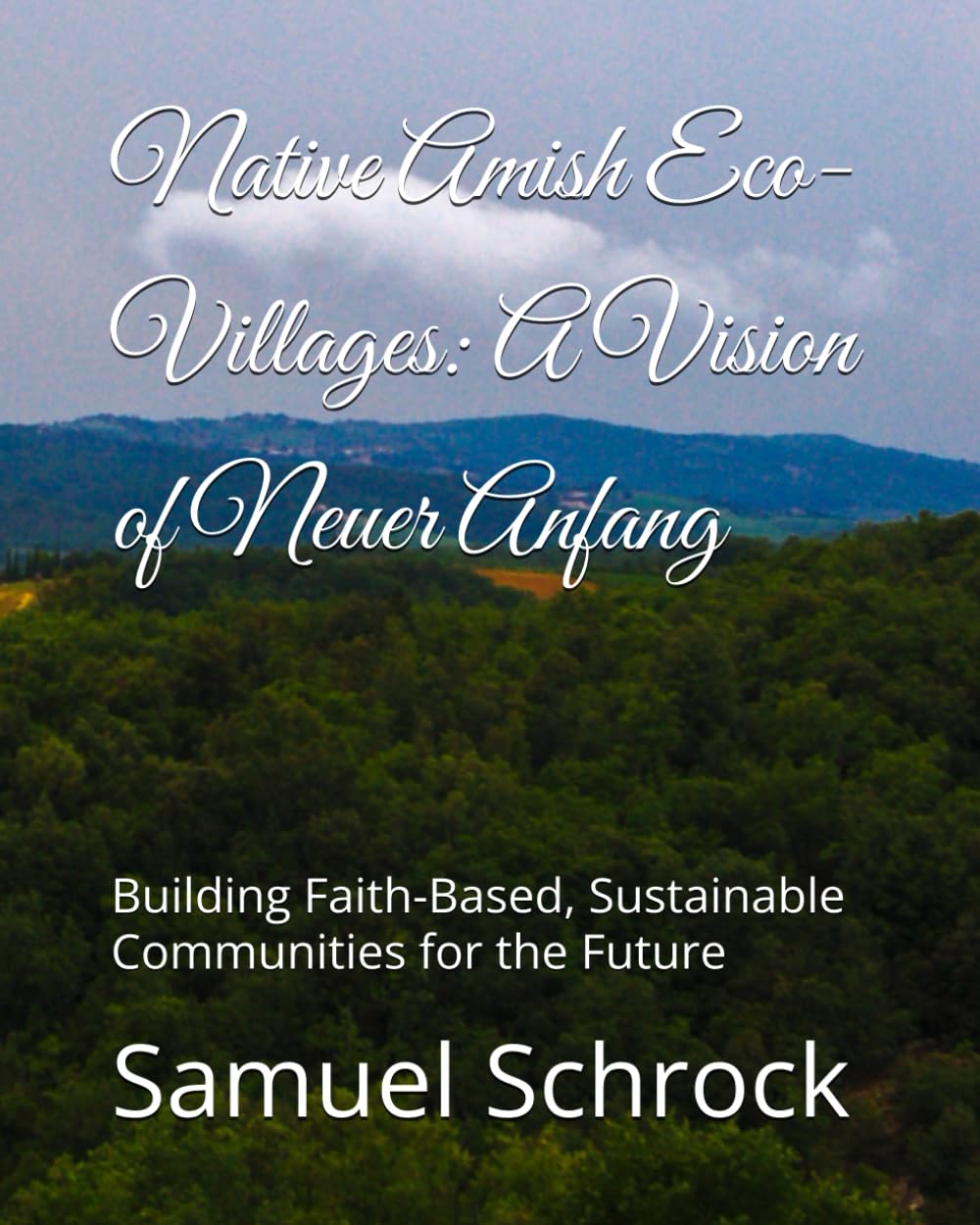
Native Amish Eco-Villages: A Vision of Neuer Anfang: Building Faith-Based, Sustainable Communities for the Future
$10.00
by Samuel Schrock



This book is a blueprint for building Native Amish eco-villages—communities rooted in faith, simplicity, and sustainability, designed to glorify God while providing a model of independence and resilience for future generations. Drawing from Amish tradition, Native wisdom, and biblical principles, it lays out a holistic vision of how families and communities can live off the land, work together, and thrive apart from the dependence on modern systems. At its heart, the book emphasizes faith in Christ as the foundation of life. Each chapter blends practical guidance with spiritual insights, showing how daily living—farming, building, cooking, healing, and working—can become acts of worship. From designing eco-village layouts to planting and harvesting crops , from raising livestock and fish to using hemp, wood, and water for energy and resources , the book presents practical, step-by-step ways for communities to thrive in harmony with God’s creation. The book also focuses on the health and well-being of individuals and families . It describes natural healing methods, herbal remedies, and the creation of village-based health centers. Education, mentorship, and the preservation of skills ensure that the next generation learns both practical trades and spiritual wisdom. Women and children are given roles of dignity, and all members are called to contribute their gifts for the benefit of the whole. Beyond its inward focus, the eco-village vision also looks outward. The chapters on welcoming strangers, refugees, and the lost and extending healthcare and hospitality through bed & breakfasts and healing centers highlight how these villages can serve as beacons of light, offering food, shelter, teaching, and the gospel to those in need. Ultimately, this is not just a manual for building homes or farms—it is a manifesto of Christian living in community . It paints a picture of how God’s people can live separately from the world yet impact the world, teaching independence, self-reliance, stewardship, and love of neighbor . Each eco-village becomes both a refuge and a testimony— a city on a hill . The final chapters look toward the future, casting a vision of expansion, outreach, and legacy. By preserving knowledge in farming, food, faith, and healing, these villages can inspire countless others. The dream is that from one village will spring many, spreading across the land as a network of self-sufficient, Christ-centered communities. The conclusion reminds us that this vision points to the greater reality of God’s Kingdom coming on earth as it is in heaven. The eco-village is not the end goal, but a pattern of obedience and faithfulness that reflects God’s design for His people: to live in harmony with Him, with creation, and with one another.